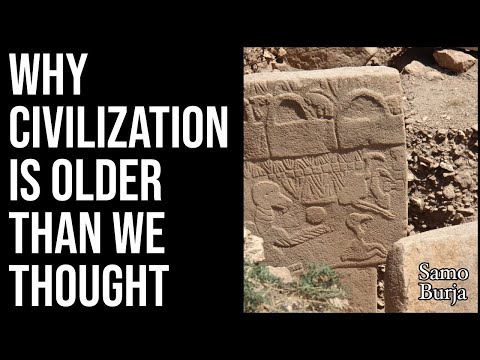
Why Civilization Is Older Than We Thought
Why Civilization is Older Than We Thought
The author reflects on the rich history of Istanbul and how modern development has hidden it. He then discusses the ancient ruins of Göbekli Tepe, which were rediscovered in 1995 and are now part of Turkey's national tourism branding strategy.
Rediscovering Ancient Ruins
- Göbekli Tepe is a Neolithic site with the world's oldest discovered buildings.
- The ruins were rediscovered in 1995 on a flat plateau in Southeastern Turkey.
- The Turkish government invested significant funds to turn the archaeological site into an archaeological park.
Misconceptions About Ancient Life
- Modern depictions of ancient life often underestimate both the social and material technologies needed for survival.
- Our understanding of human nature affects our interpretation of ancient discoveries as much as radiocarbon dating does.
Remaking History
- No bullet points associated with timestamps available.
Conclusion
- No bullet points associated with timestamps available.
The Mystery of Gobekli Tepe
This section discusses the mystery surrounding the construction of Gobekli Tepe, an ancient site in Turkey that predates human agriculture. It explores the challenges of constructing such a complex site without modern technology and questions what this means for our understanding of Neolithic society.
Construction Techniques and Labor Requirements
- Concentric stone walls enclosed spaces dotted with towering 18-foot tall T-shaped pillars.
- Each pillar weighed about 10 to 20 tons, requiring significant human labor to extract and move them from local quarries.
- No one knows with confidence what construction techniques were used or what timelines were considered acceptable for their completion.
- Archaeologists estimate that about 500 people would have been required to extract and move the pillars, which would have been quite an organizational feat given usual estimates of Neolithic population density.
Age and Significance
- The most startling aspect of these ruins is their age; they predate the consensus origin of human agriculture.
- The walled complex forces us either to push the origin of Agriculture much further into the past or else reconsider whether agriculture is necessary for such complex human societies.
- Either possibility yields important information about Humanity's extended phenotype myth and material.
Materialist Explanations for Civilization
- Historians and social theorists have proposed materialist explanations for the rise of civilization in the Near East, namely, accumulation of economic surplus.
- Fertile alluvial soil deposited by yearly floods provided abundant harvests along river systems like Tigris, Euphrates, Nile River etc., leading to population growth necessitating irrigation and river regulation to make more land arable.
- Waterworks are vast undertakings that rely on central government coordination to organize necessary labor.
Coral Whitfield's Theory
- Coral Whitfield's 1957 work Oriental Despotism, a comparative study of total power, developed a materialist history independent of Marxist orthodoxy.
- This work argued that the ancient state was born out of the need to organize vast undertakings like waterworks and relied on central government coordination to organize necessary labor.
- Long-forgotten ideological disputes shape our current understanding of seemingly unrelated topics such as the origin of civilization and human nature.
Implications for Understanding Human History
- Assuming a degree of isolation, the origin of Mesoamerican civilizations would be independent of whatever happened in regions such as the Fertile Crescent.
- The Calusa of southwestern Florida might provide a natural experiment for thinking about our Turkish Neolithic site - a complex hierarchical society that predates evidence of agriculture.
The Implications of Aquaculture and Domestication on Civilization
This section discusses the implications of aquaculture and domestication on civilization. It explores how fishing, hunting, or gathering could sustain complex societies and how social technology rather than the discovery of farming is the key bottleneck of civilization.
Aquaculture vs Agriculture
- The Colusa were a relatively advanced society built on aquaculture instead of agriculture.
- Fishing, hunting, or gathering could sustain complex societies.
- Social technology rather than the discovery of farming is the key bottleneck of civilization.
Domestication Syndrome
- Domesticated animal species display a range of anatomical and behavioral phenotypes that set them apart from their wild counterparts.
- Biologists sometimes call this domestication syndrome.
- Recent genetic studies lend further evidence to this conclusion that humans are the domesticated variant of mankind.
Complex Societies
- Once domesticated, the environment for Homo sapiens was complex society all along.
- Quebecally Tepe's location 250 kilometers from the Mediterranean Coast suggests that it wasn't just agriculture that led to complex societies.
Pastoralism or Agriculture?
- Archaeologists presume quebecally tap a to have predated agriculture by pastoralism or agriculture.
The Unusual Theology of the Yazidi
This section discusses the unique theology of the Yazidi people, who have been described as polytheistic or devil worshipers throughout history. It also explores their belief in Malached House and his refusal to pay homage to mankind.
Belief in Malached House
- Malached House was ordered by God to pay homage to a New Creation mankind but refused.
- In Islamic theology, this is taken as an act of rebellion by the angel, but in Yazidi belief, it is revealed to have been a test all along.
Ancient Knowledge and Oral Memory
- The Yazidi are believed to be keepers of ancient knowledge.
- Recent research reveals that multi-generational oral memory can be very reliable.
- Cultural heritage is often more accurate than our much younger theories about the distant past.
Rediscovery of Quebeckley Tepe
- Quebeckley Tepe was rediscovered rather than discovered in October 1994.
- Archaeologists had assumed the tops of massive limestone pillars at Quebeckley Tepe were medieval tombstones dating back to the Byzantine Empire.
- We see what we expect to see; nowhere is this more true than in archaeology.
Challenges Faced by Archaeologists
- Archaeology requires specialized equipment costing up to thousands of dollars per day and dozens if not hundreds of skilled and unskilled laborers.
- The German Archaeological Institute, which provided a professional home for much of Klaus Schmidt's career, has a mere 38 million euros yearly budget for a field that requires specialized equipment and full-time professionals to make sense of finds.
- It is difficult to evaluate evidence right in front of our faces. Afterward, it is hard to even remember what the previous worldview held to be sacred.
Discovery of Sumerian Cities
- The discovery of Sumerian cities was itself an archaeological surprise in the declining Ottoman Empire of the 19th century.
- No classical or pre-classical sources known to Europeans at the time mentioned Sumerian language or society as much younger Acadian cuneiform tablets attributed to Babylonians were translated.
- Decades of controversies ensued such as the French asteriologist Joseph hollevi insisting that Sumerian wasn't a different
The Rediscovery of the Hittites
This section discusses how the Hittite Empire was rediscovered and how skepticism of mythological sources hindered archaeological scholarship.
The Importance of the Hittites
- The Hittite Empire was previously unknown outside of sparse references in the Bible and records from Egypt and Assyria.
- Evidence of the Hittites had been assumed to be relatively unimportant to the region's history, conflated with other peoples or considered entirely mythical.
- Heinrich Schliemann identified a previously explored site in Turkey as the likely location of Troy, proving that some mythological accounts were based on actual events.
Skepticism and Archaeological Scholarship
- Scholars in the 19th century no longer considered The Iliad and Odyssey to be poetic accounts of actual events.
- Excessive skepticism of what were thought to be myth-ridden sources played a significant role in hindering archaeological scholarship.
- Illegal trade in antiquities continues to this day, with traffickers using bulldozers and metal detectors to find salable artifacts.
Uncovering Ancient Discoveries
This section discusses how further excavations are needed to uncover more ancient discoveries, including untranslated tablets from ancient cities such as Nippur and Eridu.
Untranslated Tablets
- Some 90% of hundreds of thousands of tablets found in ancient cities such as Nippur remain untranslated.
- Translating these previously neglected tablets holds exciting possibilities for pushing the boundary between recorded history and unwritten pre-history much further into the past.
Further Excavations
- Despite nearly 20 years of excavations at Göbekli Tepe, only 5% of the site had been excavated.
- Bold gambles are needed to prove or disprove what historians and archaeologists think they know about the dawn of civilization.
- Early Sumerian epics indicate an unusually intimate relationship between Sumer and an otherwise unknown land called Arata, which may be located in Iran or even further afield.
The Politics of Archaeology
This section discusses how tourism can both promote spectacular sites and compromise conservation efforts, as well as how lost or privately owned artifacts may still be waiting to be discovered.
Tourism and Conservation
- Heavy machinery used to build the walkway at Göbekli Tepe damaged the site, compromising conservation efforts.
- Compromises are made between conservation and visitation as well as between the myth built around sites and the actual material found.
Lost Artifacts
- Lost or privately owned artifacts may still be waiting to be discovered.
- The famous Lycurgus Cup was forgotten for a century in the Rothschild family's private collection until it was sold to the British Museum in 1958.
The Role of Ancient History in Modern Politics
This section discusses how ancient history shapes modern politics, particularly in Egypt where national identity and government legitimacy are built out of an uneasy compromise between a commitment to Islam and a nationalist attachment to the polytheistic past.
The Importance of Antiquity in Egypt
- Paris, the Pyramids of Giza, and the Coliseum of Rome are beloved nationally celebrated monuments partially because of their global appeal.
- National identity and government legitimacy in Egypt are built out of an uneasy compromise between a commitment to Islam and a nationalist attachment to the polytheistic past.
- Ancient ruins and artifacts have political and economic importance as great resources that have been battled over by secular nationalists and opposing Islamists.
- International tourism has been one of the pillars of Egypt's economy for decades, employing 12 percent of Egypt's entire workforce at its peak in 2010.
Building an Economic Machine from Antiquity
- Starting in the 1970s, Anwar Sadat eased visa restrictions for foreigners invested significant portions of the state budget into hotels and transport infrastructure, established new schools for hospitality and tourism management all as part of an effort to literalize and grow Egypt's private sector economy.
- Sadat's successor Hosni Mubarak continued his policies which ultimately led to building a powerful economic machine from Egypt's renowned ancient heritage.
Political Relevance of Antiquities
- Terror attacks specifically targeting tourists have killed more than 100 people in Egypt since the early 1990s each time depressing tourist arrivals and national revenue.
- The responsibility of defending the valued tourism sector falls not to the ordinary police but to Egypt's General Administration of Tourism and Antiquities police who guard not only archaeological sites but also the tour groups that visit them.
- The sphinxes and pyramids have political relevance not only due to the economic machine built around them but also directly as symbols of legitimacy.
- Shortly before widespread protests forced Hosni Mubarak to resign from office in 2011, one of the last moves he made was to create the cabinet-level office of a minister of Antiquities and appoint noted archaeologist Zahi Hawas to the post.
Pre-Islamic Monuments in Middle Eastern Countries
- Egypt is hardly alone in its use of pre-Islamic monuments to strengthen national identity. In Iraq, Saddam Hussein partially restored the ziggurat of War casting himself as a successor.
Protochromism and Selective Identification with the Past
This section discusses how state-driven archaeological efforts around the world have led to a selective identification with the past, often for political reasons. The transcript provides examples from Romania, Turkey, Pakistan, India, and China.
Protochromism
- Protochromism is an approach to building cultural autarky through state-driven archaeological efforts.
- Gebekli Tepe in Turkey can be claimed as a predecessor of modern Turkish nation due to protochromism.
- Similar selective identification with the past can be found in ever more diverging interpretations of ancient history between Pakistan and India.
Political Needs and Archaeology
- Political needs always prove decisive as to what is and isn't pursued in archaeology.
- Governments are the main source of funding for archaeology and ultimately grant or deny permission to conduct digs.
- Certain discoveries can also be seen as political crimes.
Examples from China
- Xiao Kane Min dug up the Terracotta Army in China in 1974 but kept it secret at first due to fear of political repression.
- A journalist's question helped communicate that the find was acceptable while avoiding self-incrimination through posing a question.
- The Chinese government undertook significant promotion efforts making the site one of the main stops of international tourism in China.
Iconoclasm
- Iconoclasm is always an expression of a political desire to forget achievements of the past.
- The Taliban infamously ordered the destruction of the two Buddhas of Bamian in 2001.
- Achievements of a glorious past can be embarrassing to a less capable present.
The Importance of Cultural Heritage Sites
This section discusses the significance of cultural heritage sites and how they are used to raise prestige and standing in the international community. It also highlights the destruction of some heritage sites as a demonstration of sovereignty.
The Significance of Cultural Heritage Sites
- UNESCO's list of common cultural heritages is significant in raising the prestige and standing of a site.
- The Turkish government lobbied extensively for Quebec Lee Tepe to be added to this list, which helped raise their standing domestically.
- Afghan Buddhists were destroyed as a demonstration of sovereignty and defiance to external prestige.
Impact on International Relations
- Destruction or preservation of heritage sites can have an impact on international relations.
- Turkey's exploration into ancient civilization may lead to new discoveries that could change our understanding of history.
- Political conditions in Turkey are favorable for exploring ancient past for the next decade or two.
Early Cultivation Evidence
- Evidence suggests early cultivation occurred over 10,000 years prior to when agriculture was first thought to begin.
- Small-scale farming occurred 23,000 years ago at Hollow 2 site near Sea of Galilee.
Political Capital Gains
- Erdogan is an Islamist only insofar as he is a Turkish Nationalist who supports his vision for a strong, prestigious, and unified Turkey that can throw its weight around internationally.
- Turkey's dreams of autarky and protochromism nationalism align with advancing our understanding of ancient civilization.
- A Turkish conglomerate has committed to spending over $15 million on the site over the next 20 years.
Safe Exploration
- Turkey is the most secure and hospitable country in the region for conducting expensive archaeological digs.
- The risks and physical dangers of attempting to conduct digs in neighboring Syria, Iraq, or Iran are substantially higher.
Rethinking the Origins of Urban Life
In this section, the speaker discusses the origins of urban life and how old settlements of hundreds or thousands of people might be. He challenges the assumption that such civilizations are only a few thousand years old and suggests they may be tens of thousands of years older.
Settlements Older Than 20,000 Years
- The speaker believes that permanent settlements older than 20,000 years exist.
- He is willing to bet with a qualified challenger who is skeptical about such claims.
- The speaker hopes that this bet will stimulate interest in hunting for such sites.
Implications for Our Understanding of Progress and Technology
- Finding evidence of ancient permanent settlements would require us to rethink our assumptions about progress and technology.
- Studying prehistoric human history could lead to new discoveries and possibilities for our future.
- It is important to understand what humans are and how we have lived over the last few hundred thousand years.