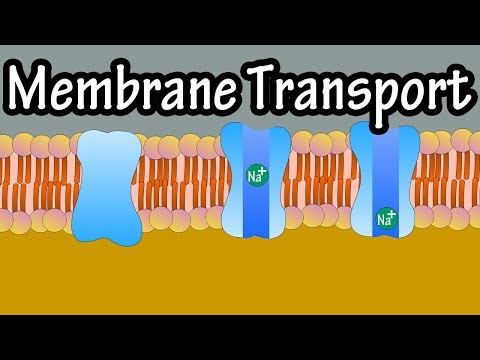
Cell Membrane Transport - Transport Across A Membrane - How Do Things Move Across A Cell Membrane

Cell Membrane Transport - Transport Across A Membrane - How Do Things Move Across A Cell Membrane

How Do Substances Move Into and Out of a Cell?

Overview of Membrane Transport

  • Cells are surrounded by a plasma membrane that regulates the movement of substances in and out, acting like a fence.
  • The plasma membrane is primarily composed of phospholipid molecules with hydrophilic heads and hydrophobic tails, forming a bilayer structure.

Types of Membrane Transport Processes

  • There are two main types of membrane transport: passive transport (no energy required) and active transport (energy required).
  • Passive processes include simple diffusion, facilitated diffusion, and osmosis.

Passive Transport Mechanisms

Simple Diffusion

  • Simple diffusion involves the movement from high to low concentration until equilibrium is reached, exemplified by sugar dissolving in water.
  • Cellular diffusion occurs across the plasma membrane based on concentration differences between interstitial fluid and cytosol.

Facilitated Diffusion

  • Facilitated diffusion allows small charged or polar solutes to cross the membrane with assistance from proteins due to their inability to pass through the non-polar lipid bilayer.
  • Two types exist: channel-mediated (specific ion channels for charged particles) and carrier-mediated (involves shape change in carrier proteins).

Osmosis

  • Osmosis is the passive movement of water through selectively permeable membranes, occurring via phospholipid gaps or aquaporins.
  • Water moves down its concentration gradient; for example, if one side has more solutes than another, water will move towards the higher solute concentration.

Active Transport Processes

Active Transport

  • Active transport moves solutes against their concentration gradient (from low to high), requiring cellular energy.

Vesicular Transport

Active Transport Mechanisms

Types of Active Transport

  • Active transport consists of two main types: primary active transport and secondary active transport.
  • In primary active transport, cellular protein pumps (ion pumps) move ions against their concentration gradient using energy from ATP.

Primary Active Transport Example

  • An example involves a sodium-potassium pump where three sodium ions and ATP bind to the pump.
  • The breakdown of ATP into ADP and P releases energy, causing the pump to change shape and release sodium ions into interstitial fluid.
  • Two potassium ions then bind to the pump, which reverts back to its original shape, releasing potassium into the cytosol.

Secondary Active Transport

  • Secondary active transport moves substances against their concentration gradient by utilizing energy from another substance moving down its gradient.
  • There are two types: symport, where both substances move in the same direction, and antiport, where they move in opposite directions.

Examples of Secondary Active Transport

  • In a symporter example, positive sodium ions move from high concentration outside the cell to lower inside, providing energy for glucose movement from low to high concentration.
  • An antiporter example shows H+ being moved out of the cell while sodium moves in.

Vesicular Transport Overview

Types of Vesicular Transport

  • Vesicular transport is used for larger substances like proteins or polysaccharides across plasma membranes. It includes exocytosis and endocytosis.

Exocytosis Process

  • In exocytosis, materials are secreted from cells via membranous vesicles formed by the Golgi apparatus that fuse with the plasma membrane.

Endocytosis Process

  • Endocytosis occurs when the plasma membrane folds inward to trap a substance, forming a vesicle around it.

Forms of Endocytosis

  • Three main forms include:
  • Phagocytosis: Engulfing large particles; also known as "cell eating."
  • Pinocytosis: Engulfing droplets of interstitial fluid; referred to as "cell drinking."
Video description

In this video we discuss the different ways how substances transport across a cell membrane, including facilitated diffusion, channel mediated diffusion, carrier mediated diffusion, simple diffusion, passive transport and active transport. Transcript/Notes (partial) Substances move into and out of a cell through several different processes called membrane transport. There are two main processes, passive transport processes and active transport processes. The main difference between the two is that passive processes do not require energy expenditure and active processes do require cells to expend energy. Lets start by looking at the passive processes, which include simple diffusion, facilitated diffusion and osmosis. Diffusion is the movement of a substance from where it has a high concentration to where it has a low concentration, or the tendency of a substance to spread out evenly over a given space. Simple diffusion occurs with solutes that are small and non polar. By being non polar they can move in between the phosphoipid molecules that form the plasma membrane because the interior region of the membrane is non polar. Some of the materials that move by simple diffusion include the gases O2, CO2, and small fatty acids. So, if there is a higher concentration of oxygen O2 molecules outside of a cell, they can move down the concentration gradient, across the membrane without assistance, and into the cell as long as the concentration gradient exists. The second type of diffusion is facilitated diffusion. This applies to solutes that are small and either charged or polar. Because these solutes are polar, the non polar phospholipid bilayer blocks them from passing through the membrane and into or out of the cell by simple diffusion. However, they can pass into and out of the cell with the assistance of plasma membrane proteins through a process called facilitated diffusion. There are two types of facilitated diffusion, channel mediated diffusion and carrier mediated diffusion. The difference between the two is the type of transport protein used to move the substance across the membrane. Channel mediated diffusion is when a ion, which is a charged particle where its total number of electrons does not equal its total number of protons giving it a positive or negative charge, moves across the membrane through a water filled protein channel. Each protein channel is typically specific for one type of ion, and there are two types of channels, a leak channel, which is continuously open, and a gated channel, which only opens due to a stimulus, and only stays open for a fraction of a second. Carrier mediated diffusion involves the movement of polar molecules such as simple sugars or simple carbohydrates and amino acids across the membrane. This is accomplished by a carrier protein, which actually changes shape in the process. For instance glucose binds to a carrier protein, which changes shape and moves the glucose molecule to the other side of the membrane. Now for osmosis. Osmosis is the passive movement of water through a selectively permeable membrane. This occurs when there is a difference in concentration of water on either side of the membrane. This can happen in one of two ways, water can slip between the phospholipid molecules that make up the plasma membrane, or through integral protein water channels that are called aquaporins. Now lets look at active processes. As stated earlier, active processes require the use of cellular energy for membrane transport. There are two types of active processes, active transport and vesicular transport. Active transport is the movement of a solute against its concentration gradient, or going from an area of low concentration to a place of higher concentration. Vesicular transport is the transport of large substances across the plasma membrane by a vesicle, which is a membrane bound sac filled with materials. Active transport has two types, primary active transport and secondary active transport. In primary active transport cellular protein pumps called ion pumps move ions across the membrane, against their concentration gradient. Timestamps 0:00 The structure of cell membranes 0:42 The 2 main membrane transport processes (passive and active) 1:12 What is diffusion? 2:11 Simple diffusion 3:05 Facilitated diffusion 3:44 Channel mediated diffusion 4:29 Carrier mediated diffusion 4:51 What is osmosis? 5:49 Active processes 6:01 Active transport 6:12 Vesicular transport 6:28 Primary active transport 7:27 Secondary active transport 8:37 The 2 types of vesicular transport 8:53 Exocytosis 9:23 Endocytosis