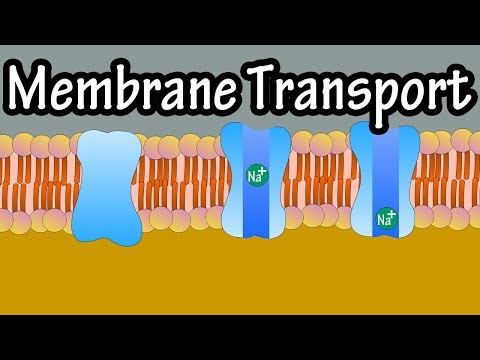
Cell Membrane Transport - Transport Across A Membrane - How Do Things Move Across A Cell Membrane
How Do Substances Move Into and Out of a Cell?
Overview of Membrane Transport
- Cells are surrounded by a plasma membrane that regulates the movement of substances in and out, acting like a fence.
- The plasma membrane is primarily composed of phospholipid molecules with hydrophilic heads and hydrophobic tails, forming a bilayer structure.
Types of Membrane Transport Processes
- There are two main types of membrane transport: passive transport (no energy required) and active transport (energy required).
- Passive processes include simple diffusion, facilitated diffusion, and osmosis.
Passive Transport Mechanisms
Simple Diffusion
- Simple diffusion involves the movement from high to low concentration until equilibrium is reached, exemplified by sugar dissolving in water.
- Cellular diffusion occurs across the plasma membrane based on concentration differences between interstitial fluid and cytosol.
Facilitated Diffusion
- Facilitated diffusion allows small charged or polar solutes to cross the membrane with assistance from proteins due to their inability to pass through the non-polar lipid bilayer.
- Two types exist: channel-mediated (specific ion channels for charged particles) and carrier-mediated (involves shape change in carrier proteins).
Osmosis
- Osmosis is the passive movement of water through selectively permeable membranes, occurring via phospholipid gaps or aquaporins.
- Water moves down its concentration gradient; for example, if one side has more solutes than another, water will move towards the higher solute concentration.
Active Transport Processes
Active Transport
- Active transport moves solutes against their concentration gradient (from low to high), requiring cellular energy.
Vesicular Transport
Active Transport Mechanisms
Types of Active Transport
- Active transport consists of two main types: primary active transport and secondary active transport.
- In primary active transport, cellular protein pumps (ion pumps) move ions against their concentration gradient using energy from ATP.
Primary Active Transport Example
- An example involves a sodium-potassium pump where three sodium ions and ATP bind to the pump.
- The breakdown of ATP into ADP and P releases energy, causing the pump to change shape and release sodium ions into interstitial fluid.
- Two potassium ions then bind to the pump, which reverts back to its original shape, releasing potassium into the cytosol.
Secondary Active Transport
- Secondary active transport moves substances against their concentration gradient by utilizing energy from another substance moving down its gradient.
- There are two types: symport, where both substances move in the same direction, and antiport, where they move in opposite directions.
Examples of Secondary Active Transport
- In a symporter example, positive sodium ions move from high concentration outside the cell to lower inside, providing energy for glucose movement from low to high concentration.
- An antiporter example shows H+ being moved out of the cell while sodium moves in.
Vesicular Transport Overview
Types of Vesicular Transport
- Vesicular transport is used for larger substances like proteins or polysaccharides across plasma membranes. It includes exocytosis and endocytosis.
Exocytosis Process
- In exocytosis, materials are secreted from cells via membranous vesicles formed by the Golgi apparatus that fuse with the plasma membrane.
Endocytosis Process
- Endocytosis occurs when the plasma membrane folds inward to trap a substance, forming a vesicle around it.
Forms of Endocytosis
- Three main forms include:
- Phagocytosis: Engulfing large particles; also known as "cell eating."
- Pinocytosis: Engulfing droplets of interstitial fluid; referred to as "cell drinking."