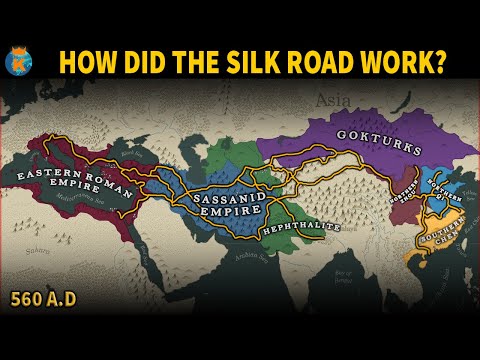
How did The Silk Road Actually Work?
The Han Dynasty and the Beginning of the Silk Road
This section introduces the Han Dynasty and its ambitions to resolve conflicts with neighboring tribes. It also highlights the role of Zhang Qian in discovering new cultures and horses during his journey through Central Asia.
The Ambitions of the Han Dynasty
- The Han Dynasty, serving as the 2nd Chinese imperial dynasty, aimed to address conflicts with Xiongnu tribes along their borders.
- Emperor Wu of the Han Dynasty sent an envoy in 138 BC to form alliances or gain support from the Yuezhi in the west.
Zhang Qian's Journey and Discovery
- Zhang Qian, an emissary of Emperor Wu, traveled through Central Asia and encountered various new people and cultures.
- He was particularly fascinated by the Da-yuan people and their superior horses compared to those bred in China.
- Zhang Qian informed Emperor Wu about these magnificent horses, leading to a decision to purchase them.
Opening of the Silk Road
This section explains how Emperor Wu's decision to purchase western horses led to the official opening of the Silk Road in 130 BC. It describes how this network connected East and West through trade routes spanning thousands of miles.
Triggering the Opening of Silk Road
- Impressed by Zhang Qian's successful journey west and collaboration it inspired, Emperor Wu decided to open trade routes.
- In 130 BC, he officially opened the Silk Road, connecting East (China) to West (Europe) through a vast network of trade routes.
Predecessor Trade Routes - The Royal Road
This section discusses pre-existing trade routes before the Silk Road. It mentions Darius I's creation of the Royal Road, stretching from Susa to Sardis, and its smaller routes reaching parts of the Indian subcontinent and northern Africa.
The Persian Royal Road
- The Persians, under Darius I and the Persian Empire, created the original trade route known as the Royal Road.
- It stretched nearly 2,000 miles from Susa (modern-day Iran) to Sardis (part of Turkey).
- Smaller routes connected to the main road reached parts of India and northern Africa.
The Silk Road's Significance
This section highlights the significance of the Silk Road as a major trade route for messengers, merchants, and explorers. It also mentions how it facilitated cultural exchange between East and West.
Impact on Trade and Goods
- The Silk Road served as a major contributor to silk trade throughout the regions it spanned.
- Initially, silk only came from China due to their discovery of harvesting silk from silkworm cocoons.
- With the creation of the Silk Road network, silk and other products could be sold throughout Europe.
Cultural Exchange on the Silk Road
This section discusses how cultural exchange occurred along the Silk Road. It mentions Rome's fascination with silk and how Western merchants brought goods like glassware, textiles, and certain foods to the East.
Spread of Culture and Ideas
- The Silk Road not only spread goods but also brought culture and new ideas to each state it touched.
- Rome developed an obsession with silk imported through this trade route.
- Western merchants introduced goods like glassware, textiles, animal furs, certain foods, rugs, blankets, armor, etc., to Eastern regions.
Conclusion - Impact on Merchants
This section concludes by emphasizing the impact of the Silk Road on merchants, messengers, and travelers.
Spread of Goods and Ideas
- Merchants, messengers, and travelers played a crucial role in spreading goods, ideas, religions, and ideologies along the Silk Road.
- The network of trade routes facilitated the exchange of products like silk, teas, dyes, spices, porcelain, paper, gunpowder, medicine.
- Western culture influenced the East with goods like glassware and textiles while Eastern trade changed Western culture with silk and other products.
Timestamps are approximate.
New Section Robbers and Routes
This section discusses the employment of robbers along trade routes, both legal and illegal.
Robbers as Employees
- Robbers were frequently employed along trade routes.
- They were utilized on both legal and illegal sides of the routes.
No specific timestamps were provided for this section.
Turn any video into a summary like this
YouTube links, meetings, lectures — with transcripts, search, and chat.