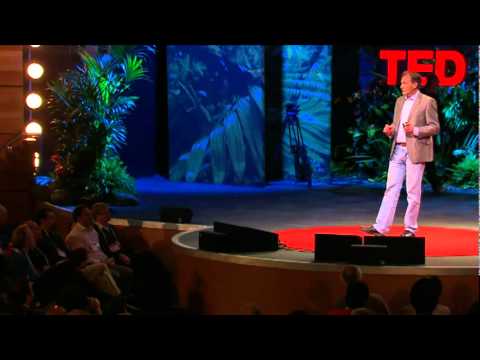
Mark Pagel: How language transformed humanity
The Power of Language and Its Evolution
The Unique Trait of Language
- Each individual possesses a powerful trait—language—that allows for the direct transfer of thoughts between minds, akin to neural audio technology.
- Language functions as a form of telemetry, similar to a remote control, using sound pulses to influence others' thoughts and behaviors.
The Subversive Nature of Language
- Languages can be seen as genes communicating desires; they hold subversive power recognized through historical censorship and restrictions on speech.
- The Tower of Babel story illustrates language's potential for unity and division, highlighting its role in communication barriers.
Consequences of Language Diversity
- Different languages create barriers that prevent effective communication, leading to societal consequences such as censorship or violence against certain expressions.
- This phenomenon raises questions about why language evolved uniquely in humans compared to other species.
Tool Use and Social Learning in Chimpanzees
- Chimpanzees use tools but lack social learning capabilities; they do not innovate or improve upon existing methods like humans do.
- Their repetitive tool use suggests an absence of cultural evolution, contrasting with human adaptability.
Insights from Homo Erectus
- Early humans (Homo erectus) demonstrated limited innovation over one million years despite their intelligence, making similar hand axes repeatedly.
- Fossil records indicate that even close relatives like Neanderthals showed minimal change in tool-making over hundreds of thousands of years.
Cumulative Cultural Adaptation
- Humans possess the ability to learn from others through imitation and observation, allowing for cumulative cultural adaptation—a key factor in technological progress.
- This capacity has led to significant advancements in society, evidenced by modern conveniences resulting from accumulated knowledge over generations.
Conclusion: A New Beginning for Humanity
The Evolution of Language and Social Learning
The Dilemma of Social Learning
- The acquisition of social learning presents a significant social and evolutionary dilemma that could shape the future of psychology and humanity, particularly in understanding the origins of language.
- Social learning is described as "visual theft," where individuals can learn from observing others, potentially benefiting without investing the same effort or time.
- This visual theft creates conflicts; species faced a choice: retreat into small family groups to protect ideas or develop communication systems to share knowledge.
Options for Addressing Visual Theft
- One option was to retreat into small family units, which would limit idea sharing but also reduce innovation. This path would have led humans to live similarly to Neanderthals.
- The alternative was to create communication systems that fostered cooperation and shared knowledge, leading to greater collective wisdom than what could be achieved within isolated families.
The Role of Language in Cooperation
- Choosing communication allowed for a vast accumulation of knowledge accessible to individuals, resulting in the evolution of language as a solution to visual theft.
- Language serves as a social technology that enhances cooperation, agreement-making, and coordination among individuals—essentially opening up new avenues for human interaction.
Practical Implications of Language
- Without language, even simple exchanges become problematic; scenarios illustrate how effective communication enables successful trade and collaboration between individuals with different skills.
- A comparison shows that with language, clear agreements can be made (e.g., trading arrowheads), leading to prosperity through cooperative efforts rather than misunderstandings.
Impact on Human Prosperity
- The ability to communicate effectively has allowed humans to thrive globally while other species remain limited by their environments.
- Language is posited as the most potent trait evolved by humans, facilitating adaptation and resource utilization unlike any other species has achieved.
Diversity in Languages
- Despite spreading across the globe, humans developed thousands of distinct languages—around 7,000 currently spoken—raising questions about linguistic diversity's relationship with population density.
The Role of Language in Human Cooperation and Isolation
Language Diversity and Cultural Identity
- A Papua man reveals that languages can be found within a mile of each other on certain islands, highlighting the incredible linguistic diversity in isolated regions.
- Language serves not only as a tool for cooperation but also as a means to define group identities and protect knowledge from external influences, slowing the exchange of ideas between different cultures.
Barriers to Communication
- Different languages create barriers that hinder the flow of technologies and genetic exchange; people are less likely to engage romantically with those they cannot communicate with effectively.
- The modern world is more interconnected than ever, yet language differences pose significant challenges to global communication and cooperation.
Economic Implications of Multilingualism
- The European Union's 27 member countries speak 23 official languages, leading to substantial translation costs exceeding 1 billion euros annually.
- Simple mathematics shows that effective communication among these nations requires an extensive number of translators—253 for all pairwise language combinations.
The Dilemma of Globalization
- As globalization increases, we face the question: can we sustain so many languages when they complicate cooperation and idea exchange?
- Nature typically favors standardization over coexistence; examples include the dominance of the metric system and universal timekeeping methods.
Future Prospects for Language Standardization
- A Chinese individual translating phrases into English exemplifies the trend towards a single global language for enhanced cooperation in an increasingly interdependent world.
Genetic Insights into Language Development
Turn any video into a summary like this
YouTube links, meetings, lectures. With transcripts, search, and chat.