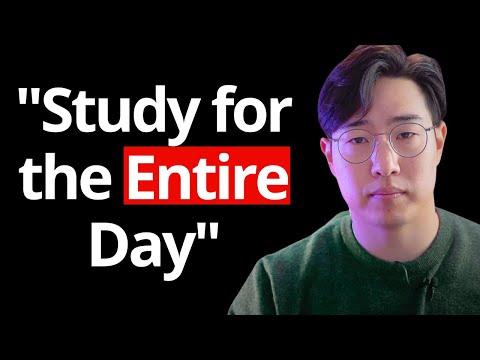
3 Tips to Maximise Long Study Sessions
Strategies for Effective Study Sessions
In this video, the speaker shares strategies to make the most out of study sessions, especially when there is a lot of time available. The speaker emphasizes that it is important to understand where time gets wasted and how to maintain focus and energy throughout the day.
Understanding the Challenge of Studying Efficiently
- Studying efficiently takes months of consistent work or a guided course.
- Rushing through studying or trying harder won't make a big difference.
- Declining focus and concentration throughout the day is a common barrier.
Maintaining Focus and Energy
- Use optimized focus rest timing to take regular breaks and use them productively.
- Get rid of distractions by using do not disturb mode or creating a focused environment.
- Partition your room with a fold-out screen or invest in noise-cancelling headphones.
Avoiding Burnout
- Long study sessions can lead to exhaustion and wasted time.
- Take care of your physical health by staying hydrated, eating well, and getting enough sleep.
- Take care of your mental health by taking breaks, practicing mindfulness, and seeking support if needed.
Organizing Information for Efficient Learning
In this section, the speaker discusses the importance of creating an organizational schema to optimize encoding and retrieval of information. The speaker explains how to manage cognitive load and process large amounts of information efficiently.
Layering Approach
- The layering approach involves breaking up a new topic into several layers of detail or difficulty.
- This approach helps in creating organizational schemas that make it easier to go through a topic.
- Layering saves time and energy while going through large amounts of information.
Encoding Information Vertically
- Instead of going from beginning to end, learn the information vertically by taking in only the easiest-to-understand information first.
- Covering the first layer involves collecting keywords, looking up their meanings, and figuring out how they relate to each other.
- Once you have your first couple schemas laid down, it becomes easier to go through that topic.
Cognitive Load Management
- When reading dense material, cognitive load increases, slowing down processing ability and decreasing reading speed.
- Overloading working memory with too much information leads to forgetting and difficulty in creating schemas.
- Creating an organizational schema before learning can help encode information into long-term memory more efficiently.
Snowball Effect
- Learning has a snowball effect where the more you know about a topic, the easier it is to learn more about it.
- Breaking up a new topic into layers helps create points of reference for relating new knowledge with existing knowledge.
Overall, organizing information using a layering approach and managing cognitive load can help optimize learning and make it more efficient. Creating an organizational schema before learning can help encode information into long-term memory more efficiently.
Understanding the Complexity of Learning
In this section, the speaker discusses how learning is a complicated process that cannot be oversimplified. They explain that while some things can be understood simply, others are genuinely very complicated and difficult to explain in a single video.
The Speaker's Approach to Teaching
- The speaker's approach to teaching involves going through topics in a way that allows viewers to gain a better understanding of how learning works and how techniques can wrap around various aspects of how we know the brain works.
- While certain things may not be explained in full depth or detail due to time constraints, the comprehensive course created by the speaker covers all elements extensively.
- If there are specific topics viewers want the speaker to dive into more deeply, they encourage leaving comments as there are many different elements to discuss.
Conclusion
- Overall, the speaker emphasizes their appreciation for viewer support and willingness to make videos about specific topics based on audience interest.
Turn any video into a summary like this
YouTube links, meetings, lectures. With transcripts, search, and chat.