October 5, 2026
Understanding the Importance of pH in Soil
Introduction to pH
- The most powerful number discussed is potential hydrogen (pH), which relates to soil acidity and alkalinity.
- The presentation will cover pH, buffering, and how soil retains charge through ion exchange.
Roadmap of the Presentation
- The discussion is divided into two parts:
- Part one focuses on potential hydrogen, acidity, alkalinity, sodic soils, and buffering.
- Part two covers ion exchange and typical values related to cation exchange capacity (CEC).
Captain pH: Key Concepts
- pH is defined as the negative logarithm of hydrogen ion concentration; a logarithmic scale means small changes in pH represent significant changes in acidity.
- Most soils have a pH between 4 and 9; optimal nutrient availability occurs between 6 and 7.
Acidity vs. Alkalinity
- Active acidity refers to free hydrogen ions measured by a meter; reserve acidity includes hydrogen ions attached to soil particles.
- Sources of hydrogen ions include carbon dioxide forming carbonic acid, decaying organic matter releasing organic acids, and leaching processes.
Exploring Alkalinity in Soils
Definition of Alkalinity
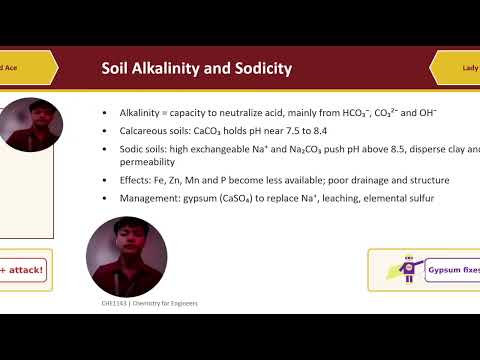
- Alkalinity is the soil's ability to neutralize acids primarily through bicarbonate, carbonate, and hydroxide ions.
Characteristics of Sodic Soils
- Excess sodium can raise potential hydrogen above 8.5; this leads to clay dispersion that prevents water drainage.
Solutions for Sodic Soils
- Gypsum application replaces sodium with calcium, aiding in leaching out excess sodium from the soil.
Buffering Capacity Explained
Importance of Buffering Capacity
- Buffering capacity indicates how resistant soil is to changes in pH when acids or bases are added.
Factors Affecting Buffering Capacity
- Clay and organic matter enhance buffering capacity compared to sandy soils; different systems dominate at various pH levels.
Cation Exchange Capacity (CEC)
Understanding CEC
- CEC involves negatively charged clay and humus particles holding positive ions like calcium and magnesium for nutrient retention.
Measurement of CEC
- CEC is measured in centimoles per kilogram; base saturation reflects the percentage occupied by basic cations.
Anion Exchange Capacity (AEC)
AEC Overview
- AEC tends to be smaller than CEC; it plays a crucial role in acidic soils where anion exchange occurs on positively charged surfaces.
Environmental Implications
- Phosphate binds strongly while nitrate leaches easily—this poses risks for groundwater contamination relevant for engineers focused on water quality.
Conclusion: Key Takeaways
Summary Points
- Potential hydrogen influences nutrient chemistry; acidity arises from hydrogen/aluminum while alkalinity comes from carbonates/sodium.
- Buffering capacity informs lime/sulfur/gypsum needs for managing soil health.
- Understanding CEC/AEC aids in land reclamation efforts across agriculture and environmental management.
Turn any video into a summary like this
YouTube links, meetings, lectures. With transcripts, search, and chat.