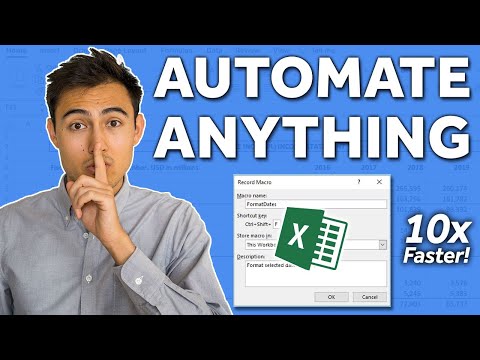
Learn Excel MACROS in 10 Minutes Using Real World Examples
Automating Repetitive Tasks with Macros in Excel
In this video, the presenter demonstrates how to automate repetitive tasks in Excel using macros. The scenario involves formatting a weekly financial data set and creating a chart for management review.
Enabling Macros
- To enable macros, right-click anywhere on the ribbon and click "Customize the Ribbon"
- Tick the "Developer" area if it's not already selected and hit OK
Recording a Macro
- Click on "Record Macro" and name it something like "Format"
- Perform the necessary formatting steps (e.g., merging cells, changing font color) that you want to automate using the macro
- Stop recording by clicking on "Stop Recording" under the Developer tab
Running a Macro
- To run a macro, go to the Developer tab and click on "Macros." Select the macro you want to run and click "Run."
- Alternatively, add a button to your worksheet that links to your macro. Go to Insert > Button, place it where you want it on your worksheet, then link it to your macro by selecting it from the list of available macros.
Conclusion
- While Excel macros can help automate repetitive tasks, more powerful tools like Power BI can be used for creating more complex visuals in less time.
Introduction to Excel Macros
In this section, the speaker introduces Excel macros and how they can be used to automate repetitive tasks in Excel.
Highlighting Specific Cells with Macros
- To highlight specific cells in an Excel sheet, the speaker demonstrates how to create a macro that will apply formatting to a selected cell.
- The macro is created by recording a set of steps, such as changing the background color and adding borders to a cell.
- Once the macro is created, it can be assigned to a button or shape on the sheet for easy access.
- The speaker also shows how macros can be assigned to images or logos on the sheet.
Dynamic Macros for Varying Data Sets
- The speaker explains that macros can be dynamic and adjust automatically based on changes in data sets.
- To demonstrate this, he shows how a previously recorded macro still works even when new rows are added to the data set.
- He explains that using keyboard shortcuts instead of specific ranges allows macros to remain dynamic.
Saving Files with Macros
- The speaker notes that files containing macros cannot be saved as regular Excel files.
- Instead, they must be saved as Macro-enabled Workbook files.