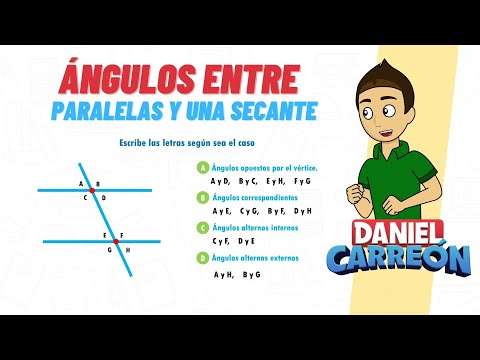
CLASIFICANDO ÁNGULOS ENTRE RECTAS PARALELAS Y UNA SECANTE Super facil - Para principiantes
Classifying Angles of Parallel Lines Cut by a Transversal
Introduction to Angle Classification
- Daniel Carrión introduces the topic of classifying angles formed by two parallel lines cut by a transversal, emphasizing the importance of understanding various angle relationships.
Opposite Angles
- Opposite angles at a vertex are equal; for example, angles A and D are noted as they are opposite each other and have equal measures.
- Angles B and C are also identified as opposite angles, with their measures being equal.
- The pairs E and H, as well as F and G, are mentioned as additional examples of opposite angles that share equal measurements.
Corresponding Angles
- Corresponding angles lie on the same side of the transversal and have equal measures; for instance, angles A and L fit this description.
- Angles C and G are highlighted as corresponding because they share the same side of the transversal with equal openings.
- On the right side of the transversal, angles B and F are also classified as corresponding due to their position and equality in measure.
Alternate Interior Angles
- Alternate interior angles occur on opposite sides of the transversal but within the parallel lines; an example is angle C and angle F.
- Another pair identified is angle Y and angle E, which meet the criteria for alternate interior angles due to their positions relative to the transversal.
Alternate Exterior Angles
- Alternate exterior angles exist outside the parallel lines on opposite sides of the transversal; for instance, angle A and H qualify under this classification.
- Additionally, angles B and G are noted as alternate exterior angles since they too lie outside both parallel lines while being on opposite sides of the transversal.
Conclusion
- Daniel concludes by encouraging viewers to engage with his content through likes, comments, shares, or subscriptions. He expresses hope that viewers found value in learning about angle classifications.
Turn any video into a summary like this
YouTube links, meetings, lectures — with transcripts, search, and chat.