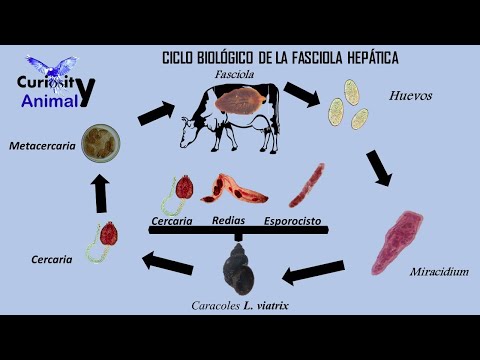
Ciclo de biológico de la Fasciola Hepática
Understanding Fasciola Hepática: The Liver Fluke
Introduction to Fasciola Hepática
- The speaker addresses emotional distress caused by a breakup, suggesting that learning about the biological cycle of Fasciola hepática is more interesting.
- Fasciola hepática is introduced as an enemy in the context of health, with hosts being affected and medications discussed for future chapters.
Identification and Characteristics
- Scientifically known as Fasciola hepática, it has various names such as "duela del hígado" and "arico," indicating its widespread recognition.
- The parasite measures between 18 to 51 mm in height and 4 to 13 mm in width, varying based on the host's size (e.g., smaller in guinea pigs compared to larger livestock).
Structure and Reproduction
- The parasite resembles a bay leaf; its outer layer (cuticle) is rigid and acellular, primarily composed of chitin, allowing it to absorb nutrients.
- It is hermaphroditic, possessing both male and female reproductive organs, which enables it to produce eggs.
Life Cycle Overview
- The life cycle involves two hosts: a definitive host where the adult develops (usually herbivores), and an intermediate host where one phase occurs.
- Adult flukes reside in bile ducts of the liver, releasing eggs into intestines that are expelled through feces. An adult can lay between 10,000 to 20,000 eggs daily.
Development Stages
- Eggs require specific temperatures (10°C - 30°C) for development; within two weeks they hatch into larvae called miracidium.
- Miracidia seek out their intermediate host—snails from the genus Lymnaea. Inside snails, they transform into sporocysts.
Multiplication Process
- Sporocysts multiply within snails over approximately two weeks before developing into cercariae that exit into water.
- Cercariae encyst on aquatic plants; upon ingestion by definitive hosts (like cows), they lose their tails and become metacercariae.
Infection Mechanism
- Consuming infected liver does not cause harm since it's not infectious; metacercariae are the infective form that leads to disease when ingested.
- Once inside a cow’s digestive system, metacercariae migrate through intestinal walls into the liver over six to seven weeks during acute migration.
Summary of Life Cycle Phases
- Definitive hosts expel eggs which develop into miracidia. These enter snails where they undergo several transformations before emerging as cercariae seeking vegetation for further infection cycles.