Ortho Dr. Bashardoust
Understanding Bone Healing Processes
Overview of Fracture and Healing Stages
- The discussion begins with the importance of understanding the classification of fractures, including their origin, destination, and stability types.
- The anatomical location of fractures is crucial for assessing infection risk and determining treatment strategies.
- Pain management and physiological protection mechanisms are highlighted as essential factors in fracture healing.
Phases of Bone Healing
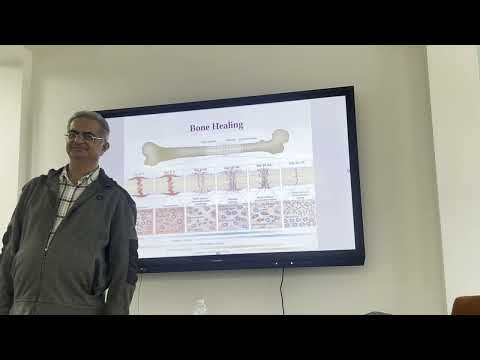
Inflammatory Stage
- The initial phase of bone healing starts immediately after injury, characterized by bleeding and inflammation.
- Bleeding leads to clot formation at the fracture site, which decreases oxygen levels and initiates a cascade of cellular responses.
- Osteoclasts and monocytes migrate to the injury site to begin removing debris from the fracture area.
Modeling Stage
- Following inflammation, the modeling stage occurs where fibroblasts contribute to forming a fibrous tissue that stabilizes the fracture.
- This primitive bony tissue is referred to as "asoid," which is not structurally sound but serves as a temporary scaffold for healing.
Callus Formation
Transitioning Between Stages
- Callus formation is identified as a critical mediator between inflammation and reparative stages; it provides initial stability for fractured bones.
- Angiogenesis plays a vital role in supplying nutrients necessary for further healing processes.
Remodeling Phase
- The remodeling phase involves transforming callus into more structured bone tissue over several weeks, depending on patient health factors.
- Delayed union or non-union can occur if proper stabilization isn't achieved during these phases; timelines vary based on individual circumstances.
Types of Bone Ossification
Primary vs. Secondary Ossification
- Two types of ossification are discussed: primary (direct transition from stem cells to osteoblasts without cartilage mediation), and secondary (involving cartilage).
- Endochondral ossification requires a mediator (cartilage), while intramembranous ossification does not necessitate this intermediary step.
Clinical Implications
Monitoring Healing Progress
- X-ray imaging is essential for evaluating callus formation; excessive callus indicates poor immobilization during recovery.
- Proper fixation techniques are emphasized; inadequate stabilization can lead to increased callus size due to movement at the fracture site.
Understanding Patient Treatment and Healing Processes
The Role of Physicians in Patient Care
- Physicians may face challenges when recommending surgeries, as patients might seek alternative opinions or treatments based on their advice.
- It's important for physicians to communicate openly with patients about treatment options and to seek collaborative input from colleagues when uncertain.
Factors Affecting Healing
- Patient age and lifestyle choices (e.g., smoking, alcohol use) significantly impact healing capabilities; older patients with unhealthy habits may not respond well to treatments.
- The size of the callus formed during healing can indicate the stability of the fracture; larger calluses suggest better stability.
Stem Cell Differentiation
- Stem cells have the potential to differentiate into various specialized cells, such as osteoblasts or chondroblasts, which are crucial for bone healing.
- Once stem cells mature into specialized cells, they cannot revert back to a different type of specialized cell; this highlights the importance of initial differentiation stages.
Bone Formation Process
- Chondroblasts initially form during callus formation before eventually transforming into osteoblasts, demonstrating a sequential process in bone healing.
- Understanding these stages is essential for comprehending how bones heal and adapt over time.
Stages of Bone Healing
- The healing process progresses through distinct stages: acute inflammation, fibrocartilage tissue formation, bony callus development, and remodeling towards stronger bone structure.
- Collaborative care among treatment teams aims at achieving anatomical realignment and immobilization to facilitate proper healing.
Goals of Treatment in Bone Fractures
- Key goals include improving function and performance post-treatment while ensuring proper alignment and stabilization during recovery.
- Rehabilitation plays a critical role in restoring normal function after fractures by simulating the healing process through targeted exercises.
Conclusion on Treatment Approaches
- Effective treatment requires understanding both medical interventions and rehabilitation strategies tailored to individual patient needs.
Turn any video into a summary like this
YouTube links, meetings, lectures — with transcripts, search, and chat.