CORAZON 9.avi
Introduction
The instructor introduces the topic of Pericardium in the context of a dedicated lesson for Marian.
Understanding Pericardium
- "Perí Cardio" is introduced as a complex and crucial topic.
- Pericardium is described as fibrous, connective, and serous tissue that surrounds the heart like a sac or tobacco pouch.
- The pericardium consists of two parts: fibrous pericardium externally and serous pericardium internally.
Structure of Pericardium
Detailed explanation of the structure and components of the pericardium.
Components and Characteristics
- The average height of the pericardium is 12 to 14 centimeters with its highest extension known as hasta de Jañero.
- Cutting through the fibrous pericardium reveals the serous pericardium inside, followed by the heart itself.
Layers of Pericardium
Discussion on the layers comprising the pericardial sac.
Layers Description
- The layers include fibrous pericardium externally, parietal serous pericardium lining internally, and visceral serous pericardium covering the heart.
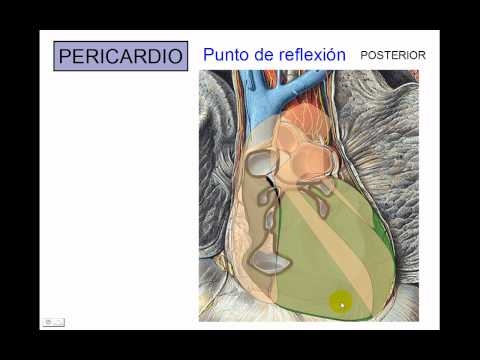
- Points of reflection mark transitions between different parts of the serous pericardium.
Points of Reflection
Exploring points where structural changes occur within the layers of the pericardial sac.
Structural Transitions
- Points of reflection delineate shifts from anterior to posterior regions in both fibrous and serous layers.
- Differentiation between parietal and visceral layers highlighted using color distinctions for clarity.
Detailed Anatomy
Examination of specific anatomical features related to reflections within the posterior aspect.
Anatomical Features
- Venous reflections are identified by landmarks such as pulmonary veins in relation to transitions from visceral to parietal layers.
New Section
In this section, the speaker discusses the anatomy of the pericardium and its relation to the heart.
Understanding the Pericardium
- The pericardial sac extends from left to right, with its boundary being a reflection point where the pericardium transitions from visceral to parietal.
- At a specific point, there is a clear distinction between the heart and the visceral layer of the pericardium, allowing for easy access to grasp the heart. Behind this area lies the aorta and esophagus.
New Section
This part focuses on reflections related to arteries at the level of pulmonary and aortic arteries.
Reflection Points on Arteries
- At the level of the pulmonary artery and aorta, there exists a double-layered pericardium with spaces between them known as sinus transversus pericardii.
- The space between venous and arterial layers within this double-layered structure is crucially named sinus transversus pericardii de Teyle.
New Section
Here, an anterior view of specific cardiac structures is discussed in detail.
Detailed Cardiac Structures
- An illustration shows various cardiac structures such as ventricles, pulmonary artery, trachea, ventricular walls (anterior view), highlighting anatomical relationships.
- The space known as sinus transversus pericardii de Teyle is visible between two layers of pericardium near ventricular structures.
New Section
This segment delves into specific boundaries and spaces within the cardiac anatomy.
Boundaries and Spaces in Cardiac Anatomy
- A detailed explanation is provided regarding spaces like seno transverso de teyle located between different cardiac structures like arteries and ventricles.
- Various boundaries are highlighted including arteries like hortes and pulmonary arteries along with ventricular structures like left atrium.
New Section
The discussion shifts towards exploring additional spaces within cardiac anatomy.
Exploring Cardiac Spaces
- The "fondo del saco de jaleo" or bottom of jelly bag is described as an area where one can place hands due to spaces created by visceral and parietal layers of pericardium.
- Lastly, details about ligaments that fixate the fibrous outer layer of pericardium are explained including ligamento esterno pericárdico divided into superior inferior parts for attachment purposes.