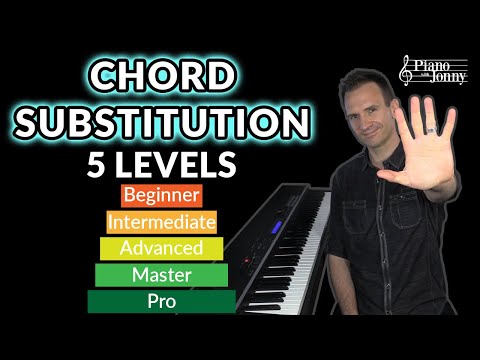
Chord Substitution: 5 Levels from Beginner to Pro 🎹
5 Essential Chord Substitution Techniques
In this lesson, the instructor teaches five essential chord substitution techniques. The lesson starts with level one, which is a beginner technique and progresses to level five, which is an advanced technique.
Chord Family Technique
- The first step to playing the chord family technique is to understand diatonic chords.
- Diatonic chords are all of the chords that belong to a key.
- Certain diatonic chords are related to one another.
- We can substitute a chord with another related diatonic chord if the melody note matches.
Secondary Dominant Technique
- Secondary dominant chords are added in front of a chord to make it sound more interesting.
- A secondary dominant chord is found by going up five steps from the target chord and playing its dominant seven chord.
- Adding a secondary dominant chord works for any target chord.
Tritone Substitution Technique
- Tritone substitution involves replacing a dominant seventh chord with another dominant seventh chord whose root is a tritone away.
- For example, instead of playing G7, we can play Db7 because Db is a tritone away from G.
Passing Chords Technique
- Passing chords are used between two main chords to create interest and movement in the music.
- Passing chords can be any type of diatonic or non-diatonic chords that fit between two main chords.
Chromatic Approach Technique
- Chromatic approach involves adding chromatic notes before or after a target note to create tension and release.
- Chromatic notes can be any note that is not in the key of the song.
Overall, this lesson teaches five essential chord substitution techniques: chord family technique, secondary dominant technique, tritone substitution technique, passing chords technique, and chromatic approach technique. Each technique is explained in detail with examples and demonstrations using Twinkle Twinkle Little Star as a reference tune. The lesson progresses from beginner to advanced techniques.
Adding Secondary Dominant Chords
This section covers how to add secondary dominant chords to a chord progression.
Adding Secondary Dominant Chords
- Add secondary dominant chords in front of the target chord.
- Use an A7 as the secondary dominant chord for a D minor chord.
- Make the G a dominant chord as well by adding another secondary dominant chord.
Two Five One Technique
This section covers the two five one technique, which is used to make chords sound more interesting and jazzy.
The Two Five One Technique
- Use the 2 5 1 chord progression before playing a target chord.
- Play the two chord of F, which is G minor with added seventh, before playing an F major chord.
- Play the two five one progression before playing a G major scale. The two is A minor with added seventh and the five is D7.
- Play a 2 5 1 to a D minor chord. The two is E minor with added seventh and the five is A7.
- Use different voicings for each of your chords. Learn this technique in our course "Play Lead Sheets with Seventh Chords."
Extension and Alteration Technique
This section covers how to use extensions and alterations to make jazz chords sound richer.
The Extension and Alteration Technique
- Add extensions and alterations to each of your chords for richer sounding jazz chords.
- Guidelines exist for which notes you can add to each type of chord.
Chord Extensions and Alterations
In this section, the instructor explains how to add chord extensions and alterations to minor and dominant seven chords.
Adding Notes to a Minor Chord
- A minor chord can be enhanced by adding three notes: the ninth, eleventh, and thirteenth.
- A flat two, raised two, raised four, or raised five can be added to a dominant seven chord.
Examples of Chord Extensions and Alterations
- The instructor demonstrates a C6/9 chord with the sixth and ninth added.
- He also shows an altered C7 chord with a flat nine added.
- An F major chord is played with the sixth, seventh, and ninth added.
- An E minor chord is played with the seventh and fourth added.
- An A7 chord is played with a flat nine added.
- A D7 chord is played with the sixth or thirteenth and second or ninth added.
- The instructor plays a G9 sus4 chord by suspending the third up to the fourth while adding a little nine in there for color.
- Finally, he resolves on a C6/9 chord.
The 2-5-1 Series
In this section, the instructor explains how to use the 2-5-1 series technique in playing jazz music.
Understanding 2-5-1 Series Technique
- The 2-5-1 series technique involves using two-five-one chords that lead to the final chord in a progression.
- To use this technique, start with the last chord of a tune and work your way backwards using two-five-one chords.
Examples of 2-5-1 Series Technique
- The instructor demonstrates how to use the 2-5-1 series technique by playing through a C major scale. He uses a 2-5-1 series to lead up to an A minor chord.
Introduction to Piano Lessons
In this section, the instructor introduces a piano lesson program suitable for all playing levels.
Piano Lesson Program
- The program teaches students how to play their favorite songs and styles.
- Students will learn how to improvise at the piano.
- The lessons are suitable for all playing levels.
Turn any video into a summary like this
YouTube links, meetings, lectures. With transcripts, search, and chat.