Introduction to epigenetics - Learn.OmicsLogic.com
Introduction to Epigenetics
This section provides a general introduction to epigenetics, an important research area in molecular biology. It covers the definition of epigenetics, its historical background, and its significance in understanding gene expression and human health.
Definition and Historical Background
- Epigenetics is the study of mechanisms that cause changes in gene expression without altering the DNA sequence.
- Konrad Waddington coined the term "epigenetics" and defined it as the branch of biology that studies the causal interaction between genes and their products.
- Historically, epigenetics was used to describe events that couldn't be explained by genetic principles.
- Over the years, various biological phenomena have been categorized under epigenetics, including para mutation, position effect variation, and imprinting.
Importance of Epigenetics
- Epigenetic phenomena play a crucial role in human health, disease understanding, and heritable traits not recorded in DNA.
- Mechanisms underlying epigenetic changes include DNA methylation, histone modification, non-coding RNA activity (e.g., microRNAs), and non-coding repeating regions in DNA.
Structure of DNA and Chromatin
This section discusses the structure of DNA in eukaryotic cells and how it is organized into chromatin. It explains how DNA packaging affects gene regulation through epigenetic mechanisms.
Organization of Eukaryotic DNA
- DNA codes for genes that are transcribed into RNA and translated into proteins.
- Phenotypic variation can result from epigenetic changes that are established and passed through generations or acquired and lost throughout an organism's lifetime.
- Eukaryotic DNA is tightly packaged into chromosomes within the nucleus.
Chromatin Structure and DNA Packaging
- Chromatin consists of DNA wrapped around histone proteins, forming nucleosomes.
- Histones can be grouped together to form compacted chromatin or relaxed and spread out chromatin.
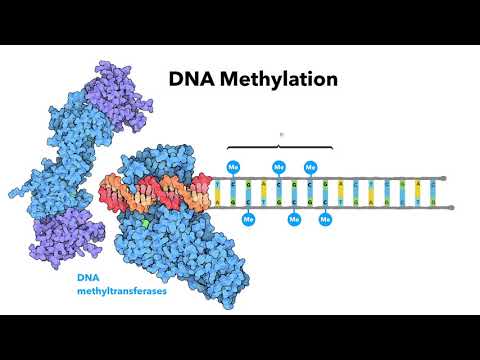
- DNA methylation is one mechanism that regulates DNA compactness. Methyl groups are added to cytosine bases by DNA methyltransferase proteins.
Post-translational Modifications of Histones
This section explores post-translational modifications (PTMs) of histones, which play a crucial role in gene regulation and epigenetic changes.
Importance of Histone PTMs
- Histone PTMs, such as acetylation, phosphorylation, methylation, and ubiquitination, regulate gene expression and transcriptional activation/silencing.
Types of Histone Modifications
- Acetylation was the first modification linked with active transcription.
- Phosphorylation of histone H3 cooperates with acetylation for transcriptional activation.
- Methylation events on histones can be associated with both transcription activation and gene silencing.
The transcript does not provide further sections or timestamps beyond this point.
Wrapped Around the Histones
This section discusses how histone proteins or nucleosomes undergo post-translational modifications, such as phosphorylation, acetylation, and methylation, which can affect gene expression and chromatin remodeling.
Histone Modifications and Gene Expression
- Histone proteins undergo various post-translational modifications, including phosphorylation, acetylation, and methylation.
- These modifications can individually or combinatorially regulate processes like transcription, replication, DNA repair, and apoptosis.
- Different types of histones can have specific modifications at various locations along the DNA.
- The accessibility of DNA is influenced by these modifications, affecting gene expression levels and alternative splicing.
Chromatin Immunoprecipitation (ChIP-seq)
This section explains how ChIP-seq is used to study histone modifications and analyze their effects on gene regulation.
ChIP-seq Process
- ChIP-seq involves using antibodies designed to bind to specific proteins of interest (e.g., histones) attached to DNA.
- Antibodies help select the regions of DNA that have these proteins for sequencing.
- After selecting the regions of interest, the antibodies and proteins are removed from the DNA.
- Sequencing libraries are prepared from the remaining DNA fragments for further analysis.
Analyzing ChIP-seq Data
- ChIP-seq data is analyzed to identify peaks associated with different histone modifications and the openness or closeness of DNA.
- Specific patterns in chip-seq data can indicate different histone modification profiles and regulatory events.
- The main challenge in analyzing chip-seq data is accurately detecting true peaks in the data where multiple reads have mapped.
Whole Genome Bisulfite Sequencing
This section discusses bisulfite sequencing, a method used to study DNA methylation patterns across the entire genome.
Bisulfite Sequencing Process
- Bisulfite sequencing is used to study DNA methylation by converting non-methylated cytosines to uracil.
- Cytosines on both strands of the DNA can be methylated, and bisulfite conversion changes only non-methylated cytosines.
- The challenge in bisulfite sequencing is accurately mapping reads and differentiating between converted cytosines and original thymines.
Analyzing Bisulfite Sequencing Data
- Mapping reads to the reference genome and comparing changes in site assignments helps analyze bisulfite sequencing data.
- Complementarity between the two strands of DNA can be leveraged for accurate mapping and analysis of converted cytosines.
Conclusion
This section concludes the transcript by highlighting the challenges in analyzing ChIP-seq and bisulfite sequencing data.
- ChIP-seq analysis aims to detect enriched genome fragments with upregulated signals associated with transcription factor binding sites, chromatin remodeling, or genome transcription events.
- Accurately detecting true peaks in ChIP-seq data is a major challenge due to variations in read mapping and pileup.
- Whole-genome bisulfite sequencing faces challenges related to library preparation and accurately mapping converted cytosines.
- Leveraging complementarity between DNA strands helps address some of these challenges in bisulfite sequencing analysis.