How the Brain Works Part 1 (UCLA)
Introduction to the Brain
In this section, we learn about how the brain works in both health and disease.
Brain Organization
- The brain is divided into a right and left hemisphere, each with different lobes.
- The frontal lobe is important for executive functions and memory.
- The parietal lobe is primarily involved in sensation and spatial awareness.
- The temporal lobe contains areas for hearing, memory (hippocampus), and language functions.
- The occipital lobe processes visual information.
Brainstem and Spinal Cord
- The brainstem contains regions for consciousness, breathing, blood pressure regulation, etc. Damage to it can cause coma.
- The spinal cord contains nerves that go out to muscles and bring in information from joints, muscles, skin about temperature, pain, movement. It helps integrate all that information.
Cerebellum
- Located at the back of the brain
- Helps with coordination and timing of movements
The Structure of the Brain
In this section, we learn about the structure of the brain and how neurons make connections with each other.
Neurons and Their Connections
- The occipital lobe allows us to see and interpret motion, color, size, and speeds of movement.
- Nerve cells have dendrites that receive signals from other neurons and an axon that sends signals to other neurons.
- Nerve cells make connections with each other through synapses that contain chemical messengers.
- Strengthening connections between nerve endings creates the basis for learning.
Anatomy of the Brain
- The human brain has a protective covering called the dura that sits up against the skull.
- Underneath the dura is another fine layer called the arachnoid, which helps bring blood vessels into the brain.
- The frontal lobe is located at the front part of the brain while at its back is where we find parietal lobe and occipital lobe.
- The cerebellum underneath provides balance while below it are found spinal cord and brain stem.
Pathways in the Brain
- Clusters of nerve cells in pathways called axons move in many directions within the brain.
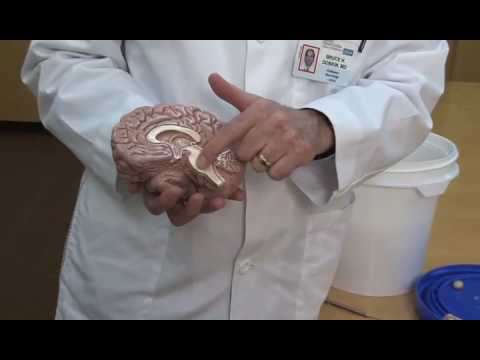
- A slice across middle part of a human brain shows frontal lobe at one end and parietal lobe at another.
Overview of Brain Anatomy
In this section, the speaker discusses the anatomy of the brain and how different parts of it are responsible for various functions.
Different Parts of the Brain
- The brain has ventricles that produce spinal fluid which surrounds it.
- The caudate nucleus is a part of the brain.
- The thalamus and internal capsule are also parts of the brain.
- Each part carries certain fibers, such as nuclei in the thalamus that are important for memory.
Effects of Damage to Specific Areas
- Damage to upper and inner parts of nerve cells in the thalamus can cause memory loss.
- Damage to a tiny area called the internal capsule can cause paralysis from even a small injury.