Tutorial 1 : Introduction to Python Basics
Introduction to Deep Learning Prerequisites
Overview of the Tutorial Series
- The tutorial series focuses on prerequisites for implementing deep learning models, assuming viewers have basic programming knowledge.
- It will cover Python syntax, NumPy, and PyTorch, with practical implementations of CNNs and RNNs planned throughout the series.
- The aim is to implement deep generative models using PyTorch libraries.
Basic Python Programming Concepts
- The tutorial begins with a standard "Hello World" program in Python, emphasizing that no library imports are needed as in C/C++.
- Variables are introduced as containers for data storage; basic data types include integers, floats, strings, and booleans.
Working with Variables
- Examples of variable assignments include age (integer), learning rate (float), course name (string), and GPU availability (boolean).
- The
type()function is used to check data types of variables like age and learning rate.
Arithmetic Operations in Python
- Basic arithmetic operations such as addition, subtraction, multiplication, division (both full and integer), and exponentiation are demonstrated.
- Integer division yields quotient and remainder; exponentiation example shows 10^3 equals 1,000.
Understanding Strings in Python
String Indexing
- String indexing starts at zero; characters can be accessed using positive or negative indices.
- Slicing allows fetching portions of strings by specifying start and end indices; omitted values default to the beginning or end of the string.
String Methods
- Common string methods include
.lower(),.upper(), and.replace(), which do not modify the original string but return modified copies instead.
Exploring Data Types: Lists
Characteristics of Lists
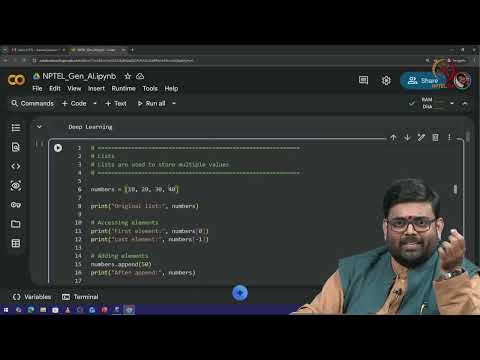
- Lists are mutable collections that allow duplicates; they can contain mixed data types including integers, floats, strings, or even other lists.
List Operations
- Elements can be accessed via positive or negative indexing. Adding elements can be done using
append()for adding at the end orinsert()for specific positions.
Advanced List Manipulations
Removing Elements from Lists
- The
pop()method removes elements from a list either from the end or a specified index.
Length Calculation
- The length of a list can be determined using the
len()function. An exercise is suggested to practice manipulating lists further.
Introduction to Tuples and Sets
Properties of Tuples
- Tuples are immutable collections that allow duplicates; they are defined using parentheses unlike lists which use square brackets.
Control Flow: Loops in Python
Types of Loops
- Two main loop types discussed: 'for' loops for known iterations and 'while' loops based on conditions.
For Loop Example
- A simple example demonstrates iterating over numbers in a list while highlighting importance of indentation for grouping instructions correctly.
Conditional Statements in Python
If/Else Structure
- Explanation on how if/else statements work based on relational operations yielding true or false outcomes.
Nested Conditions
- Demonstrates an if/else if structure where multiple conditions are checked sequentially until one evaluates true.
Understanding Dictionaries
Key Value Pairs
- Dictionaries store key-value pairs useful for configurations like model parameters. They utilize curly braces for declaration.
Functions in Python
Function Definition
- Functions encapsulate reusable code blocks executed upon calling them; examples provided illustrate defining functions with parameters.
Understanding Python Class Initialization
Constructor and Attributes
- The
__init__method serves as the constructor in a Python class, initializing instance attributes.
- The
selfkeyword refers to the current instance of the class, allowing access to its attributes.
- Attributes are defined using
self, such asself.namefor the student's name andself.marksfor their scores.
Instance Creation
- When creating an instance (e.g., student one), the
__init__method is automatically called with provided values.
- For example, if "Ragava" is passed as a name and 95 as marks, these values are assigned to the respective attributes.
Simple Model Example: Forward Method
Weight and Bias in Models
- A simple model includes weights and biases; for example, weight = 2 and bias = 3.
- The forward method calculates output using the formula y = wx + c , where x is input data.
Calculation Demonstration
- If x equals 5, then substituting into the equation gives y = (2 * 5) + 3 = 13 .
Importing Libraries in Python
Need for External Libraries
- Sometimes required functionalities are not available in Python's standard library; thus, external libraries must be imported.
Example of Math Library Usage
- Using
import math, various mathematical functions like sine, cosine, and square root can be accessed easily.
Overview of Basic Python Concepts
Recap of Key Ideas
- This section provides a brief overview of fundamental concepts in Python that will recur throughout learning.
Transition to Next Topic
- The next tutorial will focus on introducing basic concepts related to NumPy.
Turn any video into a summary like this
YouTube links, meetings, lectures. With transcripts, search, and chat.