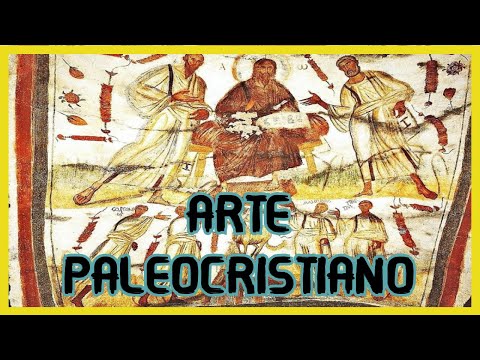
El arte PALEOCRISTIANO
The Art of Paleochristian Communities
This section provides an introduction to Paleochristian art, which developed during the first 5 centuries of the Christian era. It explores the role of Christianity as a bridge between classical and Christian cultures, and highlights the stages of early Christian art.
Development of Paleochristian Art
- Paleochristian art emerged during the first 5 centuries of our era, from the appearance of Christianity until the fall of the Western Roman Empire in the 5th century.
- Christianity served as a link that allowed for continuity in the Western world after the collapse of the Roman Empire.
- Early Christian art acted as a bridge between two cultures: classical culture that disappeared in the 5th century and Christian culture that developed in the Middle Ages.
- Two stages are distinguished within paleochristian art, separated by the Edict of Milan in 313 which granted religious freedom for Christians.
Persecution and Worship Spaces
- In the first stage, Christians were persecuted by Romans due to differences in worship and behavior between Christianity and other religions.
- To avoid persecution, Christians began meeting in private houses known as "domus ecclesiae" for worship.
- As Christianity gained more followers, aristocrats who embraced this new faith started using their larger homes for Christian gatherings.
- Churches called "Titulus" were built in some private houses in Rome after Emperor Gallienus approved an edict of Tolerance towards Christians in 260.
Catacombs and Funerary Practices
- Early Christian communities also met in catacombs, which were acquired lands on Rome's outskirts used for burying their dead and worshipping martyrs.
- Catacombs consisted of narrow galleries with cavities where bodies were deposited. Cubicles formed at intersections served as funerary chambers for martyrs.
- Outside the catacombs, Christians built small temples called "cella memoriae" to worship their deceased.
Early Christian Painting
- Early Christianity lacked defined architectural structures, but painting became the main artistic expression of this period.
- The oldest images are found in the catacombs, combining motifs from Roman mythology with Christian symbolic motifs and scenes from the Old and New Testaments.
- Symbolic motifs include the crismón or monogram of Christ, fish, vine, anchor, and dove.
- Paleochristian painting is characterized by simplicity, rusticity, lack of technical level, lack of expressiveness and naturalism, and figures on a monochrome background.
The Rise of Christian Basilicas
This section explores the impact of the Edict of Milan in 313 on Christianity's acceptance in the Roman Empire. It discusses the need for larger worship spaces and how Christians adopted basilicas as their architectural model.
Acceptance of Christianity
- After the Edict of Milan in 313, Christianity was accepted by the Roman Empire.
- The number of faithful increased significantly during this time.
Adoption of Basilicas
- As more space was needed for worship, Christians turned to an existing Roman building type: basilicas.
- Christian basilicas had an atrium as an entrance area leading to the main building.
- Basilicas typically had three naves (some had five), with a higher and wider central nave separated from lateral ones by columns or arches.
- Windows in the upper part filled interiors with light. Side naves sometimes had high galleries for women called "matroneo."
- The central nave ended with a large arch leading to a transverse nave called "transeptum."
- The presbytery contained an elevated altar where martyr remains were placed. The head featured a vaulted apse.
- Roofs were gabled with exposed wood inside.
- Examples of Christian basilicas include Santa Sabina, San Pedro, and Santa Maria Maggiore in Rome.
Conclusion
This section concludes the transcript by summarizing the main points discussed in the video regarding Paleochristian art and the adoption of basilicas as Christian worship spaces.
- Paleochristian art developed during the first 5 centuries of our era, serving as a bridge between classical and Christian cultures.
- Early Christians faced persecution and worshipped in private houses known as "domus ecclesiae" or built churches called "Titulus."
- Catacombs were used for burial and worship, while small temples called "cella memoriae" were built outside for worshipping deceased Christians.
- Early Christian painting borrowed motifs from Roman mythology and incorporated Christian symbolic motifs and scenes from the Old and New Testaments.
- The Edict of Milan in 313 marked Christianity's acceptance in the Roman Empire, leading to an increase in faithful followers.
- Basilicas became popular among Christians as larger worship spaces, adopting architectural elements from Roman basilicas.
New Section Building next to a Temple
This section discusses a building located next to a temple that was used for baptism by immersion.
Building Description
- The building is situated next to a temple.
- It was specifically designed and used for baptism by immersion.
Purpose of the Building
- The main purpose of the building was to facilitate the practice of baptism by immersion.
- It provided a dedicated space for individuals to undergo the ritual.
Importance of Baptism by Immersion
- Baptism by immersion is considered an important religious practice in certain faiths.
- It symbolizes purification and spiritual rebirth.
Historical Significance
- The presence of this building indicates the significance of baptism by immersion in the religious community.
- It highlights the importance placed on this particular ritual.