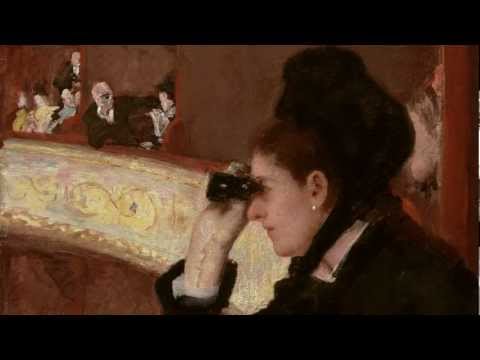
Cassatt, In the Loge
The Role of the Opera House in Modern Paris
The Transformation of Paris and the Opera House
- Paris in the late 19th century emerged as a modern city characterized by spectacle, where the wealthy showcased themselves and observed others, particularly evident in the opera house.
- The opera house served as a centerpiece of this new Paris during the Second Empire (1850s-60s), featuring lavish decorations like gold, mosaics, paintings, mirrors, and grand staircases.
Social Dynamics at the Opera
- The opera house was not just about performances; it emphasized social interaction among audiences before shows and during intermissions.
- Mary Cassatt's painting "In the Loge" captures this dynamic, focusing on a woman engaged in looking rather than watching the stage.
Gazes and Perspectives
- The female subject is depicted between two gazes: that of the viewer (us) and a male figure behind her who also observes her.
- This duality highlights voyeurism; both we and the male figure are complicit in observing her.
Gender Dynamics in Art
- Mary Cassatt, an impressionist artist invited by Degas to exhibitions, found unique opportunities for women to engage with themes of looking and being seen within socially accessible spaces like the opera.
- Unlike her male counterparts who painted public spaces freely, Cassatt utilized the opera as a venue where she could express herself artistically.
Agency Through Observation
- In "In the Loge," Cassatt presents a woman with agency actively participating in observation alongside a male gaze.
- The woman's posture conveys enthusiasm; she leans forward with confidence while holding her fan assertively.
Cultural Commentary on Visual Technology
- The painting reflects on visual culture and technology's role in enhancing perception. It emphasizes how art captures fleeting moments within this culture of looking.