Discover Real-Time PCR for the Classroom
Introduction to Real-Time PCR
In this section, the speaker introduces himself and gives an overview of what will be covered in the presentation.
Speaker Introduction
- The speaker is Ingrid Miller, product manager for Bio-Rad's Biotechnology Explorer program.
- David Palmer is the real-time PCR expert and presenter.
- Dave studied at the University of Delft and Ontario Canada where he received his Bachelor of Science in agriculture after receiving his doctorate in molecular plant pathology from Oklahoma State University.
Presentation Overview
- Real-time PCR allows us to measure minute amounts of DNA sequences in a sample.
- Conventional PCR tells us what, but real-time PCR tells us how much.
- Real-time PCR is used for gene expression analysis, disease diagnosis and management, food testing, animal and plant breeding, forensics.
What is Real-Time PCR?
This section explains what real-time PCR is and its key components.
Definition of Real-Time PCR
- Real-time PCR is part of regular PCR but allows a reaction to be visualized in real time as it progresses.
- It amplifies specific fragments of DNA with high sensitivity and specificity.
Key Components
- Amplification: process for increasing the amount of specific fragments of DNA
- Specificity: ability to detect only the target sequence
- Visualization: ability to see results as they happen in real time
Applications of Real-Time PCR
This section discusses some examples of how real-time PCR can be used.
Gene Expression Analysis
- Researchers use real-time PCR to measure messenger RNA produced from a particular gene.
- Helps researchers understand how genes are regulated under different conditions or treatments.
Disease Diagnosis and Management
- Physicians use real-time PCR to monitor viral load or amount of virus in a patient's blood.
- Allows for adjustments to prescriptions and disease treatment based on the amount of virus.
Food Testing
- Real-time PCR can detect foodborne pathogens such as Salmonella or E. coli.
- Helps ensure food safety and prevent outbreaks.
Animal and Plant Breeding
- Real-time PCR can be used to identify genetic markers associated with desirable traits.
- Helps breeders select individuals with desired traits for future generations.
Forensics
- Real-time PCR can be used to analyze DNA evidence from crime scenes.
- Helps investigators identify suspects or victims.
Conclusion
This section concludes the presentation and provides information on how to ask questions or get more information.
Summary
- Real-time PCR is a specialized technique that allows us to measure minute amounts of DNA sequences in a sample in real time.
- It has many applications, including gene expression analysis, disease diagnosis and management, food testing, animal and plant breeding, forensics.
Questions
- Participants can send questions by text chat to the presenters at any time during the presentation.
- Any unanswered questions will be answered by email after the presentation.
Real-Time PCR
The speaker discusses the use of real-time PCR in determining the percentage of GMO content in a shipment of grain, as well as its applications in forensic analysis and genotyping.
Determining GMO Content
- Sampling a shipment and measuring the amount of regular or wild-type DNA and genetically modified or foreign DNA allows for determination of the percentage of GMO food.
Forensic Analysis
- Real-time PCR can be used to identify stains on carpets by determining their composition, such as whether they are human blood or animal blood.
Genotyping
- Real-time PCR can help determine how much DNA is present in a sample, which is important for genetic fingerprinting since a certain minimum amount is needed.
How Real-Time PCR Works
The speaker explains how traditional PCR works before delving into real-time PCR.
Traditional PCR
- Double-stranded DNA template, primers, nucleotides, DNA polymerase, buffer, and water are added to a reaction tube. The tube is heated so that the DNA denatures before cooling to allow primers to anneal. TAC polymerase extends the primers with nucleotides to make copies of the original templates. This process repeats exponentially until enough copies are made.
Real-Time PCR Thought Experiment
- Imagine being in a PCR reaction at cycle number 25 with nucleotides, primers, original template, amplicons (amplified DNA product), enzyme, buffer, water and other components present. Assume there are 1 million copies of amplicon currently present.
PCR Amplification and Exponential Growth
In this section, the speaker explains how PCR doubles every reaction and how exponential growth does not go on forever.
PCR Amplification
- PCR doubles every reaction.
- PCR amplification can be plotted on a graph with cycle number on the x-axis versus the quantity of DNA on the y-axis.
- Exponential growth will continue until it hits a plateau as reagents run out. This basic curve shape is common to every real-time PCR reaction and every PCR reaction period.
Exponential Growth
- Exponential growth does not go on forever.
- A clump of DNA the size of 10 billion planets won't quite fit in a PCR tube anymore.
- Limited factors such as finding primers, nucleotides, and wearing out polymerase enzyme come into play.
Thought Experiment
- The speaker uses a thought experiment to explain that if two tubes of PCR reactions are started with different amounts of DNA, they will have different curves but the same shape.
- If one tube has four times as much DNA as another tube, then its curve will come up two cycles earlier because it has a head start of two doublings.
- If one tube has eight times less DNA than another tube, then it will take three cycles to catch up to the same number of copies.
Note that exponential growth is limited by various factors such as finding primers, nucleotides, and wearing out polymerase enzyme. The speaker uses a thought experiment to explain how PCR amplification can be plotted on a graph with cycle number on the x-axis versus the quantity of DNA on the y-axis. Exponential growth will continue until it hits a plateau as reagents run out.
Real-Time PCR Theory
In this section, the speaker explains how real-time PCR works and how it is used to measure quantities of DNA.
Left/Right Shift of Curves
- The left/right shift of curves is related to the starting quantity of DNA.
- More DNA results in earlier appearing curves, while less DNA results in later appearing curves.
- CT value or cycle threshold value quantifies the position where the curve crosses any individual arbitrary threshold.
Standard Curve
- Real-time PCR reactions use a standard curve format.
- All standard points generally fall on a straight line for any unknown sample that you have.
- Real-time PCR measures quantities by comparing the CTS of your unknowns to your standards.
Sensitivity and Quantification
In this section, the speaker discusses how sensitive real-time PCR is and how it can be used to quantify even small amounts of DNA.
Sensitivity
- Real-time PCR is just as sensitive as regular PCR.
- Even a single copy of DNA can be measured, but it takes about 100 copies to get a reliable signal.
Quantification
- A hundred copies would be twenty attograms of DNA or two one-hundredths of a microliter of blood containing about 100 copies of any particular gene.
- Real-time PCR is used to measure quantities using a standard curve and comparing CTS values.
Fluorescent Reagents
In this section, the speaker explains how fluorescent reagents are used in real-time PCR to detect amplified DNA.
Intercalating Dyes
- Ethidium bromide intercalates into DNA between stacks of bases and becomes fluorescent when it's in that position.
- It is toxic and mutagenic, making it unsuitable for use in real-time PCR.
Cyber Green
- Cyber green binds to the minor groove of double-stranded DNA.
- It gives a very bright signal and is almost always used compared to ethidium bromide.
Real-Time PCR Machines
In this section, the speaker explains how real-time PCR machines work and their components.
Components of a Real-Time PCR Machine
- Real-time instruments consist of three major components: a thermal cycler, an optical module, and a computer.
- The thermal cycler does the actual amplification of the DNA by raising and lowering temperatures.
- The optical module detects the fluorescence in the reaction.
- The computer collects data coming from the instrument, programs it with temperature settings, sets up the plate, and shows what the data looks like as it comes in.
Examples of Real-Time PCR Machines
- One example is our higher ed mini off con real-time PCR machine. It contains an array of LEDs that can illuminate different wells in a PCR plate.
- Another example is the CFX 96 real-time PCR machine. It uses multiple LEDs that can scan over every well of a 96-well plate.
Data Collection and Analysis
- The software connected to a real-time pcr system lets you set up the pcr protocol, set up the plate, analyze data as it comes in and after it's collected.
- Typical data that would come out includes actual traces showing real-time PCR amplification, standard curve if there are standards present, picture of your plate layout and table of numbers representing CT values.
What Does Real-Time PCR Data Look Like and What Are Melt Curves?
In this section, the speaker explains what real-time PCR data looks like and what melt curves are.
Real-Time PCR Data
- Real-time PCR data has a nice sigmoid shape with amplification and a left/right shift on the curves.
Melt Curves
- No new information provided in this section.
Real-Time PCR Quantitation
In this section, the speaker explains how real-time PCR works and how it can be used to quantify DNA concentration.
Quantitation with CT Values
- The numbers in real-time PCR allow for quantitation of DNA concentration.
- CT values can be used to compare the concentration of DNA between different wells.
- A difference of one CT unit represents a doubling in DNA concentration.
- With just CT values, we can estimate a thousand-fold difference in starting DNA concentration between two wells.
Melt Curves
- Melt curves are based on the principle that double-stranded DNA becomes single-stranded when heated.
- As the temperature increases, fluorescent dyes attached to double-stranded DNA fall off, resulting in a decrease in fluorescence.
- Different structures of DNA will have different melting temperatures, which can be visualized through melt curves.
- Precision melt analysis takes melt curves further by normalizing and comparing different sequences' melt curves.
Teaching Opportunities
- Understanding melt curves can lead to discussions about DNA kinetics and structure.
- Precision melt analysis is an example of how technology advances our understanding of molecular biology.
Real-Time PCR in the Classroom
In this section, the speaker discusses how to demonstrate real-time PCR in the classroom using crime-scene investigator PCR basics kit and GMO investigator kit.
Teaching Real-Time PCR with Crime-Scene Investigator PCR Basics Kit
- The crime-scene investigator PCR basics kit is used to teach real-time PCR in the classroom.
- A cyber green super mix can be used instead of a regular super mix to run the kit on a real-time instrument and computer.
- Amplification happens during the reactions, which allows students to see it happening in real-time.
- A dilution series can be done with DNA samples from different suspects to test pipetting skills and observe amplification curves.
Teaching Real-Time PCR with GMO Investigator Kit
- The GMO investigator kit is used for more advanced users who want to do real-time PCR on actual food samples from grocery stores.
- Cyber green super mix can be substituted for regular super mix to run reactions on a real-time instrument.
- Amplification curves show how much DNA was present in each sample, allowing for calculation of ratios of genetically modified food.
Tips for Teaching Real-Time PCR
- Teaching real-time PCR is easy as long as you have a cyber green super mix and plastics that are compatible with a real-time instrument.
Real-Time PCR in the Classroom
The speaker discusses the benefits of using real-time PCR in the classroom, including instant results, visualization of amplification, and engagement with computer technology. They also explain the importance of optimizing and troubleshooting real-time PCR reactions for accurate quantification.
Benefits of Real-Time PCR
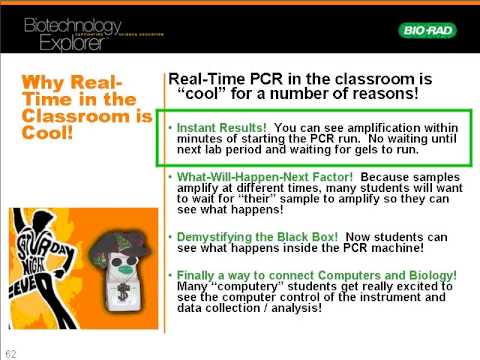
- Instant results allow students to see application within minutes instead of waiting until the next lab period.
- Visualization of amplification allows students to see their own sample curve come up and amplify.
- Engagement with computer technology connects computers and biology, making it exciting for students who are into computers.
- World applicable values allow students to put it on their resume that they learned real-time PCR.
Optimizing and Troubleshooting Real-Time PCR Reactions
- Optimization is important because a well optimized reaction will have precise calculations of quantity based on doubling every cycle.
- Standard curves are ideal for assessing optimization by showing nice evenly spaced points with all replicates essentially lines right on top of each other.
- Multiple primer sets can be designed and empirically tested with a standard curve to find the best primer set before running a temperature gradient to find the best annealing temperature for those primers.
- Troubleshooting is important because it helps reduce frustration, prevents problems at the start, and avoids lost experiment and reagents.
Real-Time PCR Troubleshooting
In this section, the speaker discusses how to troubleshoot real-time PCR reactions. They cover common issues that can arise during the process and provide tips for identifying and resolving them.
Common Issues with Real-Time PCR Reactions
- A good real-time PCR reaction will have nice flat baselines, tightly clustered replicates for the same sample, and evenly spaced dilution series.
- If things go wrong, it could be due to pipetting errors, poorly optimized PCR reactions, evaporating samples, too much or too little DNA, or improperly calibrated instruments.
- If baselines aren't flat like they should be, it could be due to sample evaporation or bubbles in the reaction.
- If dilution series are messed up, there may be pipetting errors or too much/little DNA.
- If curves aren't S-shaped as expected, it could be due to pipetting errors or evaporation. It may also indicate problems with the assay itself or electrical noise on the instrument.
- Multiple peaks in melt curves suggest that more than one product is being amplified. This could be normal at low concentrations but may indicate that primers need to be redesigned.
Teaching Tips
- Proper experimental design is crucial for successful real-time PCR reactions. Positive and negative controls should always be included.
- Real-time PCR can be used as a teaching tool to demonstrate the importance of proper experimental design.
Resources
- Additional resources regarding real-time PCR will be sent along with playback of the webinar in a few days.
- A special offer is available for a free real-time PCR starter kit with the purchase of a real-time instrument.
Animation of PCR and iCycler Software
In this section, Dave answers questions from the audience about the availability of PCR animation for download on Bio-Rad's website. He also clarifies that the software shown in the presentation is CFX Manager software, not iCycler software.
Availability of PCR Animation
- The animation of PCR is available for download on Bio-Rad's website.
- The link to download the animation can be provided in an email.
iCycler Software
- The screenshots shown in the presentation were from CFX Manager software, which is Bio-Rad's newest one.
- The workflow for setting up protocols on iCycler software is almost identical to that of CFX Manager software.
- Any manufacturer's real-time PCR will have a similar basic workflow.
Standard Threshold and CT Value
In this section, Dave explains how a standard threshold is chosen and how CT values can be anything other than whole numbers.
Standard Threshold
- Generally, the software chooses a threshold point where all curves are parallel to each other.
- A threshold can also be chosen manually by using a standard curve or by looking at where curves are parallel to each other.
CT Value
- Amplification curves being logarithmic curves can cross anywhere between individual cycles.
- Curves are smooth so when points on the curve are connected, they fall anywhere between cycle numbers.
- Differences as small as 0.1 CT units (a tenth of a cycle) can be reliably detected in well optimized assays.
Advantages of Real-Time PCR
In this section, Dave explains the practical advantages of real-time PCR over conventional PCR.
- Real-time PCR is useful for quantifying and telling how much there was.
- Conventional PCR is useful for anything where you want to tell what the sample is or what the template was.
- Real-time PCR is needed for quantifying and telling how much there was in cases such as detecting GMO in food or forensics.
Number of Students for GMO Experiment
In this section, Dave answers a question about how many students would typically be involved in a GMO experiment.
- When running the kit in real-time, around 15 students can be split into pairs.
- To ensure that individual students are not left behind due to complexity, it's best to keep work groups under 10.
Purchasing Primers and Synthetic DNA from RT-PCR
In this section, Dave answers questions about purchasing primers and making synthetic DNA from RT-PCR.
Purchasing Primers
- Bio-Rad does not sell or make primers other than those supplied in their kits.
- IDT Technologies and Biosearch Technologies are recommended companies for purchasing primers.
Synthetic DNA from RT-PCR
- There are two types of RT-PCR so it's unclear which one the question refers to.
Setting the Threshold for PCR Analysis
The speaker explains how the maximum curvature approach is used to set a threshold for PCR analysis. They also discuss how this can be automatically set in software like RI cycler software.
Maximum Curvature Approach
- The maximum curvature approach is used to identify how a threshold is set for PCR analysis.
- This approach identifies where the curves are all amplifying the most, which is where the exponential increase is highest.
- The speaker notes that this technical terminology may be difficult to understand, but it's essentially a fancy way of saying where the best place to put the threshold is.
Background Needed for Real-Time PCR
The speaker discusses what background knowledge students need to have in order to understand real-time PCR.
Background Knowledge Required
- The speaker has taught real-time PCR classes to continuing ed students with little background knowledge, including one student who had not finished high school.
- By the end of the class, even this student was comfortable with DNA structure and how real-time PCR works.
- Real-time PCR touches on many different subjects such as DNA structure, graphing, experimental design and chemistry. As such, it can be applicable in many different situations.
Precision Melt Analysis and Thermal Cyclers
The speaker explains whether all machines are capable of precision melt analysis or if a special thermal cycler is required.
Precision Melt Analysis
- A specialized thermal cycler is required for precision melt analysis when trying to differentiate between single base pairs.
- The CFX 96 system can do precision melt analysis, but other systems like the mini opticon or cycler series cannot.
Bubbles in PCR Wells
The speaker discusses how bubbles in PCR wells can be a real issue and how to avoid them.
Bubbles in Wells
- Bubbles can cause problems with real-time PCR data.
- Reverse pipetting is a technique that can help avoid bubbles. This involves pipetting down to the second stop on your pipette to suck up three agents and then pipetting down to the first stop to expel it into the tube.
Turn any video into a summary like this
YouTube links, meetings, lectures. With transcripts, search, and chat.