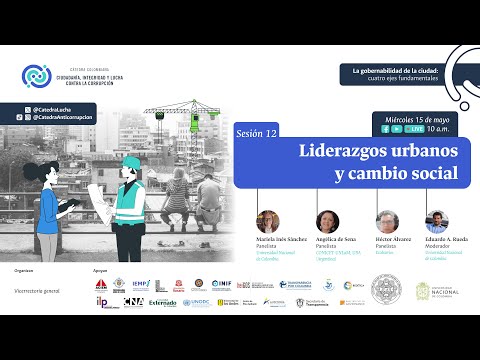
Sesión 12. Liderazgos urbanos y cambio social.
Welcome and Introduction
The session introduces the topic of urban leadership and its transformative role in social life. Three special guests are acknowledged for their expertise in the field.
Guest Introductions
- Professor Mariela Inés Sánchez, with a background in peace, conflict, and development studies.
- Professor Angélica de Siena, specializing in social policies, emotions, and social research methodology.
- Each guest will have 30 minutes to speak before engaging in a dialogue with the audience.
Professor Mariela Inés Sánchez's Introduction
Professor Mariela Inés Sánchez shares her academic background and involvement in peace-related research initiatives.
Key Points
- Holds a master's and a doctorate degree in peace, conflict, and development studies.
- Founder of sociocultural peace initiatives and active in various Colombian universities on conflict, human rights, education, and peace culture.
Technical Difficulties
Technical issues arise as Professor Mariela attempts to share her screen for the presentation.
Key Points
- Initial difficulties sharing screen prompt a shift to another speaker due to technical challenges.
Introduction of Professor Angélica de Siena
Professor Angélica de Siena's background is presented before she begins her discussion on corruption and leadership roles.
Key Points
- Specializes in social policies, emotions, social research methodology; actively involved in academia and research institutions.
New Section
In this section, the speaker introduces the topic of analyzing emotions shaping social policies, particularly focusing on social policies, emotions, and corruption.
Analyzing Emotions in Social Policies
- The discussion delves into research findings regarding urban leaders, corruption, and social change.
- Definition of corruption provided by chat participants: "dishonest and illegal practices by individuals in power for personal gain."
- Consequences of corruption highlighted: economic impacts, emotional consequences like distrust and disillusionment.
- Negative emotional effects of corruption discussed: distrust, disappointment undermining trust in institutions and those in power.
New Section
This part explores further emotional consequences of prolonged and widespread corruption on society.
Emotional Impact of Corruption
- Prolonged corruption leads to feelings of hopelessness and apathy among individuals.
- Corruption can erode societal values, ethics leading to disillusionment and demotivation.
- Sociological perspective on corruption as a social phenomenon rather than individual immorality discussed.
New Section
The focus shifts towards understanding corruption within the context of societal structures and norms.
Societal Perspectives on Corruption
- Corruption viewed as a social phenomenon linked to institutional weakening and abuse of power dynamics.
- Discussion on clientelism, state involvement in accumulation of different forms of capital like symbolic or reputational capital.
New Section
The conversation transitions to exploring the relationship between trust, reciprocity, legality, morality in corrupt actions within societal frameworks.
Trust and Reciprocity in Corruption
- Corrupt actions involve elements of reciprocity based on trust for discretionary acts consolidating abuse.
Understanding Social Policies and Their Impact
In this section, the speaker delves into how resources are distributed unequally due to social policies, leading to acts of corruption. The state defines what constitutes a social problem and determines how to address it, shaping societal actions and practices.
State Influence on Social Issues
- The definition of a social problem by the state influences actions taken to address it, highlighting the performative nature of such definitions.
- The state's role extends beyond resource allocation to defining social problems, ensuring compliance with established norms through symbolic credit.
- State actions shape sociability by influencing emotions like joy and cordiality, reflecting historical and social contexts that impact individual experiences.
Impact of Social Policies
- Social policies regulate not only material aspects but also cognitive and affective dimensions, shaping subjectivities and societal structures.
- Policies operate within social contexts, affecting material conditions and emotional landscapes while regulating social issues.
Evolution of Social Programs in Latin America
This segment explores the rise of social programs in Latin America as a response to increasing poverty levels. These interventions aim to structure sensitivities and mold societal behaviors over generations.
Expansion of Social Programs
- Poverty rates have surged in Latin America, prompting the implementation of numerous social programs targeting vulnerable populations.
- Cash transfer programs have become prevalent across Latin America, illustrating significant government intervention in addressing poverty.
Influence on Sensibilities
- Social interventions organize sensitivities by influencing daily life activities, values, preferences, and temporal-spatial management.
New Section
In this section, the speaker discusses their affiliations with different universities and the qualitative nature of their research, focusing on in-depth interviews with individuals involved in social work programs.
Universidad Affiliations
- The speaker mentions their affiliations with Universidad de Buenos Aires, Universidad de la Matanza, and CONICET for qualitative research.
New Section
The discussion revolves around social work practices, discretionary actions, and corruption within these practices.
Social Work Practices and Corruption
- Social work involves discretionary practices related to program distribution and corruption.
New Section
This part delves into empirical data highlighting discomfort in discussing certain topics openly within social work contexts.
Empirical Findings
- Empirical data reveals discomfort in openly discussing topics due to fear, distrust, manipulation, anger, and suspicion towards both individuals and institutions involved in program distribution.
New Section
The focus shifts to subjects in urban and semi-urban areas defining program distribution hierarchies based on informal preferences.
Program Distribution Hierarchies
- Subjects in territories establish hierarchies based on program receipt despite potentially being recipients themselves.
New Section
This segment explores subjects' preferences shifting towards private interests over public ones due to distrust linked to corruption suspicions.
Shifting Preferences
- Subjects' preferences lean towards private interests over public ones due to corruption-related distrust.
New Section
The discussion centers on tasks required for continued participation in social programs, including labor tasks or community service as forms of reciprocity.
Task Requirements for Social Programs
- Participation in social programs often entails labor tasks or community service as a form of reciprocity for program continuation.
New Section
This part elaborates on how community service can transition into forms of protest as a reciprocal obligation within social programs.
Community Service Evolution
New Section
The speaker discusses issues related to social programs and the challenges faced by individuals trying to work within these systems.
Challenges with Social Programs
- Many people take advantage of social programs, preventing those who genuinely want to work from doing so.
- Individuals are offered promotions where they receive benefits without working, but face complications if they wish to start working.
- Capacitation programs focus on creating solidarity projects, but participants express concerns about the practicality and usefulness of the training provided.
- Issues arise when individuals transition from social programs to formal employment, leading to financial difficulties and loss of benefits.
- Attendance at social protests or marches is mandatory for program participants, with penalties for non-compliance, highlighting coercive elements within the system.
New Section
The discussion delves into corruption and discretionality within social welfare systems, impacting both beneficiaries and administrators.
Corruption in Social Programs
- Corruption manifests through demands for payments or penalties for non-compliance with program requirements.
- Discretionality plays a significant role in program administration, affecting how benefits are distributed among recipients.
- The concept of discretionality extends beyond administrators to beneficiaries themselves, influencing their interactions within the system.
New Section
Fear and uncertainty surrounding potential political changes impact individuals' participation in social programs and community activities.
Impact of Political Uncertainty
- Participants express fear regarding potential changes after elections, affecting their engagement in community events.
- Trust is eroded due to political uncertainties, leading to increased fear and complexity in social interactions.
New Section
The importance of trust in societal interactions is explored alongside its relationship with fear and uncertainty.
Significance of Trust
- Trust forms the basis for effective social interactions and organizational functioning.
- Trust influences relationships between individuals as well as institutions, playing a crucial role in maintaining connections.
New Section
The dynamics between trust and fear are examined within societal structures, emphasizing their impact on individual behaviors.
Dynamics of Trust and Fear
- Trust serves as a key organizer in interpersonal relationships and institutional frameworks.
Desconfianza y Miedo en Relación a Programas Sociales
The discussion delves into the societal structures and social relationships that influence perceptions of social programs, particularly during the pandemic. There is a strong emphasis on the erosion of trust towards institutions, officials, and political entities due to feelings of distrust and fear.
Desconfianza en Programas Sociales
- During the pandemic and quarantine periods, distrust towards social programs intensified.
- Trust breakdown extends to parents, institutions, officials, and politics, leading to institutional fragility.
- Discretionary actions become more prevalent in the face of institutional weakening.
- Social programs become associated with distrust and fear, contributing to loss of confidence in institutions and officials.
Reconstruyendo la Confianza y Limitando el Miedo
The focus shifts towards rebuilding trust and addressing fear as essential components for future societal change. Emphasizing individual and collective responsibility alongside truthful practices to foster hope and enhance trust.
Reconstrucción de Confianza
- Rebuilding trust requires emphasizing individual and collective responsibility through truthful practices.
- Truthful practices lead to hope generation and increased confidence through responsible actions.
Impacto de Percepciones en Cambio Social
Exploring how recipients' perceptions of social policies can hinder social change processes. Highlighting the significance of trust-building efforts in mitigating negative sentiments for effective societal transformation.
Percepciones y Cambio Social
- Recipients' feelings impact policy reception; negative emotions can impede social progress.
Liderazgos y Ciudadanía para la Paz
In this section, the speaker introduces their work on leadership and citizenship for peace within institutional and social entities. They discuss their involvement in a research group on Comparative Constitutionalism and an NGO focused on territorial challenges for peace.
Leadership and Citizenship Initiatives
- The speaker highlights the work of the Corporación Sentire and the Red Retos Territoriales para la Paz in addressing peace-related issues at an international level.
- Emphasis is placed on empowering society towards achieving peace, particularly focusing on youth, families, institutions, and individuals as key players in building peace.
- The challenge lies in bridging the gap between societal aspirations for peace and the inability of states to guarantee lasting peace, prompting a call to action for realizing human rights to peace.
Escuela Sociocultural de la Paz Pedagógica
This segment delves into the concept of a sociocultural school of pedagogical peace. The speaker outlines three thematic blocks: sociocultural school of pedagogical peace, social experiences and research insights, and reflections on pertinent topics.
Sociocultural School of Pedagogical Peace
- The focus is on developing a holistic approach to education for peace by integrating cultural elements that shape societal norms and values.
- A collaborative knowledge-sharing platform involving students, researchers, and colleagues is proposed to align educational discourse with societal needs.
- Viewing life itself as a continuous learning process towards peaceful coexistence underscores the importance of community integration based on shared values.
Empowering Youth for Social Change
This part emphasizes empowering youth as pivotal agents for social transformation. It underlines the significance of engaging youth directly due to their potential impact on shaping future narratives.
Empowering Youth Initiatives
- The imperative role of youth in driving positive change is underscored as they hold the key to reshaping societal dynamics through innovative solutions.
- Addressing pressing issues such as environmental concerns, structural violence, basic needs fulfillment, immigration challenges reflects a comprehensive approach towards nurturing empowered youth.
New Section
In this section, the speaker discusses the importance of creating a social fabric based on justice and equality, emphasizing the role of youth as agents of social change over current politicians.
Creating a Just Social Fabric
- Emphasizes the need for youth to be at the forefront of social change.
- Criticizes the commercialization of peace by governments, advocating for an ethical approach to peacebuilding.
- Reflects on societal divisions within cities and regions, highlighting the need for unity and collective action among youth.
New Section
This part delves into the complexities surrounding peacebuilding efforts, addressing challenges such as political hypocrisy and educational discrepancies in promoting democratic values.
Challenges in Peacebuilding
- Critiques politicians who lack genuine understanding of peace, leading to inconsistencies in promoting peaceful coexistence.
- Discusses cognitive dissonance in societal messages about democracy, citing examples of contradictory behaviors among educators.
New Section
The focus here is on learning from grassroots leaders and communities to develop a pedagogy centered on internal growth and authenticity rather than external influences.
Learning from Grassroots Movements
- Advocates for an inward-outward learning approach based on community experiences and voices.
- Highlights the continuous evolution of knowledge through self-reflection and group discussions within research teams.
New Section
This segment explores the importance of developing unique theories and approaches to peace education tailored to local contexts rather than replicating foreign models.
Tailoring Peace Education Locally
- Stresses the significance of crafting original theories rather than adopting pre-existing foreign frameworks.
Justicia y Equidad en las Comunidades
The speaker discusses the importance of justice, equality, and equity within communities, emphasizing the need for patience, tolerance, and assistance to promote these values effectively.
Justicia y Equidad
- Communities and their leaders are deeply connected to concepts of equality, equity, patience, tolerance, and helping others.
- Transparency norms imposed by the state are essential but need support from other sources to function effectively.
- Research results demonstrate coherence in actions taken towards justice and equity.
- Society is built on small daily acts of kindness and initiatives that often go unnoticed.
Formación y Políticas de Estado
The discussion shifts towards education and state policies regarding transparency and peacebuilding efforts.
Formación y Políticas
- Collaboration with organizations like CAPAZ for courses on territorial challenges for peacebuilding in Colombia.
- Exploring socio-juridical obstacles hindering peace formation nationally and internationally.
- Building alliances with various organizations globally to foster knowledge exchange for peacebuilding efforts.
Construcción de Escenarios para la Paz
The focus is on creating scenarios for peace through educational initiatives involving leaders from diverse backgrounds.
Escenarios para la Paz
- Courses attract social leaders from Colombia and Latin America to explore peace-building from a positive perspective.
- Emphasizing strengths rather than shortcomings in peace education to uncover hidden treasures within individuals and communities.
- Formation of an international network led by social leaders promoting pedagogy of peace.
Alianza Internacional para la Paz
Establishing an international alliance dedicated to addressing territorial challenges for peace through collaborative efforts across academia, social sectors, and corporations.
Alianza Internacional
- Creation of the International Association for Territorial Challenges for Peace focusing on elevating educational levels in communities.
Detailed Discussion on Empowerment and Peace Education
In this section, the speaker discusses the importance of empowerment and peace education, highlighting initiatives aimed at empowering individuals through knowledge sharing and collaboration.
Initiatives for Empowerment and Peace Education
- The organization aims to create a toolbox with leaders from various regions to develop pedagogies for human rights and peace education. They plan to co-author a book with these leaders to showcase their work and empower them.
- Many of the participants in these initiatives are university students who seek to transform both urban and rural environments, focusing on fostering peace within themselves, with others, and with the environment.
- The organization leads groups of young people to create knowledge centered around peace potentials within each individual. This approach is also extended to female leaders and heads of families in different regions.
- Efforts extend beyond academic settings into communities where young people replicate this knowledge. For instance, in Usme, youth are trained in peace-related topics while simultaneously engaging with local communities.
Empowering Youth for Social Change
This segment delves into the role of youth as leaders in driving social change through community engagement and knowledge dissemination.
Youth Leadership for Social Transformation
- Youth participants not only engage in learning but also actively work within their communities, spreading acquired knowledge. This cascading effect ensures broader community involvement in peace-building efforts.
Fostering a Culture of Peace Through Education
The discussion shifts towards leveraging educational spaces to cultivate a culture of peace by integrating diverse perspectives and methodologies.
Cultivating Peace Through Education
- Emphasizes the importance of utilizing learnings from resilience-focused peace processes conducted by social activists across various contexts. Advocates for a collective pedagogy shift towards inclusive research paradigms that prioritize individual inclusion and community representation.
Promoting Compassion and Hope for Societal Transformation
Focuses on promoting virtues like compassion and hope as catalysts for societal transformation towards peaceful coexistence.
Virtues for Societal Transformation
- Urges a paradigm shift towards compassion-driven approaches that acknowledge societal challenges while fostering hope for collaborative efforts towards creating a better world. Emphasizes empowering youth in policy-making processes at local, national, and regional levels.
Shifting Narratives Towards Peaceful Coexistence
Advocates for reshaping narratives around violence towards narratives rooted in compassion, empathy, and collective empowerment.
Narrative Transformation Towards Peace
Centrarse en la Construcción de Procesos Educativos
The discussion focuses on the importance of paying attention to the construction of educational processes rather than just peripheral aspects.
Prioritizing Educational Processes
- Emphasize focusing on the construction of educational processes.
- Introduce a leader who has worked in Bogotá and resisted relocation policies.
- Highlight Hector's dedication to defending his community and territory.
- Discuss the ecobarrio project as a resistance to state resettlement policies.
- Hector shares his experience living in an ecobarrio and fighting for social justice.
Exploring Urban Leadership and Resistance
The conversation delves into urban leadership, social struggles, and resisting dominant narratives.
Urban Leadership Insights
- Hector discusses choosing social struggle over compromising principles for political gain.
- Ecobarrios are seen as tools for new narratives in contesting city rights and building urban leadership.
- Ecobarrios serve as physical and alternative instruments connecting nature with human relations.
- Highlight the role of ecobarrios in generating resistance against city models, territorial planning, and policies.
Revisiting Concepts of Community and Trust
The dialogue reflects on redefining notions of community post-pandemic amidst institutional distrust.
Rethinking Community Dynamics
- Call for academia to redefine concepts like community post-pandemic.
Ecobarrios and Community Resistance
In this section, the speaker discusses the concept of ecobarrios and their role in supporting communities to face challenges. They also touch upon the resistance efforts in Cerros Orientales against displacement and for sustainability.
Ecobarrios as Centers of Resistance
- The Cerros Orientales community is part of a social and political movement resisting displacement and striving for sustainability.
- Despite being recognized by the state, legal limbo persists for Cerros Orientales, highlighting ongoing struggles.
- Participation in the Cerros table connects different city territories and social organizations in collective resistance.
- Communities like Cerros engage in contestation processes for urban rights beyond traditional social movements.
Broadening Resistance Efforts
- Various social movements resist gentrification, defend natural resources like rivers and wetlands, and oppose mining activities.
- Recent resistance includes opposing airport expansion, emphasizing the interconnectedness of social processes.
Challenges of Engagement and Advocacy
This segment delves into personal experiences with engagement in community advocacy efforts, highlighting the complexities involved in effecting change.
Navigating Advocacy Spaces
- Engaging in ecological structures within cities involves advocating from peripheral positions while addressing environmental concerns.
- Personal experiences show a shift towards engaging with broader societal issues beyond immediate community concerns.
Struggles with Institutional Engagement
- Transitioning from individual to collective action requires active participation in citizen engagement spaces to find allies for shared struggles.
- Holding roles like district planning councilor provides information but may not directly improve community conditions.
Collective Vision for Urban Development
- Understanding that individual actions complement collective efforts is crucial for shaping desired urban models through territorial advocacy.
Reality vs. Conceptualization of Ecobarrios
Here, discrepancies between idealized concepts like ecobarrios and their practical implementation are explored, shedding light on community disillusionment with misrepresented urban development models.
Deceptive Urban Models
- Ecobarrio concepts often clash with actual urban realities, leading to distrust between communities and institutions due to unmet expectations.
Community Realities vs. State Narratives
- Communities' disillusionment arises when state-promoted two-dimensional eco-city ideals diverge significantly from lived experiences.
Rural-Urban Dynamics
Detailed Discussion on Long-Term Planning and Social Engagement
In this section, the speaker delves into the importance of understanding the complexity of urban areas, breaking away from traditional perceptions, and engaging in long-term planning for social progress.
Understanding Urban Complexity
- The significance of urban areas lies in their flatness, challenging the common perception that Bogotá is solely Andean or mountainous.
Anticipating Hidden Agendas
- New social movements require insights to anticipate hidden agendas not publicly disclosed by governmental bodies.
Long-Term Visioning with Key Stakeholders
- Engaging with influential figures like business leaders to envision the future of Bogotá and its region up to 2052.
Balancing Development Perspectives
- Highlighting the need to bridge perspectives between rich and poor sectors for sustainable city and regional planning.
Importance of Long-Term Thinking
- Emphasizing the necessity for academia and social organizations to think beyond short-term goals towards common long-term objectives.
Strategic Community Development and Institutional Dynamics
This segment explores how communities interact with institutions, emphasizing power dynamics and community-driven initiatives.
Shifting Focus to Long-Term Goals
- Advocating for a shift towards long-term peace-building strategies over immediate concerns.
Community Engagement Challenges
- Discussing how powerful stakeholders prioritize long-term regional development regardless of political ideologies or peace processes.
Building Collective Agendas
- Encouraging collaboration among entrepreneurs, popular sectors, and academia to construct shared long-term agendas for societal benefit.
Biopolitical Instruments in Community Governance
This part sheds light on how institutional structures can co-opt community initiatives through biopolitical mechanisms.
Co-optation of Community Initiatives
- Illustrating how institutions transform community proposals into instruments of control through extensive regulations.
Loss of Trust in Institutions
Understanding New Social Processes and Ecovillages
In this section, the speaker discusses the importance of rethinking discourses in new communalities and processes, emphasizing the impact of global experiences on local social movements.
Rethinking Discourses in Social Movements
- Emphasizes the need to analyze and reflect on the discourses within social movements to avoid self-impacting narratives.
- Questions what Latin American processes are communicating to the global North and highlights the significance of narratives that interest international academia.
Ecovillages as Alternative Models
- Defines ecovillages not as alternative models but as alternatives to current city models, focusing on nature-based solutions for peacebuilding.
- Discusses how ecovillages offer a different lifestyle promoting peace through healthy environments and sustainable practices.
The Role of Ecovillages in Peacebuilding
- Links peacebuilding with territorial organization, emphasizing the need for spaces where armed actors can engage with nature differently.
- Highlights that peace involves creating assertive territorialities, suggesting that ecovillages can generate innovative urban proposals.
Human Dimension in Ecovillage Development
This part delves into the human aspect within ecovillage development, emphasizing cultural and natural elements essential for their success.
Essential Elements of Ecovillages
- Identifies three crucial elements of ecovillages: human aspects, cultural dimensions, and natural surroundings.
Importance of Human Engagement
- Stresses that ecovillages rely on human involvement for effective functioning, highlighting the fundamental role people play in shaping eco territories.
Understanding Human-Centric Approaches
Detailed Discussion on Community Engagement and Education
In this segment, the speaker delves into the challenges faced by communities due to lack of follow-up after initial engagements, emphasizing the importance of building trust between academia and communities for sustainable impact.
Importance of Follow-Up in Community Engagements
- Communities express reluctance due to lack of sustained engagement post-initial interactions.
- Emphasizes the need for educators to rethink their approach towards community interventions to rebuild trust in institutions and academia.
- Discusses the significance of understanding and respecting diverse cultures within different localities for effective educational initiatives.
- Highlights the importance of biocultural diversity in education, citing examples from various localities like San Cristóbal and Bogotá.
- Critiques the division between youth and adults during social movements, advocating for intergenerational collaboration for social justice.
Promoting Inclusivity and Collaboration in Society
This part focuses on promoting inclusivity across different societal groups, advocating against fragmentation based on age or gender while stressing the need for collective action.
Fostering Inclusivity and Unity
- Challenges societal fragmentation based on age or gender, calling for a unified approach towards communal goals.
- Advocates for holistic participation across demographics to avoid further divisions within society.
- Stresses the importance of collective efforts transcending age or gender boundaries for communal well-being.
Understanding State Dynamics and Citizen Empowerment
The discussion shifts towards analyzing state structures, citizen empowerment, and the necessity of critical engagement with governance systems.
State Dynamics and Citizen Empowerment
- Urges moving beyond localized struggles towards understanding broader state dynamics for effective citizen empowerment.
- Explores concepts like "tragedy of commons" concerning citizen engagement with governance structures.
Linking Community to City Development Planning
The discussion revolves around the challenges of aligning public management with community needs in city development planning, emphasizing transparency and trust-building.
Aligning Public Management with Community Needs
- Lack of transparency leads to mistrust between the community and public institutions.
- Discrepancies in proposed development plans create distrust and disillusionment among the community.
- Participation without proper budget allocation or clear priorities breeds further mistrust and disengagement.
Building Trust for Sustainable Governance
The importance of establishing trust through genuine practices and accountability for sustainable governance is highlighted.
Establishing Trust for Sustainable Governance
- Building trust is a lengthy process, especially in regions with high levels of poverty and distrust.
- Emphasizing coherence between written norms and practical implementation is crucial for effective governance.
Long-Term Perspective in Community Empowerment
Exploring strategies for fostering long-term community empowerment within the framework of public institutional planning.
Fostering Long-Term Community Empowerment
- Community empowerment requires continuous effort over generations, necessitating a shift towards long-term planning by public entities.
- Public institutions should prioritize sustained engagement with communities, listening to their needs, and involving them as central stakeholders for effective planning.
Challenges in Institutional Trust-Building
Addressing the challenges related to institutional trust-building processes essential for comprehensive peacebuilding initiatives.
Overcoming Challenges in Institutional Trust-Building
- Lack of institutional commitment hampers trust-building efforts, requiring enhanced education and alignment with regional needs.
Desarrollo de Comunidades y Políticas Públicas
In this section, the discussion revolves around the importance of community involvement in policy-making processes and the role of institutions in supporting communities for long-term development.
Community Involvement in Policy-Making
- Institutions should not solely dictate long-term agendas; communities must actively participate in shaping their own future.
- Long-term community agendas should be facilitated by institutions to ensure sustainable development.
- Collaboration between institutions and communities is essential to negotiate regional and national development plans based on community needs.
Balancing Communities and Institutions
- The relationship between communities and institutions is symbiotic; both rely on each other for support and progress.
- Weak institutions in Latin America pose challenges as they struggle to sustain communities effectively.
Importance of Strong Institutions
This part emphasizes the significance of robust institutional frameworks in supporting communities and ensuring continuity in development efforts.
Role of Strong Institutions
- Rigid institutions are crucial as they provide stability, limit discretion, and safeguard community initiatives from political changes.
- Preference for strong institutions stems from their ability to prevent disruptions caused by political shifts that can undermine community progress.
Academia's Role in Leadership Development
The focus here is on academia's responsibility in nurturing transformative leaders amidst contemporary challenges, particularly within urban settings.
Academia's Responsibility
- Academics play a vital role by conducting research that intervenes meaningfully in territories, contributing to leadership consolidation.
- Educators have a duty to ensure genuine learning experiences without compromising standards or enabling student failure through leniency.
Discussion on Academic Curricula and Social Movements
In this segment, the speakers discuss the importance of aligning academic curricula with real societal issues and the need for practical, updated approaches in education.
Importance of Updated Academic Curricula
- Emphasize research projects related to local social movements for practical application.
- Advocate for a balance between theoretical knowledge and practical understanding in academic work.
- Share experiences of engaging students in researching current social movements for a deeper understanding.
Integration of Realities into Education
- Highlight the significance of incorporating real-world issues faced by communities into academic study.
- Stress the need to empower social movements through academia by bridging theory with practice.
Empowerment Through Collective Truth Construction
The conversation shifts towards the collective construction of truth, emphasizing humility, community knowledge, and resistance strategies.
Collective Truth Construction
- Discuss truth as a collective construct that involves community knowledge and collaboration.
- Acknowledge the importance of combining technical expertise with community wisdom for effective resistance efforts.
Humility and Knowledge Exchange
- Address power dynamics between academia and communities, advocating for humility and mutual learning.
Turn any video into a summary like this
YouTube links, meetings, lectures. With transcripts, search, and chat.