Gastrin || Function and mechanism of action
New Section
This section provides an introduction to gastrin, its function, mechanism of action, and factors that regulate its secretion.
What is Gastrin?
- Gastrin is a peptide hormone found in the gastrointestinal system.
- Its major function is to secrete gastric HCl from the parietal cells.
- Gastrin also aids in gastric motility and contraction of the stomach.
Forms of Gastrin
- Gastrin can exist in three different forms:
- Big gastrin (34 amino acids long)
- Gastrin 17 or little gastrin (17 amino acids long)
- Mini gastrin (14 amino acids long)
Production of Gastrin
- Gastrin is produced by G cells located in the duodenum and pyloric antrum of the stomach.
- It is encoded by the gas gene located on the 17th chromosome in humans.
- Translational modification of progastrin leads to the production of big gastrin, mini gastrin, or little gastrin.
Factors Stimulating Gastrin Secretion
- Partially digested proteins and aromatic amino acids like tyrosine, phenylalanine, or tryptophan stimulate gastrin secretion.
- Hypercalcemia, stomach distention, and vagal nerve stimulation also increase gastrin secretion.
Factors Inhibiting Gastric Secretion
- Presence of excessive HCl feedback prevents gastrin secretion.
- Hormones such as GIP, secretin, VIP, glucagon inhibit gastrin secretion.
New Section
This section explains how gastrins stimulates parietal cells to secrete hydrochloric acid and its other functions in the gastrointestinal system.
Mechanism of Gastrin Action
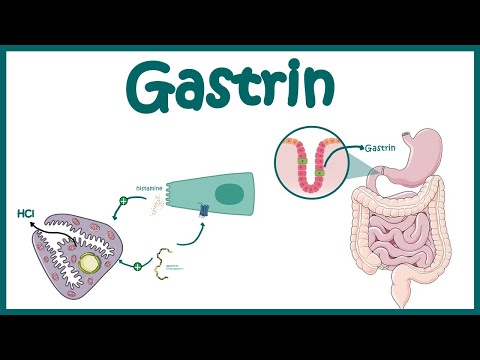
- Gastrin stimulates parietal cells to secrete hydrochloric acid directly.
- It can also indirectly work on enterochromaffin-like cells through CCK2 or gastrin receptors, leading to the secretion of histamine.
- Histamine further stimulates parietal cells to secrete more HCl.
Other Functions of Gastrin
- Gastrin helps chief cells secrete pepsinogen, aiding in protein digestion.
- It increases enteric muscle mobility and promotes stomach contraction.
- Gastrin strengthens the anterior contraction against the pylorus and relaxes the pyloric sphincter, increasing gastric emptying rate.
- It induces pancreatic secretion and helps in gallbladder emptying.
New Section
This section summarizes what has been learned about gastrin secretion, factors affecting its secretion, and its functions in the gastrointestinal system.
Summary
- Gastrin is a peptide hormone that stimulates gastric HCl secretion from parietal cells.
- It is produced by G cells in the duodenum and pyloric antrum of the stomach.
- Factors stimulating gastrin secretion include partially digested proteins, aromatic amino acids, hypercalcemia, stomach distention, and vagal nerve stimulation.
- Presence of excessive HCl feedback and certain hormones inhibit gastrin secretion.
- Gastrin acts directly on parietal cells to stimulate HCl secretion or indirectly through histamine production.
- Its other functions include aiding protein digestion, promoting stomach contraction and gastric emptying rate modulation, inducing pancreatic secretion, and facilitating gallbladder emptying.