The Vortex Flow Measuring Principle
Introduction
The transcript introduces the concept of flow measurement based on the vortex principle.
Flow Measurement Based on Vortex Principle
- Different principles are required for measuring fluids flowing through pipes with completely different properties.
- One method is flow measurement based on the vortex principle.
- Leonardo da Vinci observed how vortices form in flowing water, and Theodore von Kármán described the physical laws that govern how these vortices take shape some 400 years later.
How Vortex Flowmeters Work
This section explains how vortex flowmeters work.
Bluff Body and Mechanical Sensor
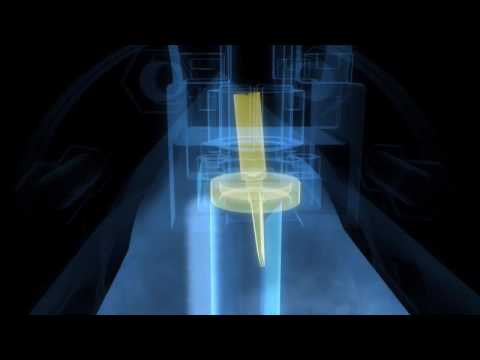
- A bluff body is located in the middle of the pipe inside each vortex flowmeter. It is a kind of obstruction that disturbs the flow.
- Downstream from the bluff body is a mechanical sensor which can register even the tiniest pressure differences in the flowing fluid.
Formation of Vortices
- As soon as fluid starts to move and reaches a certain flow rate, vortices gradually appear downstream of the bluff body.
- Zones of high or low pressure now appear downstream and thus create a phenomenon known as "the Kármán vortex street."
Measuring Total Flow
- The distance between two consecutive vortices corresponds to a defined volume of fluid; therefore, total flow can be calculated by counting the vortices that pass.
- The higher the flow velocity, the higher the measured frequency of vortices.
Applications and Enhancements
This section discusses the applications and enhancements of vortex flowmeters.
Low Velocity Applications
- In some applications, the velocity is too low for perceptible vortices to form. However, the velocity can be increased simply by installing a vortex meter that has a reduced cross-section. This modification does not affect measuring accuracy.
Temperature Measurement
- Functionality can be enhanced by incorporating optional temperature measurement into the sensor.
- A configuration like this – together with a built-in flow computer – can calculate temperature-dependent mass or energy flow. This feature is particularly important in industrial processes involving saturated steam or gases.
Conclusion
The transcript concludes by highlighting Endress+Hauser's vortex flowmeters as the world's most robust and reliable with a lifelong calibration factor. They have won several prestigious awards and widespread acclaim.