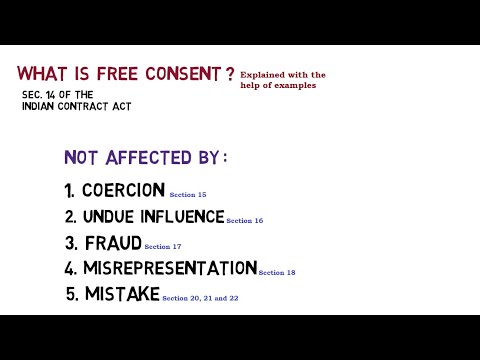
Free consent (Factors affecting consent) Section 14 of Indian Contract Act
Free Consent in Indian Contract Act
In this video, Ruth Nish Parikh explains the concept of free consent as one of the essential elements of a valid contract according to section 10 of the Indian Contract Act. She defines free consent as not being affected by coercion, undue influence, fraud, misrepresentation, and mistake.
Coercion
- Coercion is defined under section 15 of the Indian Contract Act as compelling someone to do something by using force or threats.
- Consent is caused by coercion when pressure is put on parties to obtain consent through prohibited actions or unlawfully detaining property.
- If a contract is obtained through coercion, it will be considered void.
Undue Influence
- Undue influence occurs when one party has a dominant position over another party in a relation and uses that dominance to obtain an unfair advantage.
- A person is deemed to be in a position to dominate the will of another where he has real or apparent authority or where they are in a fiduciary relation to each other.
- If there is no unfair advantage, it is not undue influence.
- If consent is obtained through undue influence, the contract will be considered void.
Misrepresentation
- Misrepresentation means misstatement of a fact material to the contract.
- There are three types of misrepresentations: unwarranted statements, breach of duty inducing mistake about the subject matter and inducing mistake about any law relevant to the subject matter.
- Unwarranted statement occurs when someone makes any statement without proper information but believes it to be true.
- Breach of duty involves no intention to deceive anyone but there's always gain for an advantage for making such statements.
- Inducing mistake about any law relevant to the subject matter is when someone makes a statement that induces another party to enter into a contract by mistake about any law relevant to the subject matter.
- If consent is obtained through misrepresentation, the contract will be considered void.
Mistake
- Mistake occurs when both parties are under a mistaken belief regarding the subject matter of the contract.
- There are two types of mistakes: mutual and unilateral.
- Mutual mistake occurs when both parties are under a mistaken belief regarding the subject matter of the contract.
- Unilateral mistake occurs when only one party is under a mistaken belief regarding the subject matter of the contract.
- If consent is obtained through mistake, the contract will be considered void.
Conclusion
In conclusion, free consent is an essential element of a valid contract in India. Consent must not be affected by coercion, undue influence, fraud, misrepresentation or mistake. If any of these factors affect consent, then the resulting contract will be considered void.
Free Consent in Contract Law
This video discusses the essential element of free consent in a valid contract. It defines free consent and explains how it can be affected by factors such as fraud, misrepresentation, coercion, undue influence, and mistake.
Definition of Free Consent
- Free consent is an essential element of a valid contract.
- It means that both parties must enter into the agreement willingly and without any external pressure or influence.
Factors Affecting Free Consent
- Fraud: making a false statement with the intention to deceive someone or induce them to enter into a contract.
- Misrepresentation: making a statement that is not true even when the person making it knows that it is false.
- Coercion: using force or threats to make someone agree to a contract.
- Undue Influence: taking advantage of someone's position of weakness or trust to influence their decision-making process.
Types of Mistakes
- Mistake of Fact: when one or both parties are mistaken about a fact related to the contract.
- Unilateral Mistake: when only one party is mistaken about a fact related to the contract.
- Bilateral Mistake: when both parties are mistaken about a fact related to the contract.
- If there is bilateral mistake, then the agreement is void.
- Mistake of Law: when one or both parties are mistaken about the law related to the contract.
- Mistake of Indian Law
- Mistake of Foreign Law
- If there is mistake of foreign law, then it will be treated as mistake of fact.
Conclusion
In conclusion, this video emphasizes that free consent is an essential element for any valid contract. The video also highlights various factors affecting free consent such as fraud, misrepresentation, coercion, undue influence, and mistake.