Future Computers Will Be Radically Different (Analog Computing)
The Resurgence of Analog Technology
In this section, the speaker introduces analog computers and explains how they differ from digital computers.
What are Analog Computers?
- Analog computers use voltage to solve mathematical problems.
- They are incredibly powerful computing devices that can complete a lot of computations fast.
- With an analog computer, you can pass a current through a resistor, and then the voltage across this resistor will be I times R. So effectively, you have multiplied two numbers together.
Advantages and Disadvantages of Analog Computers
- Analog computers are energy-efficient and fast.
- However, they are not general-purpose computing devices like digital computers.
- Since the inputs and outputs are continuous, exact values cannot be inputted or outputted.
- There is always some variation in the exact value of components like resistors or capacitors which leads to about 1% error.
Why Are Analog Computers Making a Comeback?
- Artificial intelligence is setting the scene for a resurgence of analog technology.
The Perceptron: A Basic Model for AI
In this section, the speaker discusses Frank Rosenblatt's perceptron model for artificial intelligence.
How Neurons Work
- An individual neuron can either fire or not; its level of activation can be represented as a one or zero.
- The input to one neuron is the output from other neurons with varying connection strengths (weights).
- Some connections between neurons are excitatory (positive weights), while others are inhibitory (negative weights).
- To figure out whether a particular neuron fires, we take the activation of each input neuron and multiply by its weight before adding them all together. If their sum is greater than some number called the bias, then the neuron fires.
The Perceptron
- Rosenblatt's perceptron had 400 photocells arranged in a square grid to capture a 20 by 20-pixel image.
- Each pixel is an input neuron with its activation being the brightness of the pixel.
- All of these neurons are connected to a single output neuron, each via its own adjustable weight.
- The goal of the perceptron was to reliably distinguish between two images like a rectangle and a circle.
Training the Perceptron
- To achieve this, the perception had to be trained.
The Perceptron Algorithm
This section discusses the perceptron algorithm and how it updates weights based on whether the output neuron fires or not.
The Perceptron Algorithm
- The perceptron algorithm adjusts weights based on whether the output neuron fires or not.
- If the output neuron doesn't fire, no change is made to the weights. But if it's wrong, then the weights are adjusted.
- To modify the weights, you simply add or subtract input activations from the weights depending on whether the output neuron fired when it should have or shouldn't have.
ALVINN - One of The First Self-driving Cars
This section discusses ALVINN, one of the first self-driving cars that used an artificial neural network called ALVINN to steer.
ALVINN - One of The First Self-driving Cars
- ALVINN was one of the first self-driving cars that used an artificial neural network called ALVINN to steer.
- It had a hidden layer of artificial neurons between input and output layers.
- To train ALVINN, a human drove providing correct steering angles for given input images and all weights in neural network were adjusted through training so that its output better matched that of human driver using backpropagation method for adjusting weights.
- Despite these advances, artificial neural networks still struggled with seemingly simple tasks like telling apart cats and dogs.
ImageNet
This section discusses ImageNet, a database of 1.2 million human-labeled images that was created to train artificial neural networks.
ImageNet
- Fei-Fei Li created ImageNet, a database of 1.2 million human-labeled images from 2006 to 2009.
- From 2010 to 2017, ImageNet ran an annual contest called the ImageNet Large Scale Visual Recognition Challenge where software programs competed to correctly detect and classify images into different categories including dog breeds using artificial neural networks.
- The neural network competing in this competition would have an output layer of neurons each corresponding to a category of object that could appear in the image. If the image contains say a German shepherd then the output neuron corresponding to German shepherd should have the highest activation.
The Rise of Neural Networks
This section discusses the rise of neural networks and how they have improved over time.
AlexNet: A Game Changer
- AlexNet was an artificial neural network from the University of Toronto that revolutionized image recognition.
- It consisted of eight layers and 500,000 neurons, which made it much larger and deeper than previous networks.
- Training AlexNet required 60 million weights and biases to be adjusted using a training database. Processing a single image required 700 million math operations.
- The team used graphical processing units (GPUs), traditionally used for driving displays, to train AlexNet due to their fast parallel computations.
Limitations of Neural Networks
- As neural networks become larger, energy consumption becomes a problem. Training a neural network requires as much electricity as three households consume in a year.
- The Von Neumann Bottleneck is another issue with deep neural networks. Most of the time and energy goes into fetching weight values rather than doing computation.
- Moore's Law is also becoming a limitation since the size of transistors is approaching the size of an atom.
Analog Computing
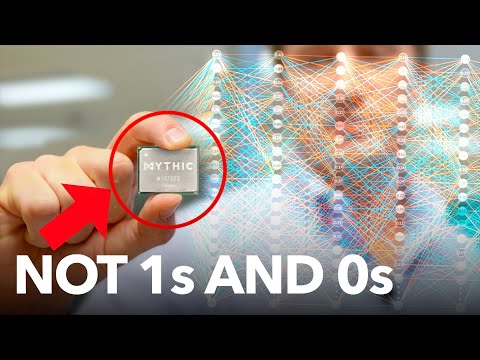
- Mythic AI is creating analog chips to run neural networks.
- These algorithms can be run on digital computers, but matrix multiplication takes place in the analog domain on Mythic's chips.
- Mythic repurposed digital flash storage cells to use them as variable resistors instead of on/off switches. A single flash cell can multiply two values together: voltage times conductance.
Analog vs Digital Computing
In this section, the speaker discusses the differences between analog and digital computing and how they relate to artificial intelligence.
Analog vs Digital
- Analog computers are better suited for certain tasks than digital computers.
- AI workloads can be deployed on analog chips instead of big hardware like digital systems.
- Examples of where analog chips could be used include security cameras, autonomous systems, and inspection equipment for manufacturing.
- Challenges with using analog circuitry include distortion that can occur during processing.
The Future of Computing
- While digital computing has been the norm for the past century, analog computing may become more prevalent in the future.
- Our brains are both digital and analog, which suggests that true artificial intelligence may require the power of analog computing.
Learning with Brilliant
In this section, the speaker promotes Brilliant as a website and app that helps users learn about problem-solving and neural networks.
Brilliant Features
- Brilliant is a website and app that engages users in problem-solving activities.
- They offer a course on neural networks that allows users to test how they work for themselves.
- Lessons are interactive and get progressively harder as users progress through them.
- If users get stuck, there are helpful hints available.
The transcript includes music at various points, but it does not contain any relevant information. Therefore, it has been excluded from the notes.
Turn any video into a summary like this
YouTube links, meetings, lectures. With transcripts, search, and chat.