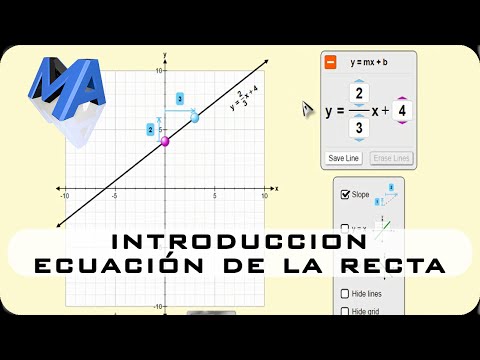
Introducción a la ecuación de la recta, fundamentos
Introduction to the Equation of a Line
Understanding the Basics of Line Equations
- The course begins with an introduction to the equation of a line, emphasizing its importance and foundational concepts.
- Every line has an inclination; lines can be steep, less steep, or horizontal. This inclination is crucial for understanding their behavior.
- Lines can either ascend or descend when viewed from left to right. The speaker illustrates this by describing how certain lines rise while others fall.
Key Components of Line Equations
- The ordinary equation of a line is introduced as y = mx + b , where m represents the slope (inclination) and b indicates the y-intercept (where the line crosses the y-axis).
- The speaker demonstrates how changing the position of a line affects its y-intercept, using specific numerical examples to clarify this concept.
Exploring Slope and Angles
- Slope not only indicates inclination but also helps calculate angles formed with the x-axis. For instance, applying tangent to a slope value provides this angle.
- It’s noted that most lines intersect both axes except for horizontal and vertical lines, which only intersect one axis each.
Recap on Inclination and Intersections
- A summary emphasizes that all lines have inclinations—some rise while others fall—and most will intersect both axes unless they are horizontal or vertical.
- Visualizing these concepts through relatable analogies (like riding a bicycle uphill or downhill) aids in understanding how slopes function in real life.
Conclusion and Next Steps
- The introduction concludes with an invitation to explore further topics related to line equations, including detailed discussions on slope calculations and graphing techniques.