Líquidos y electrolitos fisiología | Líquidos y compartimentos corporales
Understanding Body Water Distribution
Importance of Substances in Cellular Functions
- The body utilizes various substances for cellular functions, with a focus on those that can move freely due to concentration gradients and transport mechanisms.
- Key substances include water and electrolytes like sodium, chloride, and potassium, which are crucial for maintaining bodily functions.
Water Distribution in the Body
- Water and solutes form different solutions based on their location in the body, aiding normal tissue function by regulating cell volume, osmolarity, pH levels, and resting membrane potential.
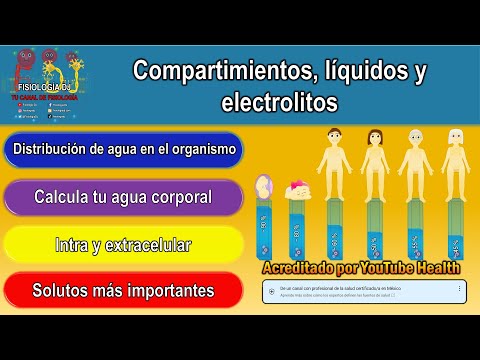
- The average adult body contains about 60% water; this percentage varies with age, sex, and fat tissue content. Infants may have up to 90% water while older adults may have around 45%.
Sources of Water Intake
- The primary source of water is through ingestion (liquids or food), contributing over three liters daily depending on dietary habits. Metabolism also produces water from carbohydrates and lipids.
- Daily water gain can reach approximately 3.5 liters under normal conditions.
Water Loss Mechanisms
- The body loses water mainly through four pathways: renal (urine), integumentary (skin), respiratory (breathing), and digestive systems.
- Renal loss can be up to two liters; skin and respiratory losses can total around 600 milliliters each day.
Compartments of Body Water
- Body water is divided into intracellular (inside cells) and extracellular (outside cells). Typically, 40% of total body water is intracellular while 20% is extracellular.
- Extracellular fluid includes interstitial fluid between cells (15%), plasma within blood vessels (5%), and transcellular fluid found in cavities like synovial or peritoneal spaces.
Calculating Total Body Water
Understanding Body Water Distribution and Solute Concentrations
Overview of Body Water Compartments
- The body contains water in two main compartments: extracellular and intracellular. For example, if the total body water is 60 liters, approximately 12 liters are extracellular (20% of 60) and about 24 liters are intracellular (40% of 60).
Key Solutes in Body Fluids
- Important solutes include potassium, phosphates, proteins, magnesium, sodium, bicarbonate, chloride, and calcium. These solutes are represented graphically to show their concentrations in different fluids: orange for intracellular fluid, blue for interstitial fluid, and yellow for plasma.
Concentration Gradients and Their Importance
- Significant differences exist in the concentrations of key ions such as potassium (high intracellularly) versus sodium (high extracellularly). These concentration gradients create potential energy essential for transport processes and electrical activities within the body.
Role of Sodium and Potassium
- Sodium is abundant in plasma and interstitial fluid but low in intracellular fluid; conversely, potassium is high inside cells. Both ions are crucial for cellular osmotic activity and electrical functions; imbalances can lead to severe health consequences.
Charge Balance Among Ions
- Phosphates, proteins, bicarbonate, and chloride carry negative charges that help balance the positive charges from sodium and potassium. Phosphates and proteins dominate intracellularly while chloride and bicarbonate are more prevalent extracellularly.
Functions of Magnesium and Calcium
- Magnesium is primarily found in higher concentrations within cells whereas calcium is mostly located outside cells. Calcium's presence inside cells is limited to specific organelles like the reticulum; it is quickly recaptured after fulfilling its role.
Turn any video into a summary like this
YouTube links, meetings, lectures. With transcripts, search, and chat.