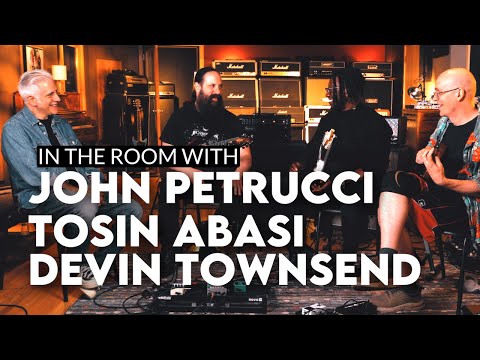
In the Room with John Petrucci, Tosin Abasi, and Devin Townsend
Music Introduction
The video starts with music playing in the background.
Music and Sound Comparison
- The participants discuss the difference in sound between the Mark 7 mode and the recto mode. Music
- They experiment with bypassing the EQ and compare the sound with and without EQ. Music
Music Channel 3 - C Plus
The discussion focuses on channel 3, which is referred to as the C Plus.
- The participants play music using channel 3. Music
- They continue playing music. Music
- The discussion concludes, mentioning that channel 3 is the C Plus. Music
Music Foreign
The participants play a foreign-sounding piece of music.
- They play a foreign-sounding piece of music. Music
- They continue playing. Music
- The music ends. Music
Music Cranked Amp Sound
The participants discuss how certain amps have a cranked amp sound even when not at high volume.
- They mention that certain amps have a cranked amp sound even at lower volumes. Music
- They continue discussing this topic while playing music in the background. Music
- The conversation continues, emphasizing how Mesa cabs contribute to the desired sound. Music
Meeting John Petrucci and Tosin Abasi
John Petrucci and Tosin Abasi talk about their previous interactions and meeting each other.
- John Petrucci mentions that he previously interviewed Tosin Abasi on his channel. Music
- They discuss their first meeting and how it was conducted remotely. Music
- The participants express pleasure in seeing each other again. Music
Dream Sonic Tour
The participants talk about the Dream Sonic tour, which features Dream Theater, Animals As Leaders, and Devin Townsend.
- They introduce the Dream Sonic tour as their own traveling prog metal festival. Music
- The lineup includes Dream Theater, Animals As Leaders, and Devin Townsend. Music
- They describe the tour as a night of insane music. Music
Prague Metal vs Prague Rock
The discussion revolves around the difference between Prague metal and Prague rock.
- They differentiate between Prague rock (bands like Genesis and Pink Floyd) and Prague metal (metal-influenced bands with long songs). Music
- The participants explain how their musical influences led to a fusion of metal and prog elements in their music. Music
Genre Classification
The conversation delves into genre classification based on guitar tone and vocal aggression.
- They discuss how guitar tone can dictate genre classification, with distortion leaning towards metal and cleaner tones towards prog or rock. Vocal aggression is also considered. Music
- The participants mention that genres can be packaged differently depending on the tone used in a song. Pop songs with heavy guitars may be classified differently than pop songs without heavy guitars.
New Section
In this section, the speakers discuss the characteristics of metal music and what makes it distinct. They explore the mood, note choices, and harmonic elements that contribute to the metal genre.
Metal as a Mood
- Metal music is characterized by its intensity and dark musical moods.
- The use of certain note choices, such as flat five intervals, contributes to the "evil" or intense sound associated with metal.
- Metal explores emotional experiences that are often absent in popular styles of music.
Open-mindedness and Sensitivity
- Metal audiences are often perceived as more open-minded due to their appreciation for confrontational and intense music.
- People who gravitate towards metal may have a heightened sensitivity to stimuli, which is reflected in their musical preferences.
- Heavy music allows for an exploration of emotions that may be lacking in other genres.
New Section
In this section, the speakers delve into the role of harmony in metal music and how it contributes to its dark and intense nature. They also discuss how metal differs from other genres in terms of musical elements.
Dark Harmony
- Certain areas of harmony in metal are inherently dark without being necessarily sad.
- The combination of specific harmonic elements, such as half steps and diminished fifths, creates a unique sound found predominantly in metal.
- These harmonic choices are less common in genres like country music.
Evocative Elements
- Minor second intervals and other evocative elements are more prevalent in metal compared to other genres.
- Metal musicians are not afraid to explore these unconventional sounds that can evoke strong emotions.
- This willingness to embrace tension and darkness sets metal apart from mainstream styles of music.
New Section
In this section, the speakers discuss their perspectives on heavy music categorization and the importance of intent in defining metal. They also touch upon the progressive nature of metal and its rhythmic complexities.
Metal as a Color
- Metal should not be strictly categorized but rather seen as a musical color that can be incorporated into various genres.
- Intent plays a crucial role in defining heavy music, focusing on the emotional level and what the artist aims to achieve.
- Progressive metal embraces exploration and is not limited by rigid parameters like progressive rock.
Rhythmic Dissonance
- Progressive metal often incorporates rhythmic dissonance, which adds tension and release to the music.
- The use of odd time signatures and metric modulations contributes to the complexity and natural flow of metal music.
- Metal reflects natural rhythms found in everyday life, making it more relatable and authentic.
New Section
In this section, the speakers discuss how metal musicians authentically deliver heaviness compared to other genres. They also explore the relationship between math, geometry, and music in creating unique musical ideas.
Authenticity of Heaviness
- Delivering heaviness goes beyond playing the right notes; it requires an authentic understanding of metal's emotional intensity.
- Broadway shows or other genres attempting to incorporate heavy sections may lack the genuine impact that metal achieves.
- Intent on an emotional level defines heavy music, distinguishing it from mere technical execution.
Music as Math
- Music is inherently mathematical, with elements like scalar fragments resetting at specific places creating geometric-like patterns.
- Metal explores these mathematical concepts through unison passages and scalar fragments that contribute to its unique sound.
- Understanding these mathematical relationships allows for creative exploration within progressive metal.
The transcript provided does not cover all parts of the video.
Prague and Structured Music
The speaker discusses how Prague usually has a structured and explicit mathematical or structural approach to music, although it doesn't always have to be that way.
Prague's Musical Style
- Prague usually has a structured and explicit mathematical or structural approach to music.
- This style doesn't have to be present in all cases, but it is often observed.
Self-Taught with Some Theory Knowledge
The speaker talks about being self-taught for the first 12 years and then learning some theory through a one-year music education program in Atlanta.
Learning Experience
- The speaker was self-taught for the first 12 years of their musical journey.
- They later attended a one-year music education program in Atlanta where they learned some theory.
- Although not as deep as some others, the speaker gained knowledge of modes and formulas during this crash course.
Understanding Modes and Formulas
The speaker reflects on their experience of learning modes and formulas, mentioning mixolydian flat six as an example.
Learning Modes
- The speaker learned the formulas for different modes, such as mixolydian flat six.
- Initially, they didn't understand why certain modes sounded different from others but still enjoyed them intuitively.
- It was interesting for them to attach understanding to things they already noticed intuitively.
Exploring Different Sounds on Guitar
The speaker discusses how guitar players can be afraid of exploring different sounds but highlights the importance of understanding why something sounds good before diving into theory.
Fear of Exploring Sounds
- Many guitar players are afraid of exploring different sounds on their instrument.
- Understanding why something sounds good should come before diving into theory.
- It's important to have context and determine the usefulness of different sounds in specific musical situations.
The Sound and Teaching of Modes
The speaker talks about the sound of modes and how teaching them can be challenging due to their mysterious nature.
Sound and Teaching of Modes
- The sound of modes, such as lydian, can be eerie and cool.
- Teaching guitar students about modes can be challenging due to their mysterious nature.
- It's important for students to understand what makes a mode special and why it evokes certain moods.
Contextual Understanding in Guitar Playing
The speaker emphasizes the importance of contextual understanding in guitar playing, where positions, chords, notes, and moods play a significant role.
Contextual Understanding
- Guitar playing requires contextual understanding, including positions, chords, notes, and moods.
- Knowing what different sounds or techniques sound like against a chord or note is crucial.
- Creativity in music writing comes from having a wide range of tools to pull from.
Learning Music through Online Tutorials
The speakers discuss the impact of online tutorials on learning music, particularly for younger generations.
Impact of Online Tutorials
- Online platforms like YouTube have made it easier for young musicians to learn various techniques.
- There has been an explosion in learning opportunities for guitarists through online tutorials.
- Access to tutorials allows young musicians to expand upon techniques demonstrated by experienced players.
Technique vs. Emotional Understanding
The speakers discuss the importance of emotional understanding over technique when creating resonant music.
Emotional Understanding vs. Technique
- Emotional understanding is more important than technique when creating resonant music.
- Articulating emotions through music requires self-awareness and understanding one's own motivations.
- Technique is secondary to understanding the sound that evokes emotions and resonates with others.
Practical Purpose in Music Creation
The speakers discuss the importance of practical purpose in music creation, emphasizing the need for techniques to serve a purpose in writing songs.
Practical Purpose in Music Creation
- Techniques should serve a practical purpose in writing songs.
- Understanding how techniques can be applied to create specific moods or effects is crucial.
- Without practical purpose, techniques become chaotic and lack resonance.
Modes as Frames of Mind
The speakers discuss modes as equivalent to frames of mind and highlight the importance of emotional maturity when applying them.
Modes as Frames of Mind
- Modes can be seen as different frames of mind or emotional states.
- Emotional maturity is necessary to apply modes effectively and understand their significance.
- Having personal experiences and emotions to connect with different modes enhances their application.
Learning Journey: Past vs. Present
The speakers compare their learning journey from the past with the current generation's access to tutorials and resources.
Evolution of Learning Journey
- In the past, learning music was more challenging without easy access to resources like tutorials.
- Younger generations now have abundant resources like YouTube tutorials for learning music.
- The availability of tools doesn't guarantee musical understanding; emotional maturity is still essential.
Creating Resonant Music through Understanding Motivations
The speakers emphasize the importance of understanding one's motivations when creating resonant music that can be shared with others.
Understanding Motivations for Resonant Music
- To create resonant music, it's crucial to understand one's own motivations behind it.
- Adhering techniques to practical purposes helps create meaningful music that resonates with others.
- Techniques alone without emotional understanding and purpose result in chaos.
Modes as Practical Tools for Songwriting
The speakers discuss modes as practical tools for songwriting, highlighting the need for emotional maturity to apply them effectively.
Modes as Practical Tools
- Modes can be seen as practical tools for songwriting, each evoking a different mood or atmosphere.
- Emotional maturity is necessary to apply modes effectively and understand their purpose in a song.
- Applying modes without emotional context leads to a toolkit with nothing to apply it to.
Applying Toolkit to Emotional Experiences
The speakers discuss the importance of having emotional experiences and contexts to apply the musical toolkit effectively.
Applying Toolkit with Emotional Context
- Having emotional experiences provides context for applying the musical toolkit effectively.
- Without personal experiences, the toolkit remains unused and lacks resonance.
- Understanding emotions allows musicians to create music that resonates with themselves and others.
Learning Journey: Understanding Harmonization
The speakers reflect on their learning journey, realizing the importance of understanding harmonization when trying to replicate certain sounds.
Importance of Understanding Harmonization
- In their early learning journey, they struggled to replicate certain sounds without understanding harmonization.
- Lack of knowledge about guitar harmonies led to frustration when trying to play songs accurately.
- Understanding harmonization helps recreate specific sounds and achieve desired results on the instrument.
Describing the Journey of Learning Guitar
In this section, the speaker discusses their initial experience with learning guitar and how they discovered new techniques and sounds. They also reflect on the process of learning and the value of struggling in developing one's own style.
Discovery and Journey of Learning
- The speaker initially couldn't believe that certain sounds were produced by a guitar, as they were unfamiliar with tapping technique, phaser pedals, and tape delay.
- Learning often happens through various sources such as observing others playing, watching commercials or concerts, and now tutorials provide instant knowledge.
- Tutorials not only teach how to play but also reveal the effects used to achieve specific sounds.
- The accessibility of information allows even young children to play proficiently, but it may result in missing out on the struggle and reward of the learning process.
The Value of Struggling in Developing Style
In this section, the speaker reflects on how guessing what other musicians are doing can lead to developing a unique style. They discuss the rewards that come from struggling through the learning process.
Creating Your Own Style
- The need to guess what other musicians are doing leads individuals to develop their own interpretations and versions.
- Struggling through the learning process helps create a unique style.
- The speaker acknowledges that previous generations had to work harder for knowledge compared to today's instant access to information.
- Instant knowledge may result in missing out on the benefits that struggling brings.
The Importance of Ear Training
In this section, the speakers discuss how relying solely on tutorials may impact ear training. They highlight the uniqueness of musicians who have developed their own distinct voice.
Ear Training and Unique Voice
- As individuals improve on an instrument, they start recognizing different musical elements by ear.
- The speakers mention a guitarist named Tosin who has a unique style that is difficult to decipher, creating a sense of wonder and intrigue.
- They emphasize the importance of ear training and the ability to identify musicians instantly by their playing style.
Departing from Musical Expectations
In this section, the speakers discuss how some musicians can depart from traditional expectations and create their own distinct sound. They highlight the rarity of such artists.
Departing from Traditional Expectations
- Musicians who can depart from traditional expectations have more freedom in shaping their music.
- Some bands or artists have moments where they break away from conventional norms, allowing for unique expressions.
- Artists like Alan Holdsworth had the freedom to explore their own sound without being restricted by others' opinions.
The Unique Artistry of Allan Holdsworth
In this section, the speakers discuss Allan Holdsworth's unique approach to electric guitar and how his frustration with traditional guitar playing led him to create his own distinctive style.
Allan Holdsworth's Unique Approach
- Allan Holdsworth didn't conform to typical electric guitar sounds and was frustrated with its limitations.
- His frustration pushed him to explore new directions, resulting in a beautiful use of the electric guitar.
- The uniqueness of his artistry lies in his ability to transform an instrument into something unexpected.
The Challenge of Learning Complex Techniques
In this section, the speakers reflect on how challenging it would be for someone unfamiliar with advanced techniques to understand and learn them solely through recordings. They contrast this with the accessibility of tutorials on platforms like YouTube or Instagram.
Learning Complex Techniques
- The speakers imagine trying to learn complex techniques solely through recordings without any prior knowledge or understanding.
- They acknowledge that even with tutorials available online, certain musicians like Tosin can still create awe-inspiring performances that are difficult to comprehend.
- The accessibility of tutorials allows aspiring musicians to learn and practice advanced techniques more easily.
Timestamps have been associated with the corresponding bullet points as requested.
New Section
The speaker discusses their experience with Meshuggah's album "Nothing" and the use of H strings. They also mention the rarity of musical moments and the importance of articulating one's internal dialogue through sound.
Meshuggah's Album "Nothing" and H Strings
- Meshuggah released an album called "Nothing" where they started using H strings.
- The speaker initially didn't understand this change and thought there was something wrong with the music file during the Napster days.
- The use of H strings resulted in a unique sound that went beyond down-tuned guitars.
Rarity of Musical Moments
- The speaker reflects on how rare it is to come across musical moments that leave a lasting impact.
- They believe that if you have the opportunity to express your internal dialogue through sound, it becomes more important than other aspects like fame.
- Following this path allows you to discover your true identity as an artist.
New Section
The speaker discusses the artist mentality and their own desire to hang out rather than focus on being in a band. They also talk about their early exploration with guitar sounds and synesthesia.
Artist Mentality and Desire to Hang Out
- The speaker shares that as a child, they were more interested in hanging out with people rather than being part of a band.
- They emphasize the importance of intent in creating music.
Early Exploration with Guitar Sounds and Synesthesia
- The speaker recalls experimenting with different guitar sounds by trying to replicate what they saw in nature through sound.
- They developed a fascination for open C tuning from an early age without necessarily knowing scales or modes.
- Synesthesia played a role in their perception of music, associating colors, shapes, and sensations with certain notes or chords.
New Section
The speaker and the interviewer discuss their early experiences with alternate tunings and the influence of Led Zeppelin. They also touch upon synesthesia and its impact on their music.
Early Experiences with Alternate Tunings
- The speaker reveals that they started using open C tuning after hearing Led Zeppelin's song "Friends" from the album "Led Zeppelin III."
- Initially, they were unaware of the whole tone concept used by Jimmy Page and thought he was playing in standard tuning.
- They recall struggling to play songs like "Looks That Kill" by Mötley Crüe without realizing that they were detuned.
Synesthesia and Music Perception
- The interviewer asks if the speaker has synesthesia, to which they respond affirmatively.
- The speaker explains that they didn't realize they had synesthesia until others pointed it out.
- Working with orchestras required them to learn music theory to effectively communicate their ideas, such as describing a passage as a butterfly landing progressively slower from leaf to leaf.
- They associate shapes, colors, and sensations with certain musical patterns or chords, allowing them to convey specific emotions or moods through their compositions.
New Section
The speaker discusses how learning about one's own frame of mind and internal processing is crucial for creating meaningful music. They mention the impracticality of synesthesia when it comes to jamming but highlight its value in shaping their creative process.
Learning About One's Frame of Mind
- The speaker emphasizes the importance of understanding one's own frame of mind and internal processing in order to create authentic music.
- By recognizing how certain musical patterns or chords evoke specific feelings or sensations, they can manipulate these elements to convey a desired mood or emotion.
Impracticality of Synesthesia for Jamming
- While synesthesia provides valuable insights into their creative process, the speaker acknowledges that it can be impractical for spontaneous jamming sessions.
- They humorously mention how synesthesia might lead to statements like "more green here" during a jam session.
The transcript provided does not cover the entire video.
Describing Music Theory and Gear
In this section, the speakers discuss their understanding of music theory and the differences between amps and plugins in terms of sound production.
Understanding Music Theory
- The speaker initially had a misconception about music theory, thinking it was more complex than it actually is. They learned that it can be practical and helpful for musicians.
- Music is described as vibratory, with consonance and dissonance being represented by triangles and circles rather than numbers and letters.
Differences Between Amps and Plugins
- The main challenge for digital products like plugins is replicating how an amplifier physically pushes air through a speaker, which affects the overall feel of playing.
- When playing through an amp with distortion, each note played interacts differently with the amplifier's components, resulting in a unique sound. This randomness cannot be fully replicated by digital products.
- Neural DSP is praised for creating plugins that come closest to capturing the feel of playing through an amp. The speaker mentions sending their own amp head to Neural DSP for accuracy.
Creating Virtual Amps
In this section, the speakers discuss the process of creating virtual amps and cabinets for digital products.
- Creating virtual amps involves setting high goals to create the best version possible.
- Conversations were held regarding what the speaker likes to hear in amplifiers and cabinets.
- Freedom exists in the digital world to create effects that may not be possible on physical amplifiers due to stability concerns.
- The visual design of virtual amps was inspired by Star Wars aesthetics.
Benefits of Software Amplifiers
In this section, the speakers discuss their perspectives on using software amplifiers versus real amps.
- Both speakers acknowledge that there is no substitute for playing through a real amp when possible.
- However, they recognize the usefulness of software amplifiers in certain situations, especially for specific sounds and effects.
- The availability of high-quality software amplifiers is seen as a positive aspect of the current music production landscape.
Experimenting with Amps
In this section, the speakers discuss their experiences experimenting with different amps and cabinets.
- The speaker mentions working with producers and engineers who tried to convince them that better sounds could be achieved through real amps.
- An array of vintage cabinets, heads, and pedals were set up to explore different sound possibilities.
- Ultimately, the speaker realized that 99% of their work involves using digital amps for specific reasons.
This summary provides an overview of the main topics discussed in the transcript. It is important to watch the video or read the full transcript for a more comprehensive understanding.
New Section
In this section, the speaker discusses the advantages of using digital replication of amplifiers for guitar tones and how it allows for better control over the sonic footprint. They also touch upon the preference for digital versus analog among different generations and the importance of choosing what works best for individual needs.
Digital Replication vs Analog Amps
- The speaker explains that using a digital replication of an amplifier allows them to fit the desired tone into a specific spectrum more easily.
- Analog amps tend to have a larger sonic footprint, requiring high cut and low cut adjustments to fit in a mix.
- By using digital replication, the speaker can capture the full sound and fit it into the spectrum more effectively.
Preference and Identity
- The speaker acknowledges that preferences in gear are often influenced by personal experiences and nostalgia.
- They mention that younger musicians who grew up with digital technology may have different preferences compared to those who played through traditional guitar amps.
- It is important to recognize that people's identities are heavily invested in their chosen ideology or gear preference, leading to potential conflicts when discussing personal preferences.
Individual Choice
- The speaker emphasizes that there are numerous options available, and individuals should choose what works best for them.
- Different people may prefer either digital or analog setups based on their playing style, sound requirements, or personal taste.
- It is essential not to judge others' choices but rather respect individual decisions based on what suits their needs.
New Section
In this section, the conversation shifts towards personal experiences with gear preferences. The speaker shares an anecdote about Pliny's first experience playing through their rig and highlights how one's familiarity with certain equipment can shape their perception of sound quality.
Personal Experiences with Gear Preferences
- The speaker recalls Pliny's positive reaction to playing through their rig during a tour, despite it being the only rig they had ever played.
- Pliny, who primarily used digital setups at the time, found the tube amp experience to be exceptional.
- The speaker mentions that personal circumstances and exposure to different gear can heavily influence one's preferences.
Identity and Ideology
- The speaker reflects on how people's identities are often tied to their chosen ideology or gear preference.
- They note that expressing a preference for one type of gear over another can sometimes lead to offense or disagreement from those who hold opposing views.
- It is important to recognize that individual choices should be respected, as everyone has different needs and preferences.
New Section
In this section, the speaker emphasizes the importance of choosing gear based on what works best for an individual. They discuss how personal preferences may vary and highlight the need for open-mindedness when discussing gear choices.
Choosing What Works for You
- The speaker reiterates that individuals should choose gear options that work best for them personally.
- Different people have different requirements and tastes when it comes to tone and equipment.
- It is crucial not to impose one's own preferences onto others but rather respect their choices.
Open-Mindedness
- The speaker acknowledges that there are various options available in today's market, catering to different needs and preferences.
- They emphasize the importance of recognizing that what works well for one person may not work as effectively for another.
- Open-mindedness allows for a better understanding of diverse perspectives and fosters a more inclusive musical community.
New Section
In this section, the conversation delves into the trade-offs between using high gain settings on amplifiers versus achieving a more controlled sound with less gain. The speaker discusses how finding the right balance can lead to a more expressive and dynamic playing experience.
Finding the Right Balance
- The speaker mentions their preference for using less gain on their amps to achieve a more controlled sound.
- They explain that cranking up the gain excessively can result in a smaller, squashed tone with less expressive qualities.
- By sacrificing some gain and making conscious choices, one can achieve a more dynamic and expressive playing experience.
Control and Technique
- The speaker highlights the importance of control and technique when playing through amplifiers with lower gain settings.
- They mention not using noise gates or other tools to control unwanted noise, as it requires more precision in delivery and technique.
- Playing through setups that require more control can lead to improved skills and a deeper connection with the instrument.
New Section
In this section, the conversation explores the concept of achieving different guitar sounds through digital modeling versus traditional tube amps. The speaker discusses how digital modeling offers unique possibilities but also acknowledges its limitations compared to real tube amps.
Digital Modeling vs Tube Amps
- The speaker acknowledges that digital modeling technology allows for creating incredibly creamy guitar sounds that are difficult to achieve with traditional tube amps.
- However, they note that there is still something special about the unpredictability and life of real tube amps.
- Digital models tend to be more linear and lack some of the chaotic elements found in analog setups.
Personal Preferences
- The speaker reflects on their personal preference for achieving a specific guitar sound rather than focusing solely on gear fetishization.
- They emphasize that ultimately, what matters is how well the guitar fits into the mix and serves its purpose within a musical context.
- Different approaches may work better for different individuals based on their artistic vision and sonic requirements.
Describing Guitar Tones and Carving Out Sounds
In this section, the speakers discuss guitar tones and how they carve out sounds to avoid frequency competition.
Approaching Guitar Tones
- John's tone is loud on stage cabinets and sounds great.
- The speakers appreciate each other's tones but acknowledge that their own playing style may differ.
- They discuss how Jordan's lead sounds are similar to John's, which raises questions about carving out unique sounds.
Carving Out Unique Sounds
- The approach to producing Dream Theater involved learning how to carve out unique sounds for different instruments.
- A guitar line is mono, while a synth lead sound is usually stereo with chorus effects.
- When doing unison lines, the keyboard would sound hugely in stereo compared to the guitar note.
- To solve this issue, they treated the keyboard signal as if it was a guitar coming out of an amp.
- They used the Pliny plugin on the latest Dream Theater record to put Jordan's keyboard sound through a guitar plugin, creating a unified space for both instruments.
Learning Vibrato and Influential Bands
In this section, the speakers discuss learning vibrato and influential bands that shaped their playing styles.
Learning Vibrato
- John credits Adrian Smith from Iron Maiden as his inspiration for learning vibrato.
- He learned vibrato by slowing down one of Adrian Smith's solos and emulating his wide vibrato technique.
- John expresses admiration for Adrian Smith and Dave Murray from Iron Maiden.
Influential Bands
- The speakers share their formative bands that influenced their playing styles.
- Liquid Tension Experiment introduced them to instrumental music with exceptional compositions performed by all band members.
- Dream Theater and Meshuggah influenced them with their heavy rhythms and harmonic elements outside of metal genres.
Finding Value in Vibrato and Personal Musical Journeys
In this section, the speakers discuss finding value in vibrato and their personal musical journeys.
Neglecting Vibrato
- Jordan reflects on how he missed the importance of focusing on vibrato.
- He was more interested in advanced techniques rather than foundational elements like vibrato.
- Being part of a community of players helped him realize the significance of vibrato.
Personal Musical Journeys
- Devin shares his journey of trying to find his own style and sound.
- He initially focused on wild techniques but later realized the value of foundational aspects like vibrato.
- Liquid Tension Experiment, Dream Theater, Meshuggah, and bands outside of metal influenced his musical journey.
Influential Guitarists and Unique Tones
In this section, the speakers discuss influential guitarists and unique tones that caught their attention.
Influential Guitarists
- Devin mentions KK Downing from Judas Priest as an influential guitarist who had a unique tone with out-of-tune playing and heavy echo effects.
- He was fascinated by Downing's possessed-sounding guitar tone.
Unique Tones
- The speakers emphasize the importance of resonating with specific music that goes beyond general preferences.
- Liquid Tension Experiment stood out for its exceptional compositions performed by all band members.
- They mention appreciating rhythmic vocabulary from Meshuggah and exploring harmony outside of metal genres.
The Grandeur of Metallica and Kick You Downing
In this section, the speaker discusses their love for Metallica's grandeur and the impact of guitarist Kick You Downing.
Falling in Love with Metallica's Grandeur
- The speaker fell in love with Metallica because of their vast and beautiful sound.
- They appreciated the sense of grandeur in Metallica's music.
- The combination of grandeur and a "Metallica vibe" was captivating to the speaker.
Kick You Downing's Influence on Guitars
- Kick You Downing had an amazing impact on guitars.
- The speaker expresses admiration for Kick You Downing's guitar skills.
Glenn Tipton, Originality, and Van Halen
This section focuses on Glenn Tipton, original metal bands, and the uniqueness of Van Halen.
Glenn Tipton as a Fan Favorite
- The speaker confirms being a fan of Glenn Tipton.
- They express appreciation for guitar players who have a distinct sound when they play.
Uniqueness of Van Halen and Other Guitarists
- The speaker mentions that some guitarists can make certain songs sound exactly how they should be played.
- They compare this observation to their experience with playing Van Halen songs, where it didn't sound quite right despite playing it correctly.
- There is mention of a technique discovered while watching someone play "Paranoid" by Black Sabbath that made it sound accurate.
Technique and Playing Style Influences
This section explores how technique influences playing style and the challenges faced when trying to replicate certain sounds.
Technique vs. Sound Replication
- The speaker reflects on how technique can affect the sound produced.
- They mention a specific example with Van Halen's guitar riffs and how only a select few could play them accurately.
- The connection between technique, sound replication, and influences from parents is discussed.
Technique Details and Sound Quality
- The speaker shares an anecdote about trying to play "Paranoid" by Black Sabbath but not achieving the desired sound until they observed someone using a specific hammer-on technique.
- They highlight the importance of small details in playing techniques that can significantly impact sound quality.
Motorhead, First Guitar Experiences, and Eddie Van Halen
This section covers topics such as Motorhead's influence, early guitar experiences, and admiration for Eddie Van Halen.
Motorhead's Unique Style
- The speaker expresses their love for Motorhead's music due to its unpredictable nature and potential for self-destruction.
Early Guitar Experiences
- The speaker recalls their first guitar being a Sears acoustic one ordered from a catalog.
- Unfortunately, it broke within a week of use.
Eddie Van Halen's Impact
- A YouTube video showcasing Eddie Van Halen playing "Eruption" is mentioned.
- The uniqueness of his style is highlighted, along with his mechanical approach to creating sounds.
- Questions arise regarding how he developed such a different playing style compared to other guitarists at that time.
Inspiration from Live Amplifiers
This section explores the inspiration derived from playing through live amplifiers and the difference between digital modelers and loud amps.
Experience with Live Amplifiers
- Playing through live amplifiers provides an intangible inspiration due to their reactive nature.
- The energy and unique characteristics of loud amps create a distinct experience that cannot be replicated digitally.
Digital Modelers and Speaker Output
- The speaker discusses the limitations of digital modelers, where the sound only comes out through the speakers being listened to.
- They emphasize the importance of capturing impulse responses (IRs) correctly to recreate the experience of playing through a live amplifier.
Understanding Impulse Responses (IRs)
This section delves into explaining what impulse responses are and their significance in capturing specific moments in time.
Definition of Impulse Responses (IRs)
- IRs are snapshots that capture a moment in time, including speaker cabinets, microphone positions, and any processing applied.
- They provide a way to recreate that specific environment and sound.
Applications of IRs
- IRs can be used with various digital platforms such as plugins, ax effects, Kempers, or IR loaders.
- By applying an IR, musicians can access the decisions and opinions made during a recording session.
Capturing Moments with Impulse Responses (IRs)
This section focuses on how using impulse responses captures specific moments in time and recreates the environment.
Recreating Moments with IRs
- Applying an IR to a digital setup allows for capturing not only the sound but also the room ambiance during recording.
- It provides an instant connection to that particular moment when sound was pumping through the cabinet.
Inspiring Experience of Live Amplifiers
- The intangible aspect of playing through live amplifiers is considered inspiring.
- The reactive nature and energy produced by loud amps create a unique experience that cannot be fully replicated digitally.
The Impact of Latency on Performance
In this section, the speaker discusses the impact of latency on performance and how it affects the sound quality.
Latency with Modelers and Amps
- Latency is rarely perceived when using modelers with low latency.
- However, when plugging directly into an amp, there can be noticeable latency.
- The speaker emphasizes that even with high-quality gear, some latency may still occur.
Post-Recording Sound Adjustments
- After recording a guitar part for albums like Dream Theater or solo records, additional adjustments are made during the mixing process.
- These adjustments include EQ shelving to control the low end and other tweaks to make the guitar fit well with other instruments in the mix.
- The goal is to capture the artist's sound as accurately as possible while ensuring it blends well within the overall mix.
EQ in Guitar Mixing
- When mixing guitars, engineers often shelf some of the low end to create space for other instruments like bass and kick drum.
- They also add some presence in higher frequencies to ensure the guitar stands out amidst cymbals and other elements.
- The specific frequency range for shelving may vary depending on individual preferences and musical context.
Shaping Lead Guitar Tones
This section focuses on shaping lead guitar tones during recording and mixing processes.
Lead Tone Considerations
- Lead tones require additional attention compared to rhythm tones due to their unique characteristics.
- While rhythm tones may undergo significant adjustments during mixing, lead tones are typically tracked to sit well in the mix from the beginning.
Pet Peeve: Altering Lead Tones
- The speaker expresses a preference for preserving lead tones as recorded without excessive alterations during mixing.
- Sometimes mixers apply boosts or other modifications to lead tones, which may not align with the artist's original intention.
- The speaker prefers hearing the lead sound as it was recorded, without excessive changes.
Evolution of Lead Tones
- Over the years, the speaker's lead tone has evolved and improved.
- There is now a focus on achieving a creamy and pleasing sound for lead guitar parts.
- This evolution is a conscious effort to create confident and representative lead tones that can still be adjusted if necessary during mixing.
Carving Out Low End for Lead Guitar
This section explores the process of carving out low-end frequencies in lead guitar tones.
Boosting Low End for Palm Muting
- The speaker enjoys boosting the sub-area frequencies, especially when palm muting, as it provides a satisfying and gratifying experience.
- This boost adds weight and depth to the overall tone.
Confidence in Mix Adjustments
- The speaker trusts that mix engineers will make necessary adjustments to fit lead guitar tones into the mix.
- While there may be some trimming or shaping of frequencies during mixing, creating a tone that represents the artist's vision is crucial.
Handling Low End in Solos
- Solos often contain significant low-end information even when played in higher registers.
- It is common practice to carve out additional low end from solo tones compared to rhythm tones.
- The goal is to ensure solos sit well within the mix without overpowering other instruments.
These sections provide insights into latency issues with modelers and amps, post-recording adjustments during mixing, shaping lead guitar tones, and handling low-end frequencies.
Evolution of Sound and Gear
John Petrucci discusses the evolution of his sound and gear over the years, focusing on guitars, pickups, and amplifiers.
Guitars
- John has been with Ernie Ball Music Man for over 20 years.
- His signature guitar is the Boogie, a C+2EQ Mark amp with 6L6 tubes.
- He experimented with different combinations of woods in neck-through guitars to find his preferred tone.
- Initially used Basswood guitars but later explored Mahogany, Maple tops, and Alder for different tonal qualities.
Pickups
- Developed pickups with DiMarzio to achieve more expressive tones.
- Aimed for tightness in lower frequencies and glassy sounds in the neck position.
- Worked on making pickups more versatile and responsive to playing dynamics.
Amplifiers
- John's amp setup has remained consistent throughout his career.
- The focus of evolution has primarily been on guitars and pickups rather than amps.
Woods Used in Guitars
John explains the different wood combinations used in his guitars and their impact on tone.
- Some Majesty models feature a full Maple top, which provides brightness and expressiveness while maintaining the weight of Mahogany.
- Neck-through construction combined with various wood choices allows for a wide range of tonal possibilities.
- Alder is another wood occasionally used in Majesties and JP 15s.
Capturing Sound during Recording
John discusses the importance of capturing sound during recording sessions and shares insights into microphone choices.
- Experimentation with microphones is crucial to finding the best sound combination.
- Recent recordings have utilized an SE VR2 microphone for capturing guitar tones.
- Dynamic mics, ribbon mics, and other combinations have been used in the past.
- Different studios, environments, and engineers contribute to varying recording experiences.
Benefits of Home Recording
John and Devin discuss the advantages of recording in a personal studio environment.
- Having one's own space allows for greater flexibility and creative freedom.
- No interruptions or time restrictions compared to commercial studios.
- John appreciates the convenience and comfort of working in his own studio.
- The shift towards home recording reflects changes in the music industry, enabling artists to record on their own terms.
Balancing Studio and Home Recording
John and Devin share their perspectives on balancing studio recording with home recording.
- Both artists appreciate the benefits of both approaches.
- Studio environments offer unique experiences, especially for drums and larger rooms.
- Home recording allows for meticulous attention to detail during mixing and editing processes.
- A combination of both approaches provides a well-rounded recording experience.
The transcript provided does not specify the language. Therefore, assuming English as the language.
The Hybrid Approach to Recording
In this section, the speaker discusses the benefits of a hybrid approach to recording, combining live room recordings with neural technology for pre-production and demos.
Benefits of the Hybrid Approach
- The hybrid approach allows for recording drums in a great live room while using neural technology for pre-production and demos.
- Live room recordings often result in better results and a more cohesive sound.
The Importance of Studio Environment
This section emphasizes the importance of a professional studio environment for recording.
Studio Environment vs Home Studio
- A professional studio provides a great working environment, which can enhance creativity and productivity.
- Working in a dedicated studio space gives a sense of going to work and helps avoid feeling isolated.
Selective Picking Technique - "The Bouncy Ball"
The speaker introduces a technique called selective picking or "The Bouncy Ball" that creates an illusion of playing more notes than actually played.
The Bouncy Ball Technique
- The bouncy ball technique involves picking, pulling off, and muting strings to create the illusion of playing more notes.
- This technique is demonstrated using the song "Paradigm Shift" in G major.
- By combining picking, pulling off, and muting techniques, it creates an effective and expressive sound.
Developing Your Own Style
This section highlights the importance of developing one's own style by learning techniques in your own way rather than relying solely on tutorials.
Developing Your Style
- Learning techniques in your own way allows for the development of a unique style.
- Following tutorials may limit creativity and individuality in playing.
Demonstrating the Selective Picking Technique
The speaker demonstrates the selective picking technique with a guitar.
Demonstration of Selective Picking
- The speaker demonstrates the selective picking technique, muting strings, and creating cascading arpeggios.
- This technique requires precise muting and setting the amp to achieve the desired effect.
Achieving Speed without Attacking Every Note
The speaker discusses how the selective picking technique allows for achieving speed without attacking every note.
Achieving Speed with Selective Picking
- The bouncy ball technique enables playing fast passages without attacking every note individually.
- By dividing notes between both hands, it creates an illusion of speed while maintaining control.
The "So That" Technique
In this section, the speaker discusses a guitar technique called the "So That" technique, which involves hammer-ons and dividing notes between the left and right hand.
The "So That" Technique
- The "So That" technique is a guitar technique that involves using hammer-ons and dividing notes between the left and right hand.
- This technique creates unique sounds on the guitar.
- The speaker started using this technique about three years ago after being introduced to it by someone else.
- It allows for creating sounds that haven't been heard before on the instrument.
- Many guitar players tend to sound like other guitar players, but exploring different techniques can lead to new and interesting sounds.
Exploring Different Sounds on Guitar
In this section, the speaker talks about exploring different sounds on the guitar and how it can be achieved through various techniques.
Exploring Different Sounds on Guitar
- The guitar is a versatile instrument that can produce a wide range of sounds.
- Depending on one's musical taste, it is possible to create cool hammered or plucked instrument-like sounds on the guitar.
- The speaker personally enjoys sounding like a step sequencer by using selective picking techniques.
- Looking beyond traditional guitar sounds can provide inspiration for creating unique music.
Musical Performance
In this section, there is a musical performance by the speaker.
Musical Performance
No notes are provided as this section consists solely of music without any spoken content.
Discussion About Guitars and Sound Preferences
In this section, there is a discussion about guitars and sound preferences between the speakers.
Discussion About Guitars and Sound Preferences
- The speakers discuss their preferred sound settings for the guitar.
- The speaker mentions using delay effects to enhance the sound.
- They talk about different guitar models and their unique characteristics.
- The speaker prefers a guitar with a rounded neck, similar to a baseball bat.
- They mention experimenting with different scale radii on guitars.
- The speakers discuss the versatility of Mark amps and how they can be adjusted for different playing styles.
Versatility of Mark Amps
In this section, the speaker talks about the versatility of Mark amps and demonstrates different playing styles.
Versatility of Mark Amps
- The speaker highlights the versatility of Mark amps in terms of adjusting sound without changing its overall tone.
- Different playing techniques, such as choking up and muting, can create varied sounds on the guitar.
- The speaker demonstrates playing techniques that showcase both big and bloomy sounds.
Musical Performance
In this section, there is another musical performance by the speaker.
Musical Performance
No notes are provided as this section consists solely of music without any spoken content.
Discussion About Practice Routine
In this section, there is a discussion about practice routines between the speakers.
Discussion About Practice Routine
- The speakers discuss their daily practice routines.
- One speaker mentions practicing every day and shares a warm-up routine inspired by Steve Morse's approach.
- Warm-up exercises focus on navigating across strings with varying numbers of notes per string.
Warm-Up Exercises
In this section, the speaker discusses warm-up exercises and demonstrates them on the guitar.
Warm-Up Exercises
- Warm-up exercises involve playing one note per string across various patterns such as fifths or chromatics.
- These exercises help develop dexterity in navigating across strings with precision.
Warm-up Routine
In this section, the speakers discuss their warm-up routines and how they prepare for playing the guitar.
Warming Up with Foundational Techniques
- The speakers talk about the importance of warming up with foundational techniques such as alternate picking and string crossing.
- They mention that these exercises help them get used to different combinations and improve their control.
- One speaker mentions practicing exercises from "Rock Discipline" by John Petrucci.
Problem Moments and Drill Practice
- The speakers discuss how they address difficult passages or problem moments in their playing. They set a timer for a few minutes and focus on each specific issue during practice sessions.
- They emphasize the importance of nailing challenging parts during live performances.
Thumb Position and Pick Direction
- The speakers talk about their thumb positions while picking. One speaker's thumb faces down, while the other's is facing up due to hyperextension.
- They note that regardless of thumb position, it is important to come off the strings at an angle rather than directly down to produce a slicing motion.
Hybrid Picking vs Using Only Pick
- One speaker mentions not using hybrid picking and instead relying solely on pick technique inspired by Steve Morse's playing style.
Personal Practice Setup
In this section, one of the speakers discusses his personal practice setup at home.
Morning Coffee Looping Session
- The speaker describes his morning routine where he makes coffee and uses a looper pedal connected to his Line 6 Helix system. He watches videos of train rides and creates loops while enjoying his coffee.
- This allows him to revisit the ideas he came up with in the morning during his evening practice sessions.
The transcript ends abruptly, and there is no further content available for summarization.
Unmuting and finding inspiration
The speaker discusses how they find inspiration by unmuting certain lines at night while working. They mention the ability to modify and incorporate these ideas into their own work.
Finding inspiration through unmuted lines
- By unmuting certain lines at night, the speaker discovers new ideas and concepts that they wouldn't have thought of otherwise.
- These unmuted lines serve as a source of inspiration and can be modified to fit different projects.
- The speaker mentions a line going from the lounge into another area, which can be used creatively.
- When combined with a cloud effect, these unmuted lines become like a keyboard, allowing for further exploration.
Creating music with clouds
The speaker explains how playing with clouds allows for creative expression and improvisation. They discuss the importance of capturing a vibe and share their preference for snowy environments.
Playing with clouds for creative expression
- Playing with clouds allows for unconsciously creating music that captures a specific vibe.
- The speaker describes how sitting on the couch with small guitars enables them to illustrate whatever they are watching or feeling.
- By letting their hands guide them, they can create music that aligns with their mood or desired atmosphere.
- Snowy environments are preferred over sunny ones due to the isolation and ambiance it provides.
Exploring creativity through cloud patches
The speaker emphasizes the versatility of cloud patches in creating diverse musical expressions. They highlight the benefits of using tiny guitars for spontaneous creativity.
Unleashing creativity through cloud patches
- Cloud patches allow for endless possibilities in creating diverse musical expressions.
- With the right patch settings, one can easily explore different riffs or melodies.
- The speaker mentions tuning the cloud patch to match a specific key or sound they want to achieve.
- They express their enthusiasm for this creative process, even though it requires a lot of coffee.
Jamming with oneself and upcoming guitar camp
The speaker discusses the joy of jamming with oneself using cloud patches. They also mention an upcoming guitar camp called "John Petrucci's Guitar Universe" and its lineup of guest instructors.
Jamming with oneself and upcoming guitar camp
- Using cloud patches allows for jamming with oneself, creating a surplus of musical ideas.
- The speaker mentions setting the pitch to 100 percent prior to inputs, enabling them to tune their music accordingly.
- They share their excitement about an upcoming guitar camp called "John Petrucci's Guitar Universe."
- The camp is held in Fort Lauderdale from August 3rd to 6th and features a diverse lineup of guest instructors, including Devin Townsend, Tim and Scott from Polyphia, Guthrie Govan, Jason Richardson, Yoshi Stefan, Zack Wilde, Frederick Ackison, Aaron Marshall, Larry Basilio, among others.
History and purpose of John Petrucci's Guitar Universe
The speaker provides background information on John Petrucci's Guitar Universe camp. They discuss its origins on Long Island and the decision to move it around for accessibility.
History and purpose of John Petrucci's Guitar Universe
- The first John Petrucci's Guitar Universe camp took place on Long Island at Glencove Mansion.
- Dream Theater had previously recorded albums nearby at Richie Kanata's Cove City studio.
- The decision was made to move the camp around different locations to provide equal opportunities for attendees from various regions.
- People from all over the world, including South America, Asia, and Europe, attend the camp.
- The speaker mentions that this year's camp will be held in Fort Lauderdale from August 3rd to 6th.
Impressive lineup of guest instructors at the guitar camp
The speaker highlights the impressive lineup of guest instructors participating in John Petrucci's Guitar Universe camp. They mention various renowned musicians who will be teaching at the camp.
Impressive lineup of guest instructors
- The speaker mentions several notable guest instructors at John Petrucci's Guitar Universe camp.
- Some of the instructors include Devin Townsend, Tim and Scott from Polyphia, Guthrie Govan, Raina Petrucci (John Petrucci's wife), Jason Richardson, Yoshi Stefan, Zack Wilde, Frederick Ackison, Aaron Marshall, Larry Basilio.
- The diversity and talent of these instructors make the camp an exciting opportunity for attendees.
Experience and camaraderie at the guitar camp
The speaker discusses the unique experience and camaraderie that attendees can expect at John Petrucci's Guitar Universe camp. They emphasize the opportunity to connect with fellow guitar enthusiasts and form lifelong friendships.
Experience and camaraderie at the guitar camp
- Attending John Petrucci's Guitar Universe camp offers a unique experience where attendees can connect with like-minded individuals who share a love for guitar.
- The speaker compares it to chilling with friends who love playing music together.
- In addition to lessons during the day, there are concerts, master classes, and a big barbecue that fosters a sense of community.
- Attendees often form lifelong friendships through their shared passion for music.
Conclusion
The transcript covers various topics related to finding inspiration through unmuted lines, creating music with clouds, exploring creativity through cloud patches, and the upcoming John Petrucci's Guitar Universe camp. The camp offers a diverse lineup of guest instructors and provides attendees with a unique experience to connect with fellow guitar enthusiasts.