DDCA Ch4 - Part 5: Combinational logic using always blocks
Describing Combinational Logic Using Always Blocks
In this section, the speaker explains how to use an always block to describe combinational logic and discusses the structure of combinational logic blocks using Verilog.
Combinational Logic Using Always Block
- The speaker introduces a combinational logic block utilizing an always statement denoted as always_com for describing combinational logic with inputs and outputs represented as four-bit buses.
- Contrasting the usage of always block with assign statements, it is highlighted that while assign statements are more concise for simple assignments, using an always block can indicate producing combinational logic within it.
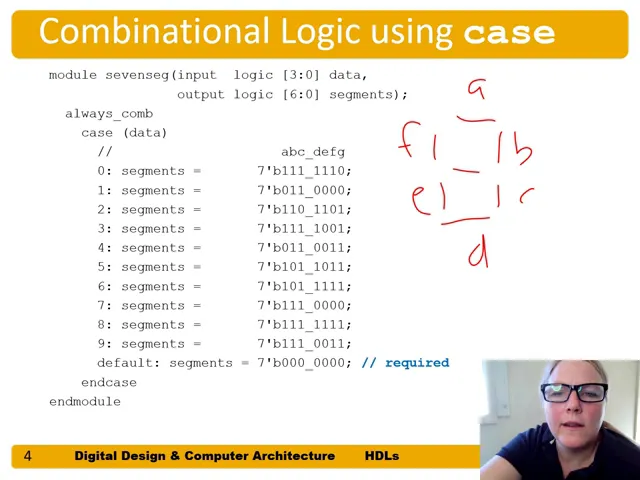
- Demonstrating a seven-segment display decoder as a combinational circuit described within an always block, emphasizing the necessity of case statements within an always block for defining combinational circuits effectively.
Seven Segment Display Decoder
- Explaining the functionality of a seven-segment display decoder where specific segments light up based on input values from 0 to 9, with other inputs resulting in no segments lighting up.
- Emphasizing the importance of including a default statement in case statements to ensure deterministic output values for all possible input combinations in combinational logic design.
- Drawing parallels between case statements and truth tables, showcasing how case statements directly translate truth table entries into HDL code without needing intermediate equations.
Priority Circuit Using Case Z Statement