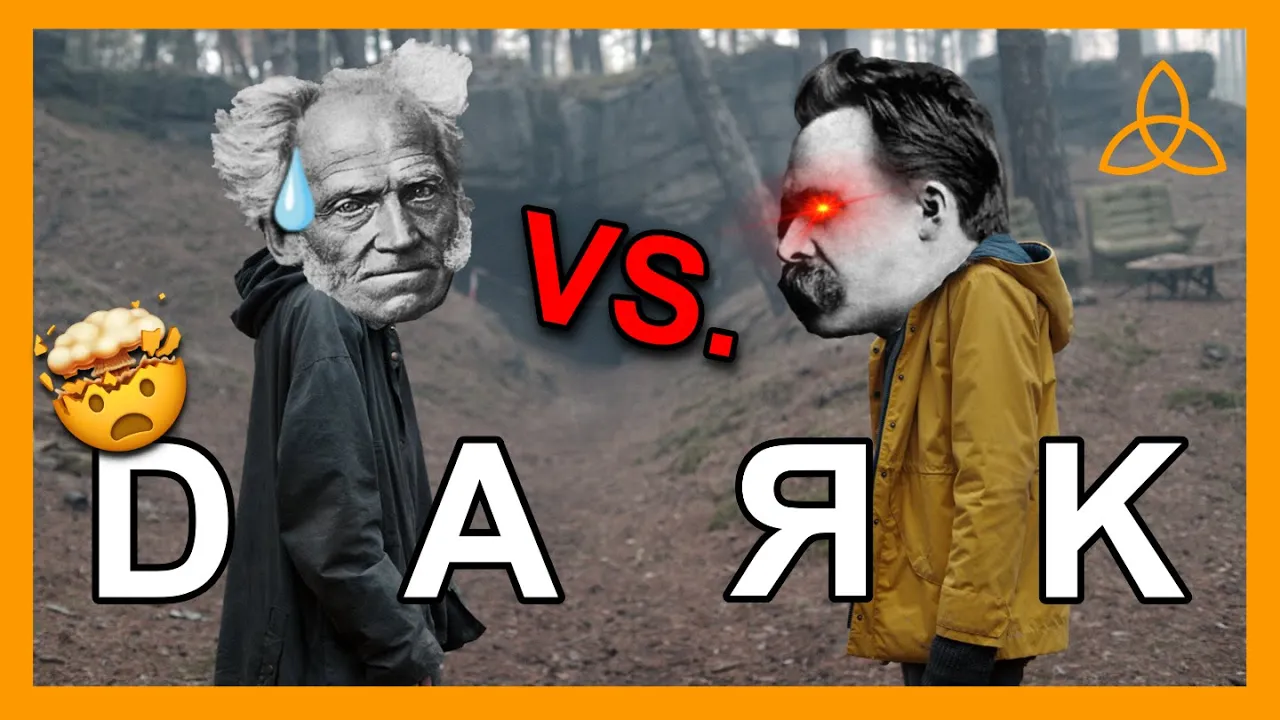
😲 DARK (Netflix) ► SCHOPENHAUER vs NIETZSCHE | Filosofía
New Section
The introduction to the video, where the speaker introduces themselves and warns about spoilers for the series DARK.
Initial Impressions of DARK
- The speaker expresses their positive opinion on the series DARK, highlighting its ability to keep them engaged and thinking throughout.
- A comparison is drawn between DARK and complex philosophical works like Hegel's Phenomenology of Spirit, emphasizing the depth of the series.
Exploring Nietzsche and Schopenhauer in DARK
Delving into the philosophical aspects of DARK by exploring the opposition between Nietzsche and Schopenhauer within the context of the series.
Key Philosophical Concepts
- Introduction to two central characters in DARK: Jonas (Adam) and Martha (Eva), trapped in a time loop where they are both ancestors and descendants of each other.
- Discussion on Adam's desire to end everything due to the suffering caused by the eternal cycle, reflecting Schopenhauer's philosophy on human desires.
Schopenhauer's Influence on Adam
Analyzing how Schopenhauer's philosophy influences Adam's actions and motivations in his quest to break free from the cycle.
Impact of Schopenhauer's Philosophy
- Drawing parallels between Adam's struggles and Schopenhauer's concept of Will as an irrational force driving existence.
- Highlighting Schopenhauer's pessimistic view that life is characterized by suffering, mirroring Adam's belief that breaking free from existence is the ultimate goal for peace.
Challenging Destiny through Desire
Exploring how Adam could have challenged his destiny by understanding and controlling his desires based on Schopenhauer’s philosophy.
Overcoming Fate
- Critique on Adam’s failure to resist desires which perpetuate his entrapment in fate, contrary to Schopenhauer’s teachings on overcoming Will through negating desires.
New Section
In this section, the discussion revolves around the philosophical concepts represented by different characters in the series "Dark."
Philosophical Representations in "Dark"
- Adam embodies Schopenhauer's view of a world trapped in suffering that must be eliminated even at the cost of non-existence.
- Martha, who becomes Eva, represents Nietzsche's perspective, advocating for embracing suffering out of love for life and its beauty.
- Eva symbolizes Nietzsche's philosophy of embracing suffering to fully appreciate life, contrasting with Schopenhauer's desire to escape pain at all costs.
New Section
This part delves into the contrasting views of Adam and Eva in "Dark" and their philosophical underpinnings.
Contrasting Philosophies
- Eva embraces the eternal return due to love and appreciation for life's beauty despite suffering, akin to Nietzsche's philosophy of embracing pain for a fuller life experience.
New Section
The discussion focuses on the characters' representations as advocates of life or death in "Dark," drawing parallels with philosophical ideologies.
Advocates of Life vs. Death
- Eva embodies a pro-life stance similar to Nietzsche, while Adam represents a pro-death ideology rooted in resentment towards existence.
New Section
This segment explores the balance between philosophical ideologies embodied by different characters in "Dark."
Balancing Philosophical Ideologies
- The presence of both Adam and Eva reflects a balance between Schopenhauer and Nietzsche's philosophies within the narrative.
New Section
The victory of certain philosophical perspectives is discussed concerning character actions in "Dark."
Victory of Philosophical Perspectives
- The resolution favors Schopenhauer’s ideology through Claudia’s actions leading to the destruction of suffering and existence itself.
New Section
The final scenes are analyzed from a philosophical standpoint regarding themes of desire and annihilation in "Dark."
Final Philosophical Reflection
Turn any video into a summary like this
YouTube links, meetings, lectures. With transcripts, search, and chat.