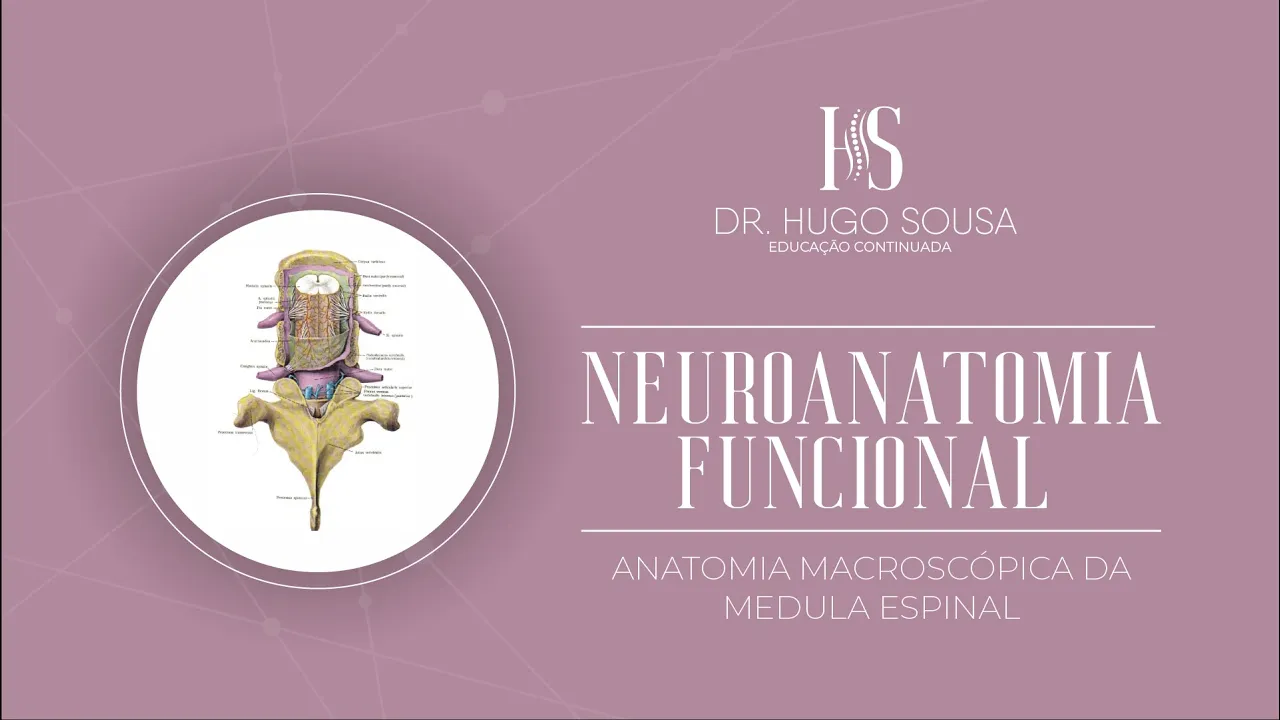
ANATOMIA MACROSCÓPICA DA MEDULA ESPINAL - PARTE 1
Anatomy of the Spinal Cord
Overview of the Spinal Cord
- The term "medula" etymologically means "core," indicating that the spinal cord is located within the vertebral canal.
- The anatomical structure includes the vertebral body and arch, with processes such as transverse and spinous processes visible.
Structure and Location
- Nerve roots exit from the spinal canal through intervertebral foramina, surrounded by protective meninges.
- The spinal cord does not occupy the entire length of the vertebral canal in adults; it ends at approximately L1-L2 vertebrae.
Dimensions and Features
- In adults, the spinal cord measures about 45 cm in length, starting from the foramen magnum to around L2. It has a conical end known as the medullary cone.
- Below L1-L2, nerve root extensions form a structure resembling a horse's tail called cauda equina, which consists of nerve roots rather than solid spinal cord tissue.
Filament Terminal
- The terminal filament is an extension of pia mater that stabilizes the spinal cord by anchoring it to the coccyx without transmitting neural impulses.
Intumescences and Plexuses
Anatomy of Plexuses and Spinal Cord Structure
Overview of Neural Plexuses
- The discussion begins with the concept of plexuses, specifically venous and neural plexuses, highlighting their significance in the cervical and lumbosacral regions of the spinal cord where neuron density is notably high.
Cervical and Brachial Plexus
- The cervical region contains a dense population of neurons that innervate both sensory and motor structures, particularly affecting the head, neck, and upper limb through the brachial plexus.
- Active movement organs like muscles require substantial innervation; thus, areas such as the cervical intumescence exhibit increased neuronal density to support these functions.
Lumbar and Sacral Plexus
- The lumbar plexus (L1-L4) is responsible for innervating thigh muscles involved in hip joint movements and influences knee articulation.
- The sacral plexus (L4-S4) extends its function to lower leg innervation, pelvic region, perineum, including anal-genital areas crucial for urinary continence.
Functional Implications of Plexuses
- Muscles in the anal region are vital for urinary retention; hence their innervation by sacral roots plays a significant role in bodily functions related to excretion and sexual activity.
- The coccigeal plexus connects to coccygeal nerves which further contribute to pelvic floor muscle control.
Spinal Cord Surface Anatomy
- An overview of spinal cord anatomy reveals various longitudinal grooves: posterior median sulcus, lateral posterior sulcus, intermedium posterior sulcus specific to certain segments.
Detailed Sulci Description
- Key features include:
- Posterior Median Sulcus: A central groove along the spinal cord's length.
- Lateral Posterior Sulcus: Present on both sides at thoracic levels.
- Intermedium Posterior Sulcus: Limited presence primarily in specific spinal segments.
Anterior Structures
- Additional anterior structures include lateral anterior sulci on either side leading into deeper grooves known as anterior median fissure which houses critical vascular elements like the anterior spinal artery.
Medullary Anatomy and Function
Overview of the Spinal Cord Structure
- The posterior lateral sulci are associated with the roots and root filaments that form the posterior nerve roots in the intermediate posterior sulcus. This area is significant for understanding spinal cord division.
- The posterior funiculus is divided into two fascicles: medial and lateral. The intermediate sulcus separates these two structures, which are crucial for sensory and motor pathways.
- An image illustrates key features of the spinal cord, including the anterior median sulcus, anterior lateral sulcus, and various root filaments. These structures play a role in identifying different regions of the spinal cord.
Distinction Between Grey and White Matter
- The spinal cord contains distinct grey (darker) and white (lighter) substances. Grey matter is located centrally within white matter, resembling a butterfly or an "H" shape.
- Grey matter consists of three columns on each side: anterior column (motor), posterior column (sensory), and lateral column (visceral motor). This anatomical arrangement is essential for understanding functional organization.
Functional Segmentation of Columns
- The anterior column is present across all medullary segments, while both posterior columns are also consistently found throughout. Understanding segmental anatomy helps clarify clinical implications.
- Lateral columns appear only in thoracic and lumbar segments starting from L2. This distinction aids in recognizing specific functions related to different spinal levels.
Motor Functions of Spinal Columns
- The primary function of the anterior column (MS - motora somática) involves innervating skeletal muscles through lower motor neurons, highlighting its role in voluntary movement.
- The lateral column (MV - motora visceral) controls involuntary muscle types such as bronchial muscles and cardiac muscle, indicating its importance in autonomic functions.
Sensory Functions of Spinal Columns
- The posterior column serves dual roles: it provides sensory input from visceral sources as well as somatic sensations from skin receptors. This duality emphasizes its critical role in sensory processing.
- Understanding how these columns interact can inform clinical assessments; lesions affecting specific areas can lead to predictable deficits based on their functional roles within the nervous system.
Clinical Implications
- Recognizing how blood supply issues affect specific regions can help predict clinical outcomes related to motor function loss or sensory deficits depending on which part of the spinal cord is compromised.
Understanding the Structure and Function of the Spinal Cord
Overview of Spinal Cord Anatomy
- The spinal cord's posterior region is associated with sensory deficits rather than motor functions, highlighting its role in somatic states.
- White matter consists primarily of myelinated fibers, which are crucial for efficient signal transmission. Glial cells, such as oligodendrocytes in the central nervous system and Schwann cells in the peripheral nervous system, form the myelin sheath around neurons.
- Myelin sheaths increase action potential speed by insulating axons, allowing for faster neuronal signal conduction through saltatory propagation.
Composition of White Matter
- The white matter appears whitish due to a high density of myelinated fibers and is organized into structures called funiculi (or cord-like structures).
- There are three main funiculi: anterior, lateral, and posterior. Each is demarcated by specific sulci (grooves) on the spinal cord surface.
Functional Pathways in White Matter
- Funiculi serve as pathways for tracts and fascicles that carry information with similar origins, destinations, and functions.
- Descending tracts (in red) convey efferent signals to motor neurons while ascending tracts (in blue) transmit sensory information from peripheral receptors to higher centers.
Types of Tracts
- Descending tracts are responsible for carrying motor commands from the brain to various body parts; they stimulate both somatic and visceral motor neurons.
- Ascending tracts transport sensory information from peripheral nerves to the spinal cord and ultimately to the cerebral cortex for interpretation.
Clinical Implications of Spinal Cord Lesions
- The gray matter contains neuron cell bodies involved in sensory processing and motor control. In contrast, white matter comprises fiber pathways facilitating bidirectional communication between the brain and spinal cord.
Investigating Spinal Cord Trauma
Understanding the Essentials of Spinal Cord Injury Investigation
- The speaker emphasizes the importance of focusing on the essence of information when investigating spinal cord trauma, suggesting that overwhelming details can lead to confusion.
- It is crucial to investigate suspected spinal cord injuries thoroughly, particularly in terms of sensory and motor functions.
- The speaker expresses a sense of urgency and concern about how to approach the investigation process effectively.
Turn any video into a summary like this
YouTube links, meetings, lectures. With transcripts, search, and chat.