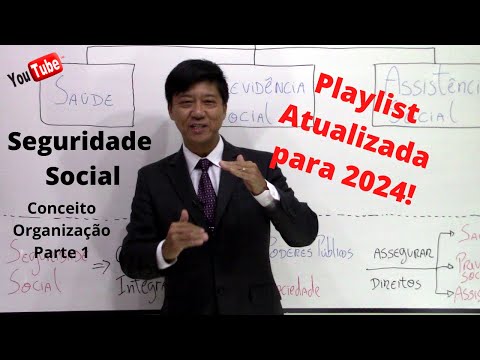
Direito Previdenciário - Seguridade Social Conceito e Organização - aula 01 - Eduardo Tanaka
Introduction to Social Security Law
Overview of the Course
- The course on social security law is introduced by Professor Eduardo, aiming to help students excel in public competitions through a completely free YouTube course.
- The professor shares his personal journey as a candidate and encourages viewers to learn more about his background and the course structure.
Course Structure
- Students are advised to follow the playlist for organized learning, with lessons released chronologically every Friday.
- The first lesson focuses on "Social Security," a crucial topic frequently tested in exams.
Understanding Social Security
Key Concepts of Social Security
- A common misconception is that social security, social assistance, and health insurance are synonymous; however, they represent distinct concepts.
- The term "social security" encompasses three components: health care, social welfare (assistance), and pension systems.
Importance of Integrated Actions
- Article 194 of the Constitution defines social security as an integrated set of actions from both public authorities and society aimed at ensuring rights related to health, pensions, and assistance.
- Understanding this integrated approach is essential for grasping how these components work together within the framework of social security.
Constitutional Framework
Definition and Components
- The concept emphasizes that actions must be coordinated among health care services, pension systems, and social assistance programs.
- Both public authorities and society play roles in implementing these integrated actions; it's critical not to overlook societal involvement.
Exam Preparation Insights
- Knowledge of this definition can aid students in answering exam questions correctly regarding the nature of social security as defined by the Constitution.
Exam Questions Analysis
Sample Questions
- An example question highlights that constitutional definitions describe social security as an integrated set of actions initiated by both public authorities and society.
- Another question clarifies that while some initiatives may seem exclusive to public authorities, societal participation is also vital for guaranteeing rights related to health care, pensions, and assistance.
Practice Recommendations
Understanding Social Security and Assistance in Brazil
Overview of Social Rights
- The discussion begins with the importance of public powers in ensuring rights related to health, beauty, and education. It emphasizes that social security is not merely about retirement but encompasses broader societal responsibilities.
Structure of Social Security
- The speaker introduces the organization of social security, indicating a focus on understanding its structure and functions over an entire course dedicated to this topic.
Key Components of Social Security
- A detailed explanation follows regarding how social security is organized under a general regime with contributory characteristics and mandatory affiliation, aimed at maintaining financial balance.
- The distinction between benefits and funding within social security is highlighted, noting that the Federal Revenue Service plays a crucial role in collecting funds for social security.
Understanding Benefits
- The speaker prompts reflection on what comes to mind when thinking about social security; most people associate it with INSS (National Institute of Social Security), which administers pension benefits.
- It’s clarified that contributions are essential for retirement eligibility; without them, individuals cannot receive pensions. An anecdote illustrates someone receiving assistance despite never contributing.
Assistance vs. Social Security
- The difference between social assistance and social security is discussed. If someone has never contributed to INSS, they likely receive assistance rather than pension benefits.
- A brief mention indicates future discussions will delve deeper into continuous cash benefit programs like BPC (Benefício de Prestação Continuada).
Nature of Assistance Programs
- Assistance programs are designed for those in need regardless of their contribution history. This includes support for low-income individuals or those with disabilities.
- Emphasis is placed on the fact that assistance does not require prior contributions; it aims to address basic needs and reduce poverty levels.
Health as a Right
- When discussing health services, SUS (Unified Health System) emerges as a key concept. Health care is framed as a right for all citizens, supported by state policies aimed at reducing disease risks.
- Universal access to health services is stressed; everyone has the right to public healthcare without needing to contribute financially beforehand.
Conclusion on Accessing Services
Understanding Social Security and Health Care Rights
The Right to Medical Assistance
- A scenario is presented where an Argentine individual gets injured in a traffic accident, highlighting the importance of medical assistance regardless of nationality.
- It is emphasized that all individuals, including foreigners like Argentinians, have the right to receive medical care without discrimination.
Contributions and Benefits in Social Security
- Discussion on the necessity of contributions for accessing social security benefits; only insured individuals and their dependents are eligible for these services.
- Mention of specific programs such as BPC (Benefício de Prestação Continuada) and Bolsa Família, which provide support to those in need.
Understanding Social Security Components
- Clarification that health care does not require prior contributions, contrasting it with social security which does.
- Explanation that social assistance has universal coverage but primarily targets those living in poverty; wealthier individuals do not qualify for this aid.
Eligibility for Assistance Programs
- A case study involving two characters: Pedro (a minor in need) and Paulo (a wealthy adult), discussing their eligibility for health care and social assistance programs.
- Pedro qualifies for both health care and social assistance due to his status as a needy minor, while Paulo can access health care but not social assistance because he is financially stable.
Legislative Framework of Social Security
- Introduction to the evolution of legislation regarding social security in Brazil will be discussed in future lessons, focusing on Article 194 as a critical component.
Turn any video into a summary like this
YouTube links, meetings, lectures. With transcripts, search, and chat.