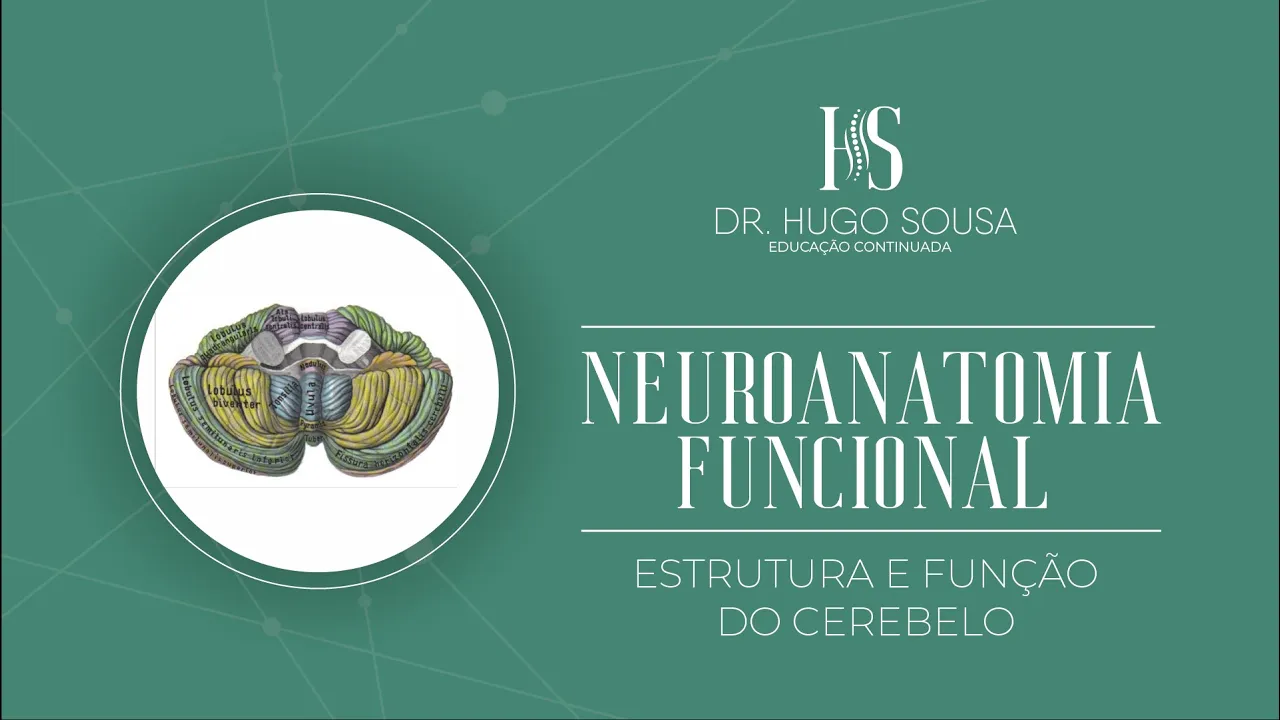
ESTRUTURA E FUNÇÃO DO CEREBELO PARTE 3
Cerebellar Connections and Functions
Overview of Cerebellar Structures
- The presentation discusses the connections between cerebellar nuclei, the cortex, and the flocculonodular lobe, highlighting how these structures transmit various information.
- It introduces the interposed nuclei, which consist of globose and emboliform nuclei that project to intermediate longitudinal zones in the cerebellum.
Functional Zones of the Cerebellum
- The dentate nuclei are associated with lateral hemispheres and connect to vestibular nuclei in the brainstem, indicating their role in motor control.
- The flocculonodular lobe is linked to vestibulocerebellar functions essential for maintaining balance.
Motor Control Mechanisms
- The medial zone (vermis) is involved in somatic reflex control and locomotion, while intermediate zones relate to voluntary movement regulation.
- Lateral hemispheres project neurons to higher brain areas for voluntary movement control, emphasizing their role in motor planning.
Interaction Between Motor Neurons
- Upper motor neurons located in the cerebral cortex influence lower motor neurons found in segmented regions of the central nervous system.
- Lower motor neurons are crucial for executing movements as they reside within spinal cord segments connected to peripheral nerves.
Cognitive Functions of the Cerebellum
- Recent research indicates that cerebellar functions extend beyond motor control into complex cognitive tasks such as reasoning and language processing.
- Studies suggest a relationship between cerebellar activity and linguistic abilities, including problem-solving related to geometric figures.
Summary of Research Findings
- While traditional views emphasize motor functions of the cerebellum, emerging studies explore its involvement in cognitive processes; however, these findings remain secondary compared to established roles.
Cerebral Connections and Motor Control
Overview of Cerebral Structures
- The cerebral cortex connects with various structures, including the superior colliculus and red nucleus in the midbrain, which are linked to motor neuron control.
- The red nucleus is associated with motor activities and parallels fibers projecting from the cerebral cortex through the corticospinal tract, particularly influencing flexor muscle activity.
Impact of Brainstem Trauma
- Individuals with trauma above the brainstem may exhibit atypical postures when stimulated, such as a decerebrate posture, highlighting the role of the red nucleus in posture regulation.
- Observations regarding these postures will be further explored later in the course.
Proprioceptive Information Processing
- Proprioceptive information from cervical regions must connect effectively within spinal cord structures; this includes understanding how proprioceptive fibers enter and ascend through specific spinal pathways.
- These proprioceptive fibers can either ascend or establish connections within different spinal cord segments, crucial for sensory processing.
Role of Cerebellum and Thalamus
- The cerebellum plays a significant role in coordinating movements by receiving information from various sources before relaying it to the cortex.
- Key structures like the thalamus and hypothalamus are essential for processing sensory information before it reaches higher cortical areas.
Movement Control Mechanisms
- The thalamus is critical for integrating afferent stimuli into movement coordination; however, olfactory signals bypass direct thalamic routing initially.
- Various pathways project to the thalamus from different brain regions (e.g., spinothalamic tract), emphasizing its central role in sensory-motor integration.
Basal Ganglia's Influence on Movement
- The basal ganglia function as controllers of movement; disturbances here lead to movement disorders.
- Other structures like subthalamic nuclei and substantia nigra also contribute significantly to motor control mechanisms.
Somatotopic Representation in Cerebellum
- The vermis region influences axial body movements (neck, thorax, abdomen), showcasing somatotopy—a representation of body parts within specific CNS regions.
Understanding the Role of the Cerebellum in Motor Control
Overview of Cerebellar Function
- The cerebellum is compared to a didactic tool, emphasizing its role in controlling motor functions and refining movements.
- It specifically manages distal muscle control, particularly in the hands, and is involved in planning sequential body movements while evaluating errors consciously.
Cerebellar Connections and Comparisons
- The cerebellum establishes bidirectional connections with various brain structures, acting as a comparator that refines movement execution based on command center information.
- It does not execute movements directly but provides feedback for adjustments by comparing planned versus actual movements.
Feedback Mechanism and Motor Learning
- Spinocerebellar pathways inform the cerebellum about planned actions, allowing it to compare these with executed movements for effective feedback.
- Without the cerebellum's input, motor execution would be crude; advancements in artificial intelligence aim to improve this aspect of movement precision.
Clinical Implications of Cerebellar Function
- The cerebellum influences motor neurons on its own side; understanding this lateral influence is crucial for clinical observations.
- A famous saying highlights that clinical observation is paramount; neuroanatomical studies must translate into practical clinical insights.
Symptoms Related to Cerebellar Lesions
- Damage to one hemisphere of the cerebellum results in ataxia symptoms on the same side, contrasting with cerebral hemisphere lesions which affect opposite sides due to crossed pathways.
Understanding the Role of the Cerebellum in Motor Control
The Importance of Vestibulocerebellum
- The cerebellar cortex is characterized by its rigid member presentation, which influences movement coordination and balance during gait.
- Repetitive information emphasizes the vestibulocerebellum's critical role in maintaining posture and equilibrium.
Connections of Purkinje Cells
- Purkinje cells from the flocculonodular lobe connect with vestibular nuclei (lateral, medial, superior, inferior), crucial for modulating spinal vestibular tracts.
- Lateral vestibular nuclei help maintain axial muscle tone and posture during walking; medial nuclei coordinate eye movements with head motion.
Spinocerebellar Pathways
- The anterior spinocerebellar tract sends proprioceptive information to the brain via the superior cerebellar peduncle, assessing motor neuron activity.
- The posterior spinocerebellar tract enters through the inferior cerebellar peduncle, providing feedback on muscle tension and joint position.
Projections to Brainstem Nuclei
- Projections from Purkinje cells reach interposed nuclei (globose and emboliform), influencing red nucleus activity in the midbrain.
- These connections facilitate communication between lower motor neurons in the spinal cord and higher brain centers.
Cortical Interactions
- Information is relayed to cortical areas responsible for motor control through a loop involving interposed nuclei and thalamus.
- Cerebral cortex projects fibers to pontine nuclei that relay signals back to the cerebellum contralaterally.
Functional Implications of Cerebellar Connections
- Pontine nuclei are significant as they form a major part of middle cerebellar peduncle fibers connecting lateral zones of the cerebellum with motor/non-motor cortical areas.
- This connection allows for integration of sensory input into coordinated motor output essential for smooth movement execution.
Summary Insights on Cerebellar Functionality
- The lateral zone of the cerebellum processes both motor commands and sensory feedback before transmitting it to dentate nucleus for further action.
- Dentate nucleus communicates with primary motor cortex influencing voluntary movements through corticospinal pathways.
Understanding Executive Functions and Memory
The Role of the Prefrontal Cortex
- Discussion on executive functions related to verbal memory and language, emphasizing the importance of the prefrontal cortex as a highly developed area in the brain.
- The prefrontal cortex is linked to complex psychological processes that influence motivation and decision-making strategies, highlighting its role in working memory.
Cognitive Processes Involved
- Key cognitive processes such as attention, behavioral inhibition, and decision-making are associated with the prefrontal area, indicating its critical function in managing these tasks.
- Ongoing research in neuroscience aims to clarify how these cognitive functions interact within our psyche and their overall significance.
Impact of Cerebellar Lesions
- Discussion on how cerebellar lesions can lead to various syndromes characterized by specific symptoms, including motor alterations.