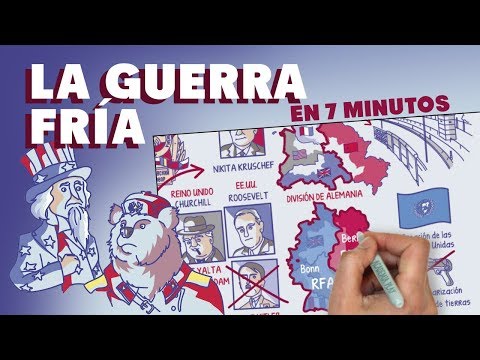
La Guerra Fría en 7 minutos
The Cold War Overview
The Cold War began after World War II, with the emergence of the United States and the Soviet Union as superpowers leading two opposing blocs - the capitalist Western bloc and the communist Eastern bloc.
The Origins of the Cold War
- The term "Cold War" was coined due to indirect conflicts between the US-led Western bloc and the Soviet-led Eastern bloc, driven by ideological, political, economic, and propaganda differences.
- Pre-Cold War tensions date back to events like the 1917 Russian Revolution, which strained US-Russia relations due to conflicting ideologies.
Post-WWII Developments
- After WWII, Yalta Conference divided Germany into zones among major powers and laid foundations for post-war order.
- The subsequent Potsdam Conference addressed issues like disarmament, war criminals' trials, and UN formation.
Economic Aid and Military Alliances
- The Marshall Plan aimed to rebuild Europe economically post-WWII and contain communism's spread in war-torn regions.
- Formation of NATO in 1949 as a defense alliance countered by Warsaw Pact in 1955 led to a divided Europe under Churchill's "Iron Curtain."
Expanding Influence: Asia & Beyond
Cold War rivalries extended globally with alliances forming in Asia while Europe remained divided by ideological barriers.
Asian Dynamics
- China's Communist victory in 1949 aligned it with USSR against US-backed Nationalists; Korea saw US-Soviet involvement leading to Korean War ceasefire in 1953.
European Divisions
- East-West migration prompted Soviet blockades; Berlin Wall construction symbolized German division amidst global nuclear fears.
Crisis Points & Global Tensions
Tensions escalated globally with Cuban Missile Crisis testing US-Soviet brinkmanship amid Vietnam conflict complexities.
Cuban Missile Crisis & Vietnam Conflict
Desgaste y Frustración en la Historia Norteamericana
The transcript discusses the Vietnam War, highlighting the conflict between the United States and South Vietnam against North Vietnam and communist guerrillas in South Vietnam.
The Vietnam War
- The Vietnam War resulted in a significant setback in American history, characterized by experiences of failure, attrition, and frustration.
- The war extended to Cambodia. Additionally, the Cold War involved espionage, mutual inspection, conferences, crises, and diplomatic solutions. The space race between the US and the Soviet Union showcased power rivalry.
Competing Powers: US vs. USSR
This section delves into the competition between the United States and the Soviet Union during the Cold War era.
Cold War Competition
- The space race intensified with Russia launching Sputnik in 1957 countered by America's Explorer 1 in 1958 for prestige.
- Reagan's election pledge to increase military spending and confront Soviets globally highlighted anti-communist sentiments shared with British PM Margaret Thatcher.
The Fall of Berlin Wall & End of Cold War
Discusses Reagan's anti-communist stance evolving into a doctrine advocating for subverting existing communist governments leading up to Berlin Wall's fall.
End of Cold War Era
- Reagan's doctrine supported US intervention to overthrow communist regimes. In 1989, the Berlin Wall fell marking openness between blocs and dissolution of communism.