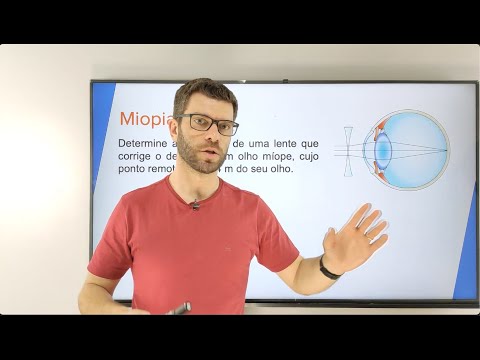
Olho humano - Miopia, Hipermetropia, Presbiopia e Astigmatismo.
Overview of the Human Eye
Basic Structure of the Eye
- The human eye consists of several key structures: cornea, pupil, ciliary body with ciliary muscles, lens (crystalline), and retina.
- The cornea and crystalline lens function as lenses; the cornea is a secondary lens while the crystalline is the primary one.
- The retina transforms electromagnetic waves into electrical impulses sent to the optic nerve and then to the brain.
Common Vision Problems
- Discusses common vision issues such as myopia (nearsightedness), hyperopia (farsightedness), presbyopia, and astigmatism.
- Myopia occurs when the eyeball is elongated, causing distant images to focus in front of the retina.
Understanding Myopia
Characteristics of Myopia
- In myopic eyes, light focuses before reaching the retina, leading to blurred distance vision but clear near vision.
- Correction for myopia involves using diverging lenses that help light rays spread out before entering the eye.
Visual Mechanics in Myopia
- A myopic person sees clearly up close because nearby objects form images on or near the retina.
Exploring Hyperopia
Characteristics of Hyperopia
- Hypermetropia is characterized by a shorter eyeball shape; distant images are focused behind the retina.
- People with hypermetropia struggle to see objects up close but can see far away clearly due to image formation behind their retinas.
Correction for Hyperopia
- Corrective lenses for hypermetropia are converging lenses that help bring light rays together before they reach the eye.
Presbyopia Explained
Nature of Presbyopia
- Presbyopia typically develops around age 40 due to muscle weakening or rigidity in the crystalline lens affecting near vision.
Symptoms and Corrections
- Individuals may hold reading materials further away as they experience difficulty focusing on close objects.
Understanding Astigmatism
Causes and Effects
- Astigmatism arises from imperfections in the cornea's shape, leading to distorted or blurred vision regardless of object distance.
Correction Methods
- Astigmatism requires cylindrical lenses for correction which address varying focal points caused by corneal irregularities.
Multiple Vision Issues in One Eye
Coexistence of Conditions
- It’s possible for an individual eye to have multiple refractive errors like myopia combined with presbyopia or astigmatism but not both myopia and hypermetropia simultaneously.
Intermediate Concepts in Optics
Vergence and Lens Types
- Vergence relates to how much a lens alters light direction; higher vergence indicates greater alteration between optical center thickness versus edges.
Advanced Calculations in Optics
Example Problem: Myopic Correction Calculation
- A problem example illustrates calculating vergence needed for correcting a myope whose remote point is four meters away using formulas related to focal length.
Summary on Vergence Formulas
- For correcting myopes, it’s essential that any corrective lens forms an image at their specific remote point distance which can be calculated through established formulas involving vergence.
Turn any video into a summary like this
YouTube links, meetings, lectures. With transcripts, search, and chat.