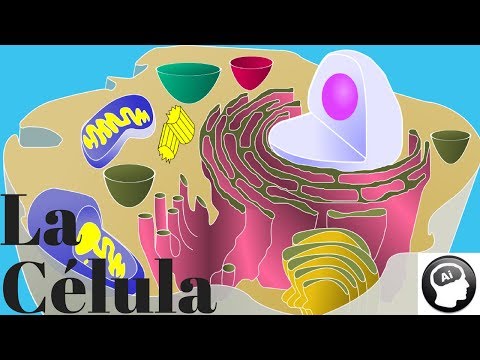
La Célula, organelos celulares, estructura y función |
Introduction to the Cell
In this section, we introduce the concept of cells and their basic structures.
Basic Structures of a Cell
- Cells are complex structures with common features such as the nucleus, cytoplasm, and plasma membrane.
- The nucleus is like the brain of the cell, while the plasma membrane separates the cell from its external environment and regulates interactions with neighboring cells.
- The cytoplasm is the space between the plasma membrane and nucleus, consisting of a semi-liquid phase called cytosol and a network of organelles.
Organelles in Detail
This section focuses on describing various organelles within a cell.
The Nucleus
- The nucleus is enclosed by a double membrane with pores that allow communication with the cytoplasm. It contains nucleoplasm and chromatin fibers made up of DNA associated with proteins called histones.
- Chromatin can be divided into euchromatin (active DNA) and heterochromatin (inactive DNA). The nucleus controls cellular activities and gene expression.
Ribosomes
- Ribosomes are small structures involved in protein synthesis. They lack membranes and consist of ribosomal RNA (rRNA) and proteins organized into two subunits. They play a crucial role in protein synthesis by translating messenger RNA (mRNA) information from the nucleus.
Endomembrane System
- The endomembrane system consists of the nuclear envelope, rough endoplasmic reticulum (ER), smooth ER, and Golgi apparatus. It synthesizes macromolecules, provides intracellular transport pathways, and aids in packaging and secretion.
Golgi Apparatus
- The Golgi apparatus is a stack of flattened vesicles involved in protein modification, glycosylation (adding sugars), and phosphorylation (adding phosphates). It plays a role in protein secretion and vesicle formation.
Vesicles
- Vesicles are small closed compartments that play essential roles in cellular metabolism, including storage, transport, and digestion. Examples include lysosomes derived from the Golgi apparatus that contain hydrolytic enzymes for cellular digestion.
Conclusion
This summary provides an overview of the cell's basic structures such as the nucleus, cytoplasm, and plasma membrane. We also discussed various organelles like ribosomes, endomembrane system components (rough ER, smooth ER, Golgi apparatus), and vesicles (lysosomes). Understanding these structures is crucial for comprehending cellular functions and processes.
Timestamps have been associated with bullet points to facilitate studying the transcript.
Enzymes and Mitochondria
This section discusses the role of enzymes in hair formation and degradation, as well as the structure and function of mitochondria.
Enzymes in Hair Formation and Degradation
- Enzymes such as peroxidase and catalase participate in the formation and degradation of hair. They convert hydrogen peroxide into water and oxygen.
Structure and Function of Mitochondria
- Mitochondria have a double membrane, with an outer membrane and inner membrane that contains numerous folds called cristae.
- The main function of mitochondria is to generate energy through ATP synthesis via cellular respiration.
Centrosomes, Cytoskeleton, and Cell Membrane
This section covers centrosomes, cytoskeleton, and the cell membrane.
Centrosomes
- Centrosomes are conglomerates composed of microtubules located near the cell nucleus. They are known as the organizing center for microtubules.
Cytoskeleton
- The cytoskeleton is a network of fibrous filaments that provide support and shape to cells. It helps maintain or modify cell shape according to cellular requirements.
- The cytoskeleton is composed of microfilaments (primarily actin), microtubules (formed by tubulin), and intermediate filaments.
Cell Membrane
- The cell membrane is composed of lipids, integral proteins, glycoproteins, steroids (such as cholesterol), phospholipids, proteins, and lipid groups. It acts as a semipermeable barrier between the cell's interior and its surroundings.
- The cell membrane delimits and protects the cell, exhibits selective permeability, participates in cellular recognition processes, and allows interaction between cells.
Summary
This section provides a summary of the topics covered in the video.
- The video discussed the nucleus, cell membrane, cytoplasm, organelles, centrosomes, cytoskeleton, and their functions.
- It highlighted the role of enzymes in hair formation and degradation.
- Mitochondria were described as double-membraned structures responsible for energy generation through ATP synthesis.
- Centrosomes were identified as organizing centers for microtubules.
- The cytoskeleton was explained as a network of fibrous filaments that maintain cell shape and facilitate cellular processes.
- The composition and functions of the cell membrane were also discussed.