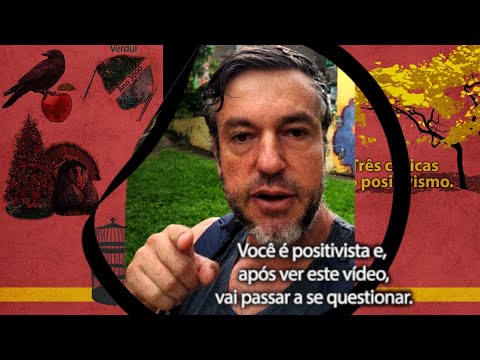
Três Críticas ao Positivismo #15
Introduction
In this section, the speaker introduces the topic of the video and discusses how people often arrive at truths through observation and examples. The speaker aims to challenge this way of thinking and introduce alternative perspectives.
- The majority of people believe that we arrive at truths through observation and examples.
- The speaker hopes to challenge this perspective.
The Fallacy of the Straw Man
In this section, the speaker introduces the concept of the "straw man" fallacy, which involves distorting a theory or narrative in order to make it easier to refute. They then discuss how simplifications can also lead to misunderstandings and misrepresentations.
- The "straw man" fallacy involves distorting a theory or narrative in order to make it easier to refute.
- Simplifications can also lead to misunderstandings and misrepresentations.
The Mannequin vs. The Scarecrow
In this section, the speaker compares two different types of figures: scarecrows, which are meant to repel animals but are poorly made and do not resemble humans; and mannequins, which are designed to attract humans with their beauty. They use these comparisons as metaphors for oversimplification versus complexity.
- Scarecrows are poorly made figures that repel animals but do not resemble humans.
- Mannequins are beautiful figures designed to attract humans.
- These figures serve as metaphors for oversimplification versus complexity.
Criticisms of Positivism
In this section, the speaker discusses three theories that criticize positivism: David Hume's philosophy, logical positivism from the Vienna Circle, and Karl Popper's negativism. They argue that positivism is often too simplistic and can lead to intolerance.
- David Hume's philosophy criticizes positivism.
- Logical positivism from the Vienna Circle also critiques positivism.
- Karl Popper's negativism is another theory that challenges positivism.
- Positivism can be too simplistic and lead to intolerance.
The Limitations of Knowledge
In this section, the speaker argues that people often have an overly optimistic view of knowledge and its capabilities. They discuss how this can lead to intolerance towards those who hold different perspectives or beliefs.
- People often have an overly optimistic view of knowledge and its capabilities.
- This can lead to intolerance towards those who hold different perspectives or beliefs.
Paradox of the Black Crow and Nelson Goodman's Theory
In this section, the speaker presents two arguments against the positivist perspective. The first argument is the paradox of the black crow presented by Carl Gustav Hempel, which shows that instances that confirm a theory do not necessarily prove it. The second argument is Nelson Goodman's theory on induction, which suggests that confirming instances do not necessarily lead to a true conclusion.
Paradox of the Black Crow
- Instances that confirm a theory do not necessarily prove it.
- The paradox of the black crow is an example of how confirmation bias can lead to false conclusions.
- The paradox shows that using examples to confirm a theory does not guarantee its truthfulness.
- Call Hampel believes in logic but argues that induction does not confirm theories.
Nelson Goodman's Theory on Induction
- Confirmation bias leads to false conclusions when using examples to confirm a theory.
- Induction is based on the belief that examples confirm theories, but this is not always true.
- Using examples to confirm a theory can lead to absurd and illogical conclusions.
- Nelson Goodman's theory suggests that confirming instances do not necessarily lead to a true conclusion.
Nelson Goodman's New Riddle of Induction
In this section, the speaker discusses Nelson Goodman's new riddle of induction and how it challenges traditional views on induction.
The New Riddle of Induction
- Traditional views on induction suggest that confirming instances support a universal claim.
- However, according to Goodman's new riddle of induction, there are many ways to describe the same confirming instances.
- The new riddle shows that using examples to confirm a theory is not a reliable method of proving its truthfulness.
- Induction is based on the belief that examples confirm theories, but this is not always true.
The Paradox of Confirmation
- The paradox of confirmation shows that using examples to confirm a theory can lead to absurd and illogical conclusions.
- Confirmation bias leads people to seek out confirming instances and ignore disconfirming ones.
- The paradox suggests that we need more than just confirming instances to prove a theory's truthfulness.
[CUTOFF_LIMIT]
Turn any video into a summary like this
YouTube links, meetings, lectures. With transcripts, search, and chat.