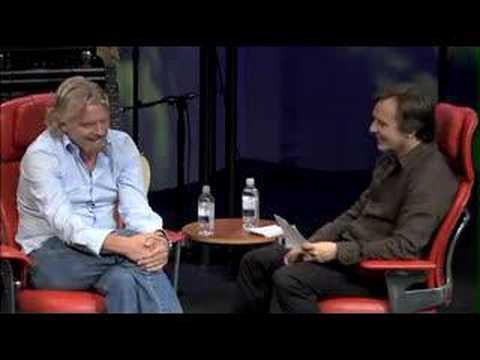
Life at 30,000 feet | Richard Branson
Introduction
Chris Anderson welcomes Richard Branson to TED and they discuss the interesting people at the event.
Meeting Interesting People
- Richard Branson shares that everyone at TED is interesting.
- He mentions meeting Goldie Hawn and apologizing for a past incident involving her wedding ring.
Starting Companies
Chris Anderson asks Richard Branson about his experience starting companies.
Running Companies
- Richard Branson believes that if you can run one company, you can run any company.
- He emphasizes the importance of finding the right people, inspiring them, and drawing out their best qualities.
- He enjoys learning and taking on challenges to turn things upside down.
Starting Virgin Atlantic
Chris Anderson asks Richard Branson about his decision to start Virgin Atlantic.
Creating a Better Airline Experience
- After experiencing an unpleasant flight with another airline, Richard Branson decided to create an airline that he would enjoy flying on.
- Despite being advised against it, he sold Virgin Records to invest in Virgin Atlantic in order to protect the jobs of those working for both companies.
- The move proved successful in hindsight after Napster's impact on the music industry.
The Virgin Brand
Chris Anderson asks Richard Branson about his use of the Virgin brand across various industries.
What Does the Brand Stand For?
- Richard Branson believes that the Virgin brand stands for quality and having fun while doing business.
- He enjoys shaking up industries and doing things differently than others.
- While some launches have not been as successful as others (such as Virgin Brides), he takes these experiences in stride.
Richard Branson: Life at 30,000 feet
In this TED Talk, Richard Branson shares his experiences as an entrepreneur and adventurer. He talks about some of the challenges he has faced in his various business ventures and how he has overcome them. He also discusses his latest project, Virgin Galactic, which aims to take people into space.
Launching a Megastore
- Richard Branson was launching a megastore in Los Angeles.
- The audience asks if the hair on the screen is real.
- Richard confirms that it is not.
Dropping in for Tea
- Richard talks about dropping in for tea.
- It was a wonderful car-boat event with TEDsters.
- The audience laughs.
Taking Risks
- Richard talks about taking risks with employees in America.
- He mentions that lawyers advise against it but he still does it anyway.
"The Pammy"
- Richard talks about launching "The Pammy," a cola bottle shaped like Pamela Anderson.
- The bottle kept tipping over.
Virgin Brides
- Richard talks about Virgin Brides and an award they received.
Knighthood
- Richard talks about being knighted by the Queen of England.
- He mentions that nobody ever calls him Sir Richard except for Americans who think there's a Shakespearean play happening.
Space Travel
Virgin Galactic Spaceship
- A video shows the Bert Rutan designed spaceship for Virgin Galactic.
- It will be ready in 12 months and then undergo extensive testing before people can take rides into space.
Philippe Starck Design
- Philippe Starck designed the interior of the spaceship and is building a space station in New Mexico.
- The space station will be one giant eye that people can see from space.
Engine Design
- Philippe Starck would not be the best person to design the engine for the spaceship.
- Richard mentions that Philippe is quite erratic.
Ballooning and Boating Expeditions
- Richard talks about his exploration bug and how he has regretted it many times.
- He mentions getting pulled out of the sea six times by helicopters during ballooning and boating expeditions.
- Each time, he didn't expect to come home alive.
Crossing the Atlantic in a Hot Air Balloon
- Richard talks about crossing the Atlantic in a hot air balloon for the first time.
- They had to build a hot air balloon capable of flying in the jet stream.
- They weren't sure if it would survive 200, 220 miles an hour winds found up there.
- During lift off, they were crossing every finger hoping that everything would hold together.
Surviving a Balloon Crash and PR Value
Richard Branson talks about his experience surviving a balloon crash and how he made the decision to use the balloon as a parachute. He also discusses the PR value of his adventures.
Surviving a Balloon Crash
- Branson had about half an hour's fuel left when he realized that jumping out of the capsule would only give him a couple of minutes to live.
- He climbed back into the capsule, wrote some notes to his family, and tried to make sure he was making the right decision.
- Branson decided to use the enormous balloon above him as a parachute and managed to fly it down through the clouds before hitting the sea.
- He threw himself overboard about 50 feet before hitting the sea, while the balloon shot back up without him.
PR Value
- Branson's adventures have had incredible PR value for his companies.
- The PR experts said that as an airline owner, heading off in balloons and boats and crashing into seas was not good for business.
- Despite this, Branson continued with his adventures.
Dyslexia and Leadership
Richard Branson talks about being dyslexic and how it affected him academically. He also discusses how he excelled at sports in school and became captain of both cricket and football teams.
Dyslexia
- Branson was dyslexic which meant he had no understanding of schoolwork whatsoever.
- He left school when he was 15 years old because if he wasn't interested in something, he couldn't grasp it.
- As someone who is dyslexic, there were some quite bizarre situations such as not knowing the difference between net and gross during board meetings.
Leadership
- Despite struggling academically, Branson was a natural leader and captain of both the cricket and football teams in school.
- He was a bit of a maverick and rebel but excelled at sports.
Parenting and Childhood
Richard Branson talks about his childhood experiences with his mother who believed in making her children stand on their own two feet from an early age. He also discusses how he believes that you can't mollycoddle your kids too much.
Childhood
- Branson's mother believed that her children needed to stand on their own two feet from an early age.
- She did things to them which now she would be arrested for, such as pushing them out of the car and telling them to find their own way to Granny's.
- Branson believes that if you're bringing up kids, you just want to smother them with love and praise and enthusiasm.
Parenting
- There is a dilemma about how to bring up wealthy kids.
- Branson doesn't think you can mollycoddle your kids too much.
The Sex Pistols and the Law
Richard Branson talks about how the Sex Pistols got arrested for using the word "venereal disease" in public, and later for using the word "bollocks" on their album. He also shares how a linguistics expert helped them defend themselves in court.
The Arrests
- The police threatened to arrest the Sex Pistols for mentioning "venereal disease" in public.
- They changed it to "social diseases," but were still arrested when they switched back to "VD."
- The police also arrested them for using the word "bollocks" on their album.
- John Mortimer, a playwright, defended them in court.
Defending Themselves
- Richard Branson contacted a linguistics expert from Nottingham University to help come up with a different definition of "bollocks."
- The professor explained that it was actually a nickname given to priests in the eighteenth century.
- Their key witness argued that it should have been called "Never Mind the Priest, Here's the Sex Pistols."
- The judge reluctantly found them not guilty.
Business Ethics and Life Balance
Richard Branson discusses his views on business ethics and life balance.
Business Ethics
- Richard Branson believes that treating people well is important for becoming a successful business leader.
- He also believes that extreme wealth comes with extreme responsibility, and that individuals should use their money to create new jobs or tackle issues around the world.
Life Balance
- Richard Branson believes that being a father is incredibly important, and he spends three months away on holiday with his children every year.
- He also has a small island in the Caribbean where he can take his family and keep in touch with work.
Capitalist Philanthropy
Richard Branson talks about capitalist philanthropy and how it can be used to address global issues.
Capitalist Philanthropy
- Richard Branson believes that capitalism works, but extreme wealth should be used to create new jobs or tackle global issues.
- He launched a prize for extracting carbon out of the Earth's atmosphere and methane as well.
- He is also working on coordinating efforts to address social problems in Africa through something called "the war room."
Business Leaders and Philanthropy
Richard Branson discusses the role of business leaders in philanthropy, particularly in Africa. He emphasizes the importance of consistency and sustainability in aid efforts.
The Risks of Over-Simplification
- Branson acknowledges the risk that Western business leaders may oversimplify complex problems in Africa.
- He stresses the importance of working with African governments to address issues like HIV/AIDS.
- Consistency is key; aid efforts must be sustained over time to have a lasting impact.
Entrepreneurial Know-How
- Business leaders can bring their entrepreneurial skills to bear on social problems.
- Branson cites his own company's efforts to set up clinics in Africa that provide free treatment for diseases like malaria, TB, and HIV/AIDS.
- These clinics are designed to be self-sustaining by charging for some services.
Motivations for Philanthropy
- Branson responds to criticism that his philanthropic work is driven by a desire for a positive public image or guilt avoidance.
- He argues that he wants to make a difference in people's lives and hopes to continue doing so for many years.
- Branson cites Sergey Brin and Larry Page as examples of wealthy individuals who care about making a positive impact on the world.
Legacy and Inspiration
- When asked about his legacy, Branson says he doesn't think too much about it but hopes to make a difference while he can.
- He notes that he was inspired by other successful businesspeople when starting out himself, including those who took a different approach than ruthless competition.
- The interviewer thanks Branson for inspiring him as well.
Turn any video into a summary like this
YouTube links, meetings, lectures. With transcripts, search, and chat.