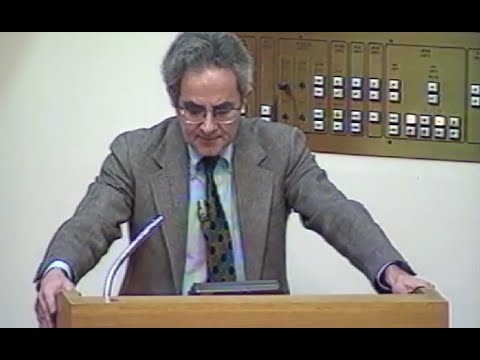
Thomas Nagel on Reason - Two Lectures (1995)
Understanding Reason: Objective vs. Subjective Justification
The Nature of Understanding and Justification
- The discussion centers on the origins of understanding and justification, questioning whether they stem from objective principles or individual perspectives.
- The speaker aims to defend a rationalist perspective against subjectivism, exploring if reasoning is inherently personal or universally applicable.
Reason as a Universal Authority
- Reason is portrayed as a potential court of appeal that transcends both societal norms and personal biases, suggesting it has universal authority.
- This concept implies that reason allows individuals to distance themselves from common opinions without merely asserting their individuality.
Skepticism about Reason
- The prevalence of skepticism regarding reason in contemporary culture is noted, with some forms being labeled as irrationalism.
- The speaker expresses concern over how creatures with biological limitations can access universally valid methods of thought, highlighting an ongoing philosophical dilemma.
Critique of Subjectivism
- Crude subjectivism interprets disagreements in belief as mere contests for power among different frames of reference, lacking objective judgment criteria.
- In contrast, the idea of reason suggests non-relative methods for justifying beliefs that aim for universal truth rather than community validation alone.
Generality in Reasoning
- A key characteristic of reasoning is its generality; reasons must apply beyond individual circumstances to justify broader conclusions effectively.
- Any deviation from this generality requires further justification based on universally applicable reasons, emphasizing the need for systematic thinking recognized by others.
Consequences of Relativism and Subjectivism
- The rise of subjectivism contributes to intellectual laziness and undermines serious arguments within humanities and social sciences by dismissing objective discourse as mere opinion.
Understanding the Role of Reason in Human Thought
The Nature of Reason
- The speaker argues that reason is a category of thought applicable to beliefs, desires, intentions, and decisions, suggesting it has both theoretical and practical implications.
- This perspective is termed the "rationalist position," which seeks to reconcile the ambitious goals of reasoning with its everyday application in human thought.
Philosophical Influences
- The speaker expresses alignment with philosophers like Descartes and Fraga while critiquing limitations imposed by thinkers such as Hume, Kant, and Wittgenstein regarding human reason's reach.
- A general tendency among various philosophical arguments reduces the objective claims of reason, which the speaker aims to challenge throughout their discussion.
Subjectivism vs. Objectivity
- The speaker opposes a form of subjectivism that questions the objectivity of reason based on personal or social influences but believes this view lacks intelligibility.
- They argue that while some judgments may be discredited as subjective, one must still rely on certain judgments that are not subject to similar challenges.
Challenges to Rationality
- Both affirmations and denials about reason present problems for understanding; being rational requires accountability for thoughts beyond mere expressions of personal viewpoints.
- Doubts about reason often arise from psychological explanations rather than logical errors, leading individuals to question their moral or political convictions' foundations.
Limits of Self-Awareness
- Pursuing self-awareness can falter when extending external psychological critiques too far; if nothing qualifies as true reasoning, it undermines our ability to understand ourselves.
- The idea that all convictions could stem from local or contingent sources raises questions about what basis we have for forming such views about ourselves.
Implications of Relativity
- If one posits that all reasoning is culturally contingent without universal validity, it creates a paradox where such claims cannot be substantiated logically.
- Assertions about relativity imply an objective context; thus claiming everything is subjective becomes nonsensical since it contradicts itself by denying any objective truth.
Subjectivism and Its Implications
The Nature of Subjectivism
- Some subjectivists, identifying as pragmatists, present their views without requiring justification for acceptance or rejection. This perspective is merely a reflection of personal agreement.
- The critique of incoherent ideas, such as relativism, remains relevant; questioning whether a claim about truth applies to itself can often disprove it.
Reason and Criticism
- Critiquing our rational claims necessitates the use of reason itself, which may limit but not eliminate the domain of rational judgments.
- Subjectivity requires an objective framework to contextualize individual perspectives and responses.
Kant's Epistemology
- Kant’s division between subjective reasoning (our perceptions) and the objective reality (the "ding an sich") illustrates a fundamental epistemological challenge.
- Even extreme subjectivism maintains an objective frame by positing that there exists a way things are in themselves, influencing how we perceive them.
Limits of Knowledge
- The discussion does not delve into Kant's specific views but highlights the tension between perspectival knowledge and non-perspectival thought.
- All reasoning falls on the perspectival side while pure ideas remain unknowable on the non-perspectival side.
Authority of Human Reason
- Emphasizing universality over absolute certainty allows for a broader defense of human reason beyond what Kant proposed.
- Descartes' cogito reveals limits to self-examination; one cannot fully escape one's own thoughts when evaluating beliefs.
Skepticism and Rational Thought
- Epistemological skepticism relies on rational thought; it identifies logical possibilities based on evidence that reason must navigate.
- Skepticism cannot be total because it emerges from arguments reliant on reason itself, revealing inherent limitations in doubt.
Inescapable Thoughts
- Descartes suggests some thoughts are unavoidable; they cannot be dismissed as mere appearances without undermining our understanding of ourselves.
Understanding the Nature of Thought and Reasoning
The Existence of Thoughts
- The recognition of a single thought's existence leads to an understanding that numerous thoughts can persist, not limited to "I exist." This concept extends to practical and moral reasoning.
Cultural Influence on Reasoning
- Attempting to adopt a completely external viewpoint on our moral or arithmetical beliefs is futile. While cultural influences may prompt re-examination, it must be through first-order reasoning rather than abandoning these domains for cultural anthropology.
External Explanations and Moral Questions
- We must evaluate whether external explanations justify withdrawing assent from propositions in arithmetic or ethics. This includes recognizing subjective character without altering content.
Challenges to Morality and Ethics
- Addressing claims that individual rights are mere ideology requires reassessing the reasons for respecting them. This reflects a new moral question rather than exiting moral reflection entirely.
Objectivity in Science and History
- Challenges against the objectivity of various fields (science, history) should be met with further reasoning within those fields. Revision is possible but must follow established processes rather than dismiss them outright.
Subjectivism vs. Rational Assessment
- Any subjectivist claim must compete with existing beliefs; it cannot assume precedence without providing reasons for reinterpretation of plausible thoughts from within its framework.
Complexity in Defending Reason
- The structure of rational assessment reveals itself through our thought processes, raising questions about self-understanding amidst biological fallibility and external influences.
Authority of Thought Processes
- Fundamental thoughts' authority emerges internally; thus, resisting the primacy of self-understanding is crucial as disputes over reason's authority often reveal inequalities between attackers and defenders.
Justification Within Practices
- Critics argue that justification stems from contingent dispositions lacking universal backing. However, defenders must demonstrate that methods within specific inquiries possess inexhaustible authority against relativization attempts.
Local Consensus vs. Universal Objectivity
Exploring Objectivity and Subjectivism in Philosophy
The Nature of Solidarity and Objectivity
- The desire for solidarity within a community can lead to popular yet unexamined views, which may appear self-evident but are inconsistent with the consensus needed for objectivity.
- Scientific and mathematical beliefs are considered true independently of human agreement; their truth is not contingent on collective acceptance.
- Subjectivists often argue that they do not conflict with common scientific or ethical judgments, merely explaining how these beliefs function within discourse.
Reality and Language Games
- Philosophers like Kuhn and Derrida suggest it is pointless to question the reality of entities like mountains or neutrinos, emphasizing utility over independent existence.
- The discussion around whether reality exists independently from our language suggests that practical engagement with concepts (like mountains) does not negate their objective existence.
Challenges to Subjectivism
- Claims that objectivity is merely about solidarity contradict categorical statements about truths such as mathematical facts or ethical judgments.
- The subjectivist's insistence on the relativity of truths fails when confronted with universally accepted statements, highlighting a fundamental inconsistency in their position.
Understanding Truth and Belief
- Commonplaces about knowledge—such as the existence of unknown truths or the independence of true beliefs—are inadequately addressed by subjectivist claims framed as mere language games.
- To take subjectivism seriously requires interpreting it as a genuine alternative worldview, which must then be subjected to rational assessment for credibility.
Rational Assessment and Consensus
- Reason and objectivity should not be seen as grounded in consensus; rather, consensus arises from individuals converging towards truth through reasoning processes.
- A consensus on complex mathematical concepts (e.g., non-denumerability of real numbers) stems from conclusive demonstrations rather than collective agreement alone.
Limitations of Naturalistic Views
- Fundamental thoughts cannot be fully interpreted through psychological or sociological lenses; they resurface in their original form regardless of contextual framing.
- While some philosophical ideas may evolve or be refuted, there remains an outer boundary defined by non-relative interests that shape our understanding of logic and ethics.
Final Thoughts on Logic and Ethics
Philosophical Reflections on Language and Subjectivity
The Nature of Existence and Language
- The speaker reflects on the paradox of claiming ownership over the world through language, emphasizing that existence precedes individual perception.
- Ethical and logical thoughts are discussed as lacking a first-person element, suggesting that reasoning is rooted in deep-seated responses rather than subjective qualifications.
Subjectivism vs. Objectivism
- The speaker critiques solipsism, arguing that the language used to describe the world does not validate subjectivist claims about reality.
- A contest between subjectivist and objectivist perspectives is highlighted, with emphasis on justifications dominating over mere recognition within language practices.
Limitations of Personal Statements
- Adding personal qualifiers to statements (e.g., "this is my form of life") does not contribute meaningful content to discussions about objective truths.
- The idea that non-subjective thoughts exist is challenged; even if they do, someone must still think them, complicating claims of purely objective reasoning.
Challenges in Philosophical Discourse
- A tautology cannot resolve disputes or establish correctness among differing viewpoints; this raises concerns about relying solely on ordinary statements for justification.
- There’s a tension between wanting definitive judgments (like "two plus two equals four") and the risk of falling into subjectivism without positive assertions.
Pragmatism and Reasoning
- The impulse to qualify arguments can undermine philosophical clarity; resisting this temptation requires acknowledging how first-order reasoning prevails in discussions.
- A pragmatist approach may avoid making objective claims while still providing attractive reasons based on shared cultural contexts.
Generality in Judgments
- This pragmatic stance necessitates refraining from labeling dissenters as wrong, which challenges traditional ambitions in reasoning.
Understanding the Role of Logic and Experience
The Interplay Between Individual Experience and General Principles
- The discussion begins with the relationship between individual experiences and overarching principles of logic, which help construct a coherent worldview governed by general laws.
- An alternative to subjectivism is questioned, emphasizing that certain thoughts are unavoidable, suggesting an inherent aspect of human cognition.
- It is noted that many types of reasoning do not strictly adhere to logical rules but may stem from evolutionary dispositions.
Constructing a Coherent Worldview
- The speaker critiques the seductive nature of constructing a picture of contingent creatures reacting in specific ways, questioning the basis for such constructions.
- There is an assertion that framing these creatures within an acceptable worldview cannot merely be seen as manifestations of personal dispositions or limitations.
The Nature of Logical Thoughts
- Simple logical or arithmetical thoughts are highlighted as fundamental elements in anyone's thinking process, immune to doubt despite their complexity.
- The example illustrates that even if one imagines being incapable of basic arithmetic truths (like 2+2), it does not undermine their validity.
Conviction Beyond External Influences
- A personal anecdote about believing in mathematical truths despite external influences (like affection for a teacher) emphasizes the independence of logical convictions from subjective experiences.
- Modifying beliefs to avoid contradictions is discussed; this process reflects deeper cognitive constraints rather than mere subjective perspectives.
Non-Contradiction and Relativism
- The principle of non-contradiction is essential; any relativistic framework must ultimately conform to this principle.
- Euclid's proof regarding prime numbers serves as an example where consensus has no role; logical conclusions stand independently from agreement or conformity.
Authority in Thought Processes
- Mistakes in judgment about inconceivable propositions must be corrected at the same level they were made, requiring positive understanding rather than external information alone.
Understanding Contingency in Thought
The Nature of Human Thought
- Humans are described as products of biological development and environmental influences, leading to contingent psychologies that express themselves through various languages and cultures.
- Despite the variability in human experience, fundamental logical truths (e.g., "two plus two equals four") remain unchallenged by these contingencies.
The Limitations of Empirical Thoughts
- Empirical thoughts do not allow us to transcend basic logical principles; we cannot temporarily set aside foundational beliefs like the validity of contraposition.
- Descartes' first meditation is critiqued for entertaining the idea that an evil demon could manipulate his understanding of arithmetic truths, which undermines rational thought.
The Challenge of Doubting Basic Truths
- Descartes faces a dilemma: he must choose between believing in mathematical truths or doubting them due to potential manipulation by an external force.
- This dilemma is deemed unintelligible because it suggests alternatives that lack coherent meaning within the framework of established logic.
Implications for Rationality and Belief
- Engaging with the possibility of manipulation implicitly affirms Descartes' commitment to logical thought, indicating that some forms of reasoning cannot be doubted without contradiction.
- Descartes posits that God could alter eternal mathematical truths, but this notion is criticized for being unintelligible based on our understanding of mathematics.
Hierarchy Among A Priori Judgments
- There exists a hierarchy among a priori judgments; while some concepts may seem inconceivable, they should not lead us to doubt what we understand clearly.
- The argument suggests that if God's omnipotence can explain inconceivability, it does not justify distrust in established mathematical truths.
The Structure of Reasoning and Doubts
- Doubts about reasoning often involve reasoning itself; thus, skepticism must engage with foundational logical principles rather than dismiss them outright.
- Every hypothesis inherently contains logic; even doubts require arguments demonstrating their plausibility against existing beliefs.
Language and Thought Interconnection
- Language use precedes its analysis; understanding our cognitive processes requires immediate engagement with first-order thoughts about reality.
Understanding the Nature of Reason
The Validity of Contraposition
- The speaker discusses the acceptance of contraposition as valid, emphasizing that this validity is independent of personal belief. It highlights a rationalist perspective where claims to mind independence are maintained within subjective frameworks.
Subjectivism and Its Limitations
- The subjectivist's arguments often extend beyond mere expressions of basic responses, introducing contradictions that challenge the original statements' integrity.
- These contradictions reveal a deeper issue: comments made by subjectivists can only be understood as objective claims, undermining their own framework.
Impersonal Thoughts and Reasoning
- A key takeaway is that reflections on any topic lead to thoughts devoid of first-person content, suggesting an impersonal nature to reasoning.
- Attempts to reinterpret these impersonal thoughts through personal or communal lenses fail, as they cannot adequately capture their essence.
The Relationship Between Particular and Universal in Reason
Understanding Infinity Through Reason
- The speaker notes the puzzling relationship between particular experiences and universal truths in reason, suggesting that reason connects finite beings with infinite concepts.
- This connection raises questions about whether reason can truly bridge local activities with universal truths.
Grasping Infinity
- The concept of infinity is introduced through natural numbers; we recognize its existence even if we cannot fully comprehend it.
- Counting serves as a foundation for understanding infinity—each number has a successor, illustrating how finite practices hint at infinite realities.
Implications for Human Understanding
- Everyday counting represents just the beginning of an endless series; our limited experience does not diminish the existence of something larger.
- This realization emphasizes that our finite abilities must be contextualized within an infinite framework to make sense of them.
The Irreducibility of Reason
Finite vs. Infinite Perspectives
- The idea that finite practices can explain infinite concepts is challenged; instead, it’s suggested that finitude should be understood through infinity.
Expanding Views on Reason
- Engaging deeply with reasoning reveals its complexity—it appears small from outside but expands into vastness when examined closely.
Discovering Infinity Through Inquiry
Understanding the Relationship Between Rational Capacities and the World
The Interconnection of Self-Description and Worldview
- Our understanding of ourselves is inherently linked to our understanding of the world; we cannot create a narrative about our rational capacities that contradicts this broader context.
- Descriptions of ourselves, including our rational abilities, must align with how we understand the world, particularly in relation to counting and natural numbers.
Counting and Infinite Series
- Counting should be viewed as applying a successor relation that generates an infinite series; any external perspective that overlooks this aspect is inadequate.
- The internal view from within mathematical practice reveals insights not captured by external reductionist approaches, highlighting failures in behavioristic reductions in philosophy.
Internal vs. External Perspectives
- Consciousness's internal perspective challenges attempts to reduce it solely to physiological or behavioral explanations; an adequate account must incorporate internal experiences.
- The objectivity of science mirrors these discussions, where responses to relativism must emerge from within the domain being critiqued.
Addressing Relativism in Scientific Beliefs
- To counter claims that scientific methods are merely culturally contingent, one must recognize their independent authority beyond historical context.
- Relativism regarding natural science suggests viewing physics externally, which fails because scientific reasoning stands as a robust structure beyond socio-historical commentary.
Subjectivism and Scientific Authority
- A relativist's claim lacks sufficient leverage against the objective validity of scientific methods; such claims can only undermine themselves when scrutinized internally.
- When faced with subjectivist qualifications on scientific theories, one must weigh the overwhelming evidence supporting those theories against historicist arguments.
The Challenge of Finite Beings Thinking Universally
The Role of Science and Religion in Understanding Reality
The Nature of Science and Its Limitations
- The ultimate goal of science is to learn from the universe, relying on facts but recognizing that this alone is insufficient for deeper understanding.
- Facts are valued not just for their empirical nature but because they connect to a greater, beautiful, sacred reality that inspires worship and aspiration.
- Knowledge from mathematics and philosophy gradually influences our core being, impacting our lives through ideal and eternal truths rather than mere practical importance.
Anti-Reductionism and Platonic Views
- The speaker highlights an anti-reductionist stance that contrasts with contemporary views, suggesting a deep connection between human intuition and nature in forming hypotheses.
- This perspective raises concerns about associating it with religious or quasi-religious worldviews, as rationalism often carries a spiritual undertone compared to empiricism.
Fear of Religion in Modern Intellectual Life
- There exists a fear of religion that affects modern thought; this fear stems not from hostility towards specific religions but from a deeper apprehension about the implications of belief itself.
- The speaker shares personal experiences with this fear, expressing discomfort at the intelligence of religious believers while wishing for atheism to be true.
Scientism and Evolutionary Biology
- A tendency towards scientism leads to overreliance on evolutionary biology to explain all aspects of life, including human consciousness.
- Darwin's theories provided secular culture relief by removing purpose and design as inherent features of existence, framing them instead as incidental outcomes.
Mind vs. Physical Laws: A Complex Relationship
- Despite fears surrounding physical laws potentially posing a religious threat, atheists should not be alarmed by fundamental mind-world relations either.
- It’s possible to accept non-theistic worldviews without reducing everything to quantum physics; there may exist unknown laws consistent with known physics that explain consciousness development.
Understanding the Universe and Reason
The Nature of Existence and Consciousness
- The universe's ability to generate organisms with minds capable of understanding it is seen as a fundamental feature, echoing a quasi-religious sentiment. This idea aligns with Spinozistic philosophy, suggesting an intrinsic connection between consciousness and the cosmos.
- A more mind-friendly cosmology would need to include laws that not only explain intelligent life but also account for the specific initial conditions necessary for its existence, such as the formation of molecules and galaxies.
Evolutionary Epistemology
- Robert Nozick's work in "The Nature of Rationality" endorses an evolutionary explanation for human reason, proposing that reason is shaped by facts rather than vice versa, challenging Kantian perspectives on knowledge.
- Nozick argues that our reasoning capabilities are influenced by reality, which selects what seems evident to us; however, this does not provide independent justification for reason itself. Instead, it grounds reason in empirical facts without guaranteeing their truthfulness.
Limitations of Evolutionary Hypotheses
- The evolutionary hypothesis offers a naturalistic explanation for reason but does not justify its validity or reliability independently; thus, it remains part of ongoing scientific discourse rather than foundational philosophy.
- There is skepticism about whether reasoning can be trusted if it is merely a product of natural selection; this raises concerns about its application in fields like mathematics and science where objective truth is paramount.
Trusting Reason Beyond Evolution
- For confidence in reasoning to persist despite evolutionary origins, one must believe that logical rules are correct independently from biological programming; otherwise, trust in reasoning becomes problematic.
Understanding the Nature of Reasoning
The Relationship Between Thought and Psychological Dispositions
- One cannot simultaneously engage in logical reasoning while viewing those thoughts merely as psychological dispositions, regardless of their biological origins.
- If one considers certain psychological dispositions as reliable methods for reaching truth, they must rely on other thoughts without reducing them to mere dispositions.
Epistemological Foundations
- There must be foundational thoughts in any reasoning process that are accepted from an internal perspective rather than viewed as biologically programmed.
- An evolutionary explanation of rationality is inherently incomplete; even if believed, it requires acknowledgment of the independent validity of reasoning outcomes.
The Universality of Reasoning Methods
- The methods of reasoning employed by humans are not exclusive but belong to a broader category applicable to any species capable of thought.
- Attempts to create a naturalistic account of reasoning will always fall short because reason itself cannot be fully understood as just another natural phenomenon.
Trusting Reason and Its Reliability
- Understanding reason requires reliance on its own principles; one cannot trust a natural process without understanding its reliability through reason itself.
- Engaging with the world necessitates making decisions about beliefs and actions based on reason, which transcends individual impulses or thoughts.
Infinity and Finite Counting
- Questions arise regarding how concepts like infinity apply to cultures with limited numerical systems; imagination plays a crucial role in grasping these ideas.
- Even without iterative notation, individuals can recognize that adding one to a set results in a different cardinality, indicating an implicit understanding of infinity.
Self-Justification and Rationality
- The discussion shifts towards whether reason can justify itself despite being contingent; distinguishing self-evidence from internal grounds is essential.
- It’s possible to hold two conflicting beliefs simultaneously—acknowledging potential errors while asserting the existence of universally valid principles.
Indubitability vs. Rational Domain
- A distinction is made between indubitability and the independence of rationality; correcting perceived self-evident reasoning involves deeper engagement with rational thought processes.
Understanding Perspectives on Natural Numbers
The Debate on Recognition of Natural Numbers
- Deborah raises a question about the complexity of recognizing natural numbers, highlighting the contrast between individuals who acknowledge only a hundred distinct numbers versus those who believe in an infinite quantity.
- The discussion emphasizes that this difference in perspective may not solely be subjective; both views could be considered objective yet challenging to reconcile.
- John Dupre's example is introduced to illustrate cultural relativity in understanding numbers, suggesting that the recognition of infinitely many natural numbers might not be universally accepted.