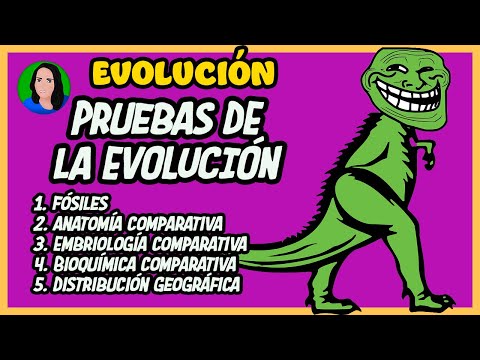
Pruebas científicas de la evolución | Evolución |
Understanding Evolution: Evidence and Concepts
Defining Evolution
- Evolution is described as cumulative changes in groups of organisms over time, with evidence found in various scientific fields.
- Key areas providing evidence for evolution include:
- Fossil records
- Comparative anatomy
- Comparative embryology
- Biochemical comparisons
- Geographic distribution of species
Fossils and Their Significance
- Fossils offer insights into species that existed millions of years ago, revealing evolutionary changes and the persistence of certain organisms.
- Paleontology studies fossils to interpret ancient life forms, highlighting their importance in understanding evolutionary history.
Homologous vs. Analogous Structures
- Homologous structures are anatomically similar features inherited from a common ancestor (e.g., whale fins and human arms). This suggests modification rather than creation from scratch.
- Analogous structures have different anatomical origins but serve similar functions (e.g., wings of insects vs. birds), indicating convergent evolution towards similar functions despite different ancestries.
Vestigial Structures and Their Implications
- Vestigial structures are reduced forms of functional organs from ancestors, predicted by evolution to diminish over time if they lose their function (e.g., kiwi wings). This illustrates how traits can become obsolete through evolutionary processes.
Embryological Evidence for Evolution
- Comparative embryology shows that vertebrate embryos share homologous structures during early development stages, which later specialize according to the organism's needs. This supports the idea of common ancestry among diverse species.
Molecular Evidence and Environmental Influences on Evolution