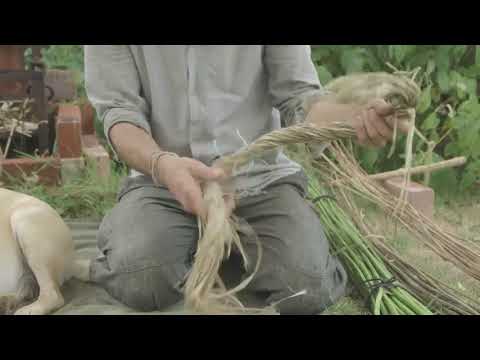
Nettles for Textiles!
Exploring Sustainable Textiles: The Journey of Nettle Fiber
Introduction to Nettle Fibers
- The speaker expresses a long-standing interest in sustainable textiles and traditional textile production methods, leading to an exploration of nettles as a resource.
- Nettles are highlighted for their widespread growth near human activities and their nutritional value, alongside their potential for fabric production.
Harvesting Techniques
- Over three years, the speaker has experimented with various techniques for extracting fibers from nettle plants.
- A method is described where nettles are cut above the roots to avoid disturbing the plant's root structure, promoting regrowth.
Stripping and Preparing Fibers
- To strip the fibers from nettles, a piece of leather is used to flatten out the stinging hairs, making handling safer.
- The speaker notes that fresh nettle fibers can be easily separated by tearing apart leaves and stems when wet due to their waxy pectin binding.
Retting Process Explained
- Retting is introduced as a crucial process involving the breakdown of pectins and gums that bind fibers together; it requires careful monitoring over several weeks.
- Daily turning of retted bundles on grass is recommended to facilitate even breakdown; environmental conditions affect timing.
Assessing Fiber Readiness
- The speaker explains how nodes along the stem can complicate fiber stripping; effective techniques involve cracking above and below these nodes.
- Indicators of insufficient retting include bits of core sticking to fibers during peeling; further retting may be necessary if this occurs.
Comparison of Fiber States
- Different bundles of nettles are compared based on harvesting time; freshly picked ones retain moisture while older ones have dried out but may not be fully processed yet.
- Fully retted fibers exhibit a thinner, paper-like quality with natural separation—this state represents the desired outcome in fiber preparation.
How to Process Nettle Fibers for Spinning
Gathering and Preparing Nettle Fibers
- The speaker describes a method of collecting nettle fibers while walking the dog, using a bundle that is hand-rolled to extract fine silk-like fibers.
- A blunt kitchen knife is used to scrape the fibers from the plant, resulting in short waste bits that are also collected for use.
- Scraping starts at the ends of the fibers, effectively removing bark and tangled bits, leading to clearer separation of fibers.
- Previous scraping sessions yield very fine and soft separated fibers, which are essential for creating a decent thread during spinning.
- The scraped material can be further processed with wool carders to enhance fiber quality before rolling it into a "rollag" for spinning.
Spinning Techniques and Fiber Quality
- The speaker demonstrates how to create a rollag from well-prepared fibers, emphasizing that some unwanted bits can be discarded during spinning.
- Adding twists into the bundle of tangled fibers allows for drafting them out to desired thickness; this process locks down the fibers effectively.
- Dyed nettle fibers exhibit good color absorption due to their fluffy texture; examples include natural dyes like woad and turmeric used on spun samples.
Applications and Historical Context
- Initial test samples show varying textures; coarser spins may not be suitable against skin but could work for durable items like bags or belts.
- The speaker notes that humans have historically made clothing from nettles, particularly in regions like Nepal, highlighting lost methods in Northern Europe.