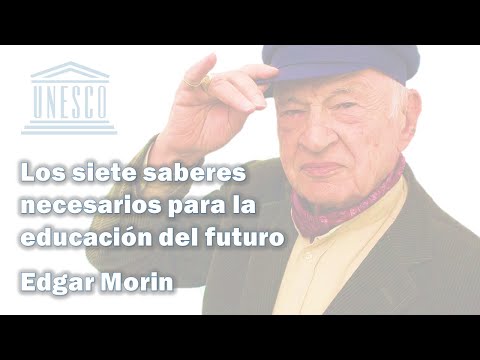
Edgar Morin. Los siete saberes necesarios para la educación del futuro.
Introduction to the 20th Century's Challenges
Overview of Historical Context
- The 20th century ended amidst a fervor believing solutions were found for humanity's major issues, including world wars and economic determinism.
- The 1990s and early 2000s saw global leaders implementing strategies like planetary censuses to address these challenges.
Edgar Morin's Contribution
- Edgar Morin authored "The Seven Necessary Knowledges for Education in the Future," published by UNESCO in 1999, addressing educational needs amid societal complexities.
- This document critiques absolute polarizations and deterministic views that propose singular solutions to complex human problems.
Importance of Morin's Document
Educational Relevance
- The podcast aims to explore Morin’s document chapter by chapter, emphasizing its significance as an academic reference for knowledge construction in the 21st century.
Prologue: Purpose of the Text
Central Themes
- Morin emphasizes that his text is not a traditional teaching guide but rather highlights fundamental problems often overlooked in education.
- He identifies seven essential knowledges that should be integral to education across all societies and cultures.
Chapter One: The Blindness of Knowledge
Understanding Knowledge Limitations
- Education often fails to address the imperfections and tendencies toward error inherent in human knowledge.
- There is a need for education systems to teach about the nature of knowledge itself, preparing students for potential errors and illusions.
Chapter Two: Principles of Relevant Knowledge
Addressing Global Issues
- A critical issue is promoting knowledge that can tackle global challenges while integrating local insights into broader contexts.
- Education must foster understanding of relationships between parts and wholes within complex systems.
Chapter Three: Teaching Human Condition
Complexity of Humanity
- The multifaceted nature of humans—physical, biological, psychological, cultural—needs recognition within educational frameworks.
- Education should help individuals understand their complex identities while acknowledging shared human experiences.
Chapter Four: Teaching Earthly Identity
Planetary Awareness
- Understanding humanity's planetary destiny is crucial; education must reflect on historical developments leading to global interconnectivity since the 15th century.
Chapter Five: Facing Uncertainties
Embracing Uncertainty in Science
- While science provides certainties, it also reveals numerous uncertainties; education should prepare students to navigate these complexities effectively.
Chapter Six: Teaching Comprehension
Importance of Mutual Understanding
- Education must prioritize mutual comprehension among individuals as vital for improving human relations globally.
Chapter Seven: Ethics of Humanity
Ethical Considerations
- Education should cultivate an anthropoethical perspective recognizing individuals as part of society and species.
Turn any video into a summary like this
YouTube links, meetings, lectures. With transcripts, search, and chat.