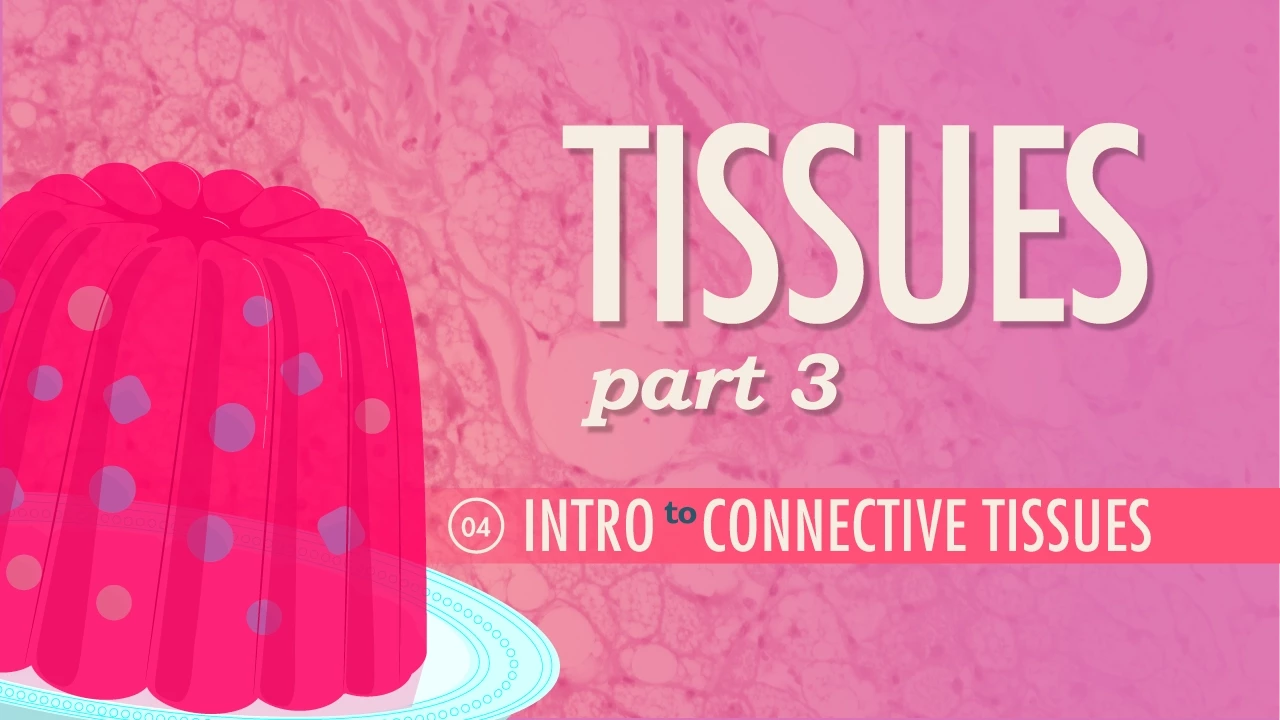
Tissues, Part 3 - Connective Tissues: Crash Course Anatomy & Physiology #4
New Section
This section introduces Flo Hyman, a talented volleyball player who tragically died at a young age due to Marfan Syndrome. It also discusses the characteristics and impact of Marfan Syndrome on the body.
Flo Hyman's Story
- Flo Hyman was a tall girl, standing at 6 feet by her 12th birthday and reaching over 6'5'' by the age of 17. She initially felt self-conscious about her height but later used it to her advantage in volleyball.
- She attended the University of Houston as their first female scholarship athlete and went on to compete in World Championships at the age of 21.
- In 1984, she participated in the Olympics and helped her team win the silver medal.
- Tragically, she collapsed and died during a game in Japan in 1986 at the age of 31.
- Initially thought to be a heart attack, an autopsy revealed that she had died from a tear in her aorta caused by undiagnosed Marfan Syndrome.
Understanding Marfan Syndrome
- Marfan Syndrome is a genetic disorder that affects connective tissue, leading to its weakening over time.
- People with Marfan Syndrome often have tall and thin physiques with loose joints and longer limbs and fingers.
- Some famous individuals believed to have had Marfan Syndrome include blues guitarist Robert Johnson, pianist Sergei Rachmaninov, and violinist Niccolo Paganini.
- As people with Marfan's get older, their weakened connective tissue can cause serious problems in various parts of the body such as joints, eyes, lungs, and heart.
Connective Tissue: The Glue That Holds You Together
This section explores connective tissue as one of the four main tissue types in the body. It highlights its importance, functions, and different classes.
The Importance of Connective Tissue
- Connective tissue is abundant and diverse in the body, playing a crucial role in maintaining structure, supporting organs, and facilitating oxygen and nutrient delivery.
- Connective tissue is present throughout the body but varies in quantity depending on the organ. For example, skin is mostly connective tissue while the brain has very little.
- There are four main classes of connective tissue: proper (found in ligaments and supporting skin), cartilage, bone, and blood.
Functions of Connective Tissue
- Contrary to its name, connective tissue does more than just connecting muscles to bones.
- Proper connective tissue (including fat) provides insulation, fuel storage, and structural support for organs like kidneys and eyeballs.
- Bones, tendons, and cartilage bind, support, protect organs, and provide a skeletal framework for movement.
- Blood acts as a transport system for hormones, nutrients, and other materials throughout the body.
Characteristics of Connective Tissue
- All connective tissues share three common factors that distinguish them from other tissue types:
- They develop from mesenchyme during embryonic development.
- They have varying degrees of vascularity (blood flow).
- They consist mostly of nonliving extracellular matrix rather than living cells.
Connective Tissue: More Than Just Glue
This section delves deeper into the characteristics of connective tissue by comparing it to jello. It emphasizes the diversity and significance of this type of tissue.
Comparing Connective Tissue to Jello
- The extracellular matrix in connective tissue resembles jello's structure. Cells are dispersed within this matrix similar to marshmallows floating inside jello.
- Despite its appearance, the extracellular matrix is vital for connective tissue function.
- Connective tissue is incredibly diverse and abundant in the body, enabling various movements and functions.
Conclusion
Connective tissue plays a crucial role in maintaining the structure, support, and functionality of the body. Understanding its characteristics and functions helps us appreciate its significance in our overall health and well-being.
Protein Molecules and Types of Cells
This section discusses protein molecules mixed with water and the different types of cells in the body.
Protein Molecules Mixed with Water
- Protein molecules are mixed with water.
- If something goes wrong, there can be damage.
Types of Cells and Their Phases
- There are two phases of cells: immature (blast) and mature.
- Immature cells can be recognized by the suffix "-blast" in their names.
- The term "blast" means "formation" and refers to cells that are still dividing to replicate themselves.
- Different types of blast cells have specialized functions.
- Connective tissue is an example of a type of tissue made up of blast cells.
Gelatin and Connective Tissue
This section explains the concept of gelatin and focuses on connective tissue.
Gelatin and Connective Tissue
- Gelatin is discussed as an analogy for connective tissue.
- Connective tissue is found throughout the body, varying in amount depending on the organ.
- Different types of blast cells have specific functions, such as forming cartilage or bone.
- The matrix created by blast cells determines the characteristics of different tissues.
Types of Connective Tissue
This section explores the four main classes of connective tissue.
Four Classes of Connective Tissue
- Adipose tissue is a type of connective tissue that provides insulation and fuel storage.
- Osteoblasts are blast cells responsible for bone formation, while osteocytes maintain bone health.
- Different types of cito cells support the matrix built by blast cells and serve structural purposes.
- The matrices created by these cells form bones, tendons, cartilage, and other supportive structures in the body.
Functions of Connective Tissue
This section discusses the functions of connective tissue in the body.
Functions of Connective Tissue
- Connective tissue supports and protects organs, providing structure and forming an internal framework.
- It allows movement with purpose and prevents displacement of organs.
- Blood, a type of connective tissue, transports hormones, nutrients, and other materials throughout the body.
- Connective tissue also plays a crucial role in immune functions, protecting the body from various threats.
Characteristics of Connective Tissue
This section highlights the characteristics that distinguish connective tissue from other types of tissues.
Characteristics of Connective Tissue
- Macrophages are large cells involved in immune functions within connective tissue.
- All connective tissues share a common origin: they develop from mesenchyme, an embryonic loose and fluid connective tissue.
- Unlike fixed cells found in other tissues, mesenchymal cells can change their location within the body.
- Different degrees of vascularity exist among different types of connective tissue. For example, cartilage is avascular.
Importance and Impact
This section emphasizes the widespread importance and impact of connective tissue in the body.
Importance and Impact
- Conditions affecting connective tissue can have significant consequences for overall health.
- Disorders like Marfan syndrome can cause havoc due to their impact on this vital tissue.
- Understanding the nature and function of connective tissue helps explain its essential role in maintaining bodily structures and functions.
What Happens When Something Goes Wrong with Your Connective Tissue?
This section discusses the consequences of connective tissue dysfunction.
Consequences of Connective Tissue Dysfunction
- Connective tissue dysfunction can lead to various health issues and complications.
- Problems with connective tissue can affect different parts of the body, including joints, skin, blood vessels, and organs.
- Conditions such as Ehlers-Danlos syndrome and Marfan syndrome are examples of connective tissue disorders.
- Connective tissue disorders can cause symptoms like joint hypermobility, skin elasticity issues, and cardiovascular problems.
- Understanding the impact of connective tissue dysfunction is crucial for diagnosis and treatment.
Lo que ocurre cuando algo va mal con ellos. En el caso de tu tejido conjuntivo,
Sección general: Esta sección discute las consecuencias de la disfunción del tejido conectivo.
Consecuencias de la Disfunción del Tejido Conectivo
- La disfunción del tejido conectivo puede llevar a diversos problemas de salud y complicaciones.
- Los problemas con el tejido conectivo pueden afectar diferentes partes del cuerpo, incluyendo articulaciones, piel, vasos sanguíneos y órganos.
- Condiciones como el síndrome de Ehlers-Danlos y el síndrome de Marfan son ejemplos de trastornos del tejido conectivo.
- Los trastornos del tejido conectivo pueden causar síntomas como hipermovilidad articular, problemas de elasticidad en la piel y problemas cardiovasculares.
- Comprender el impacto de la disfunción del tejido conectivo es crucial para el diagnóstico y tratamiento.