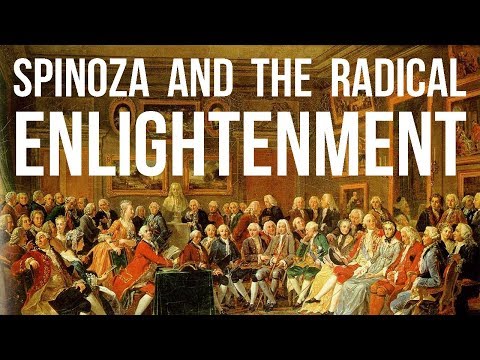
Spinoza and the Radical Enlightenment
What is Enlightenment?
Definition and Historical Context
- Immanuel Kant defines enlightenment as "man's emergence from his self-incurred immaturity," emphasizing the importance of using one's own understanding without external guidance.
- The concept has evolved, with historians like Peter Gay viewing it as a unified movement, while others argue for national distinctions (e.g., British vs. French Enlightenment).
- Postmodern thinkers criticize the Enlightenment as Eurocentric, claiming it failed to contribute significantly to anti-imperialism, democracy, or feminism.
Radical vs. Moderate Enlightenment
- Jonathan Israel's book "Radical Enlightenment" defends the idea of enlightenment against postmodern critiques by categorizing thinkers into moderate and radical factions.
- Moderate thinkers like John Locke sought to reconcile reason with traditional hierarchies, while radicals rejected all forms of ecclesiastical authority and social hierarchy.
Spinoza's Role in Radical Enlightenment
- Israel posits that Baruch Spinoza should be viewed as a central figure in radical enlightenment due to his rejection of Cartesian dualism and critique of religious orthodoxy.
- Spinoza was one of the first philosophers to rigorously critique the Bible, which led him to be labeled an atheist during a time when such views were heavily stigmatized.
Contributions and Philosophical Impact
- His works illustrate a shift from theological approaches towards materialism; this transition is evident in his writings from "Theological Political Treatise" to "Ethics."
- In "Ethics," he defines good and bad based on utility rather than moral absolutes, promoting a view that emphasizes human connection over divine morality.
Legacy and Influence
- Spinoza’s monism challenges supernatural beliefs and hierarchical systems imposed by religion; this perspective influenced later philosophical movements.
- His ideas resonate through history with figures like Hegel, Nietzsche, Marx, and Engels acknowledging his contributions to philosophy.
Turn any video into a summary like this
YouTube links, meetings, lectures — with transcripts, search, and chat.