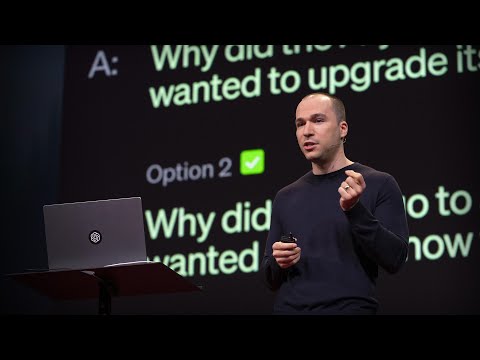
The Inside Story of ChatGPT’s Astonishing Potential | Greg Brockman | TED
Introduction
In this section, the speaker introduces OpenAI and their mission to steer AI in a positive direction. They also discuss the importance of managing AI for good.
- OpenAI was founded seven years ago to help steer AI in a positive direction.
- The field of AI has come a long way since then.
- We are entering an historic period where we will define a technology that will be important for our society going forward.
- The speaker believes that we can manage AI for good.
Building Tools for AI
In this section, the speaker demonstrates how they are building tools for an AI rather than building it for humans. They showcase a new Dolly model that generates images and is exposed as an app for chat GPT to use on your behalf.
- OpenAI is building tools specifically designed for AIs rather than humans.
- They have developed a new Dolly model that generates images and is exposed as an app for chat GPT to use on your behalf.
- Chat GPT can generate both text and images, which expands its power in carrying out your intent.
- These tools are very inspectable, allowing users to provide feedback to them.
Extending Chat GPT with Other Tools
In this section, the speaker discusses how they have extended Chat GPT with other tools such as memory. They demonstrate how these tools work together seamlessly to carry out user intent.
- OpenAI has extended Chat GPT with other tools such as memory.
- Users can save information for later use and integrate it with other applications like Instacart or Twitter.
- This unified language interface allows the AI to take away all those details from you so you don't have to spell out every single little piece of what's supposed to happen.
- Traditional UIs are still valuable, but we have a new augmented way to build them.
Introduction
In this section, the speaker introduces the topic of teaching AI and how they use an old idea to train chat GPT.
Teaching AI
- The speaker explains that it's not just about building tools for AI but also teaching them how to use these tools.
- They mention Alan Turing's 1950 paper on the Turing test and explain that instead of programming an answer, we can build a machine like a human child and teach it through feedback.
- The speaker explains that GPT is trained using an unsupervised learning process where it predicts what comes next in text it has never seen before. Then, they provide feedback by having the AI try out multiple things and human rates them.
- They explain that providing high-quality feedback is hard, but the AI itself can help us provide even better feedback and scale our ability to supervise the machine as time goes on.
Fact Checking with AI
- The speaker demonstrates how we can use AI to fact-check its own work by issuing search queries and clicking into web pages.
Conclusion
In this section, the speaker concludes by emphasizing the importance of teaching AI and providing high-quality feedback.
Teaching AI
- The speaker mentions that sometimes they have to teach the AI unexpected things such as pushing back on humans in specific scenarios.
- They explain that when users push thumbs down in chat GPT, it signals an area of weakness where they should gather feedback.
- The speaker emphasizes that as we move to harder tasks, we will have to scale our ability to provide high-quality feedback.
Fact Checking with AI
- The speaker concludes by emphasizing the importance of using AI to fact-check its own work and how it can help us scale our ability to supervise the machine.
Fact Checking Tool and AI Collaboration
In this section, the speaker talks about a fact-checking tool that uses AI to produce data for another AI to become more useful to humans. The collaboration between humans and machines is carefully designed in how they fit into a problem and how we want to solve that problem.
Human-AI Collaboration
- The fact-checking tool is an example of human-AI collaboration where a human using this tool produces data for another AI to become more useful to humans.
- Humans and machines are carefully designed in how they fit into a problem and how we want to solve that problem. Humans provide management, oversight, feedback while machines operate in an inspectable and trustworthy way.
- Over time, if the process of human-AI collaboration is done right, it will be possible to solve impossible problems.
Rethinking Interactions with Computers
- Spreadsheets have been around for 40 years but haven't changed much. However, with AI tools like Chat CPT, it's possible to rethink almost every aspect of how we interact with computers.
- Chat CPT can analyze large datasets like the archive of all AI papers from the past 30 years (167k papers). It can infer what columns mean even if semantic information wasn't included in the dataset.
- Chat CPT can also make exploratory graphs based on high-level instructions from users. For example, it can create histograms or word clouds based on uploaded files.
Limitations of Current AI Tools
- Sometimes current AI tools may not understand user intent fully. Users may need to inject their intent or provide additional pieces of information.
- AI tools may not be able to predict future events accurately. For example, a projection made by Chat CPT about the number of papers in 2023 was inaccurate because it didn't take into account that the year wasn't over yet.
Introduction
In this section, the speaker talks about how AI can be used to help humans in various fields.
Using AI to Help Humans
- The speaker explains that AI can update titles and provide brainstorming partners for medical professionals.
- A parable is shared about a sick dog whose life was saved by using GPT4 as a brainstorming partner with a medical professional.
- The speaker emphasizes that these systems are not perfect and should not be overly relied upon. However, they can be used as brainstorming partners to achieve better outcomes.
- The importance of human participation in deciding how AI should integrate into our world is discussed.
- The need for everyone to become literate in AI is emphasized, and the release of ChatGPT is mentioned as a way to achieve the open AI mission.
Q&A Session
In this section, the interviewer asks questions about OpenAI's technology and its development.
OpenAI's Technology Development
- The interviewer expresses amazement at the possibilities presented by OpenAI's technology and asks how it was developed with such a small team compared to other companies like Google.
- The speaker explains that OpenAI made deliberate choices from the early days, confronted reality as it lay, tried many things that didn't work, and got teams of people who were different from each other to work together harmoniously.
- The importance of investing in language models and growing them over time is discussed. It is noted that sometimes unexpected results emerge from training models on specific tasks.
Emergence and Scaling in Machine Learning
In this section, the speaker discusses the concept of emergence and how it applies to machine learning. The speaker explains that as you get more of a thing, different things emerge, which is true for ant colonies, cities, and even machine learning models.
Emergence in Machine Learning
- Emergence is when you get more of a thing and suddenly different things emerge.
- As you scale up machine learning models, they learn things that were not expected or predicted.
- The model has learned an internal circuit for adding 40 digit numbers but hasn't fully generalized to adding arbitrary numbers of arbitrary lengths.
- There are smooth scaling curves in machine learning that tell us something fundamental about intelligence.
Risks of Scaling Up Machine Learning
- There is a risk that something truly terrible could emerge as we scale up machine learning models.
- Integration with the world is also an emergent property that needs to be considered when deploying machine learning models incrementally.
Supervising Tasks Properly
- Providing high-quality feedback is important when supervising tasks for machine learning models.
- It's hard to supervise tasks like summarizing a book because it requires reading the whole book.
OpenAI's Approach to Artificial General Intelligence
In this section, Greg Brockman discusses OpenAI's approach to artificial general intelligence and how they believe that the expansion of scale and human feedback will lead to achieving truth and wisdom.
OpenAI's Belief in Achieving Truth and Wisdom
- Greg believes that the expansion of scale and human feedback will take AI on a journey towards achieving truth and wisdom.
- The OpenAI approach has always been to let reality hit them in the face, push the limits of technology, and exhaust its potential before moving on to a new paradigm.
- They believe that their alternative approach is better than building AI in secret, hoping it works safely, then pushing go.
OpenAI's Original Mission vs Current Reality
In this section, Sam Harris questions Greg about OpenAI's original mission as a non-profit organization versus their current reality as a for-profit company.
Original Mission vs Current Reality
- The original mission was for OpenAI to be a check on big companies doing unknown or possibly evil things with AI by building models that could hold them accountable.
- However, their release of GPT shook up the tech world causing Google and Meta to scramble to catch up.
- Some criticisms were made about forcing AI out without proper guardrails.
- While they don't always get it right, they think about these questions all the time.
Responsibility vs Recklessness in AI Development
In this section, Sam Harris asks Greg about whether OpenAI's approach to AI development is responsible or reckless.
Responsibility vs Recklessness
- OpenAI's approach to AI development is to let reality hit them in the face and give people time to give input before these machines are perfect.
- They believe that this alternative approach is the only other path towards building artificial general intelligence that benefits all of humanity.
- They've seen from GPT3 that giving people time to give input can lead to unexpected results, such as generating Viagra spam instead of misinformation or election interference.
- Greg believes that building AI in secret and hoping it works safely is terrifying and doesn't feel right.
Choosing the Right Time for Technological Advancements
In this section, the speaker discusses whether it is better to have technological advancements sooner or later.
Timing of Technological Advancements
- The speaker poses a question about whether it is better to have technological advancements sooner or later.
- The speaker argues that it is better to have technological advancements later because people will have more time to get it right and put safety precautions in place.
- The speaker emphasizes that the development of technology should be incremental and managed at each step to avoid an overhang of powerful technology without proper safety measures.
Incremental Development of Technology
In this section, the speaker discusses how technology should be developed incrementally with proper management at each step.
History of Computing
- The speaker explains that the history of computing has been an industry-wide shift towards faster computers and improved algorithms.
- The speaker warns that if these pieces are not put together properly, there can be an overhang of powerful technology without proper safety measures in place.
- The speaker compares the development of technology to nuclear weapons, emphasizing that every technology must be developed incrementally with proper management at each step.
Responsibility for Managing Technological Advancements
In this section, the speaker discusses our collective responsibility for managing technological advancements.
Providing Guard Rails for Technology
- The speaker suggests that we have a collective responsibility to provide guard rails for new technologies and teach them to be wise rather than destructive.
- The speaker acknowledges that this model may shift over time and emphasizes the importance of getting literate in new technologies, providing feedback, and deciding what we want from them.
- The speaker concludes by expressing gratitude for the debate around technological advancements.
Turn any video into a summary like this
YouTube links, meetings, lectures. With transcripts, search, and chat.