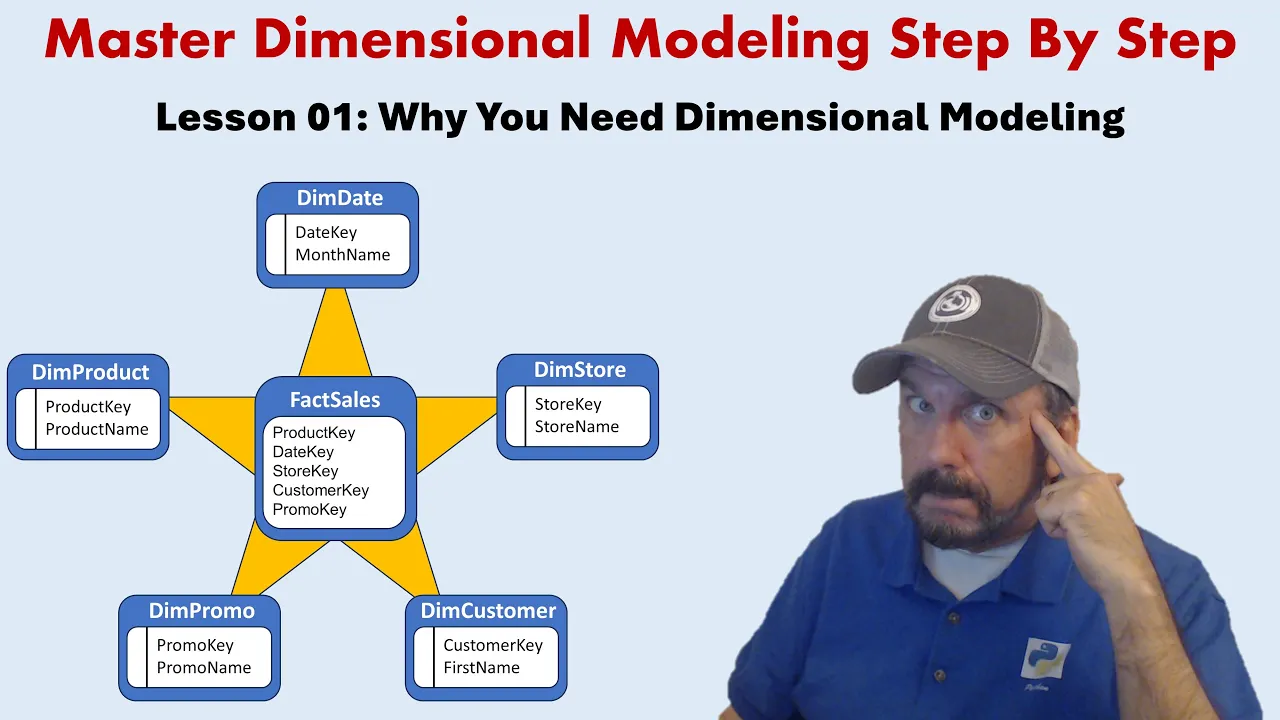
Master Dimensional Modeling Lesson 01 - Why Use a Dimensional Model?
Why Do You Need Dimensional Modeling?
Section Overview
This section introduces the concept of dimensional modeling, specifically focusing on the star schema and its significance in data analysis.
Introduction to Star Schema
- Brian Kaery begins a new series on Master Dimensional Modeling, starting with an overview of why dimensional modeling is essential.
- The video presents a simple star schema diagram from Microsoft's Adventure Works dataset, highlighting the central fact table that contains quantifiable sales data.
- Dimensions are introduced as separate tables that allow for slicing and dicing of data; examples include product and date dimensions linked via foreign keys.
- Dimension attributes (e.g., product name, category) are defined, emphasizing that while the entire table is a dimension, individual values are attributes.
- A key takeaway is that any dimension can be accessed with a single join from the fact table, enhancing efficiency in querying.
Importance of Star Schema
- The focus remains on numeric measures (facts), such as order quantity and sales amount, which require organization through dimensions for meaningful analysis.
- The star schema's design minimizes necessary joins by denormalizing dimension tables, simplifying user access to data.
- This structure allows end users to quickly understand and utilize data effectively without complex queries or relationships between dimensions.
- A link to additional resources on dimensional modeling is provided for deeper understanding.
Comparison with Entity Relationship Modeling
- The video contrasts star schemas with entity relationship models (ERM), typically used in OLTP databases like SQL Server or Oracle.
- ERM structures involve numerous joins among various tables aimed at reducing redundancy through normal forms but complicate querying processes compared to star schemas.
- Data Vault modeling is briefly mentioned as serving different needs than dimensional modeling; it’s not directly related to how business data is presented.
Applications of Star Schema
- The star schema supports diverse applications including reporting, data analysis, machine learning, and AI by making data easily consumable for model training.
- Its flexibility allows for easy addition of new attributes or dimensions without disrupting existing structures—promoting reusability across datasets.
- Dimensional modeling transcends technology; it's a mindset applicable across various platforms including relational databases and big data environments like Databricks.
Understanding Dimensional Modeling in Snowflake
Section Overview
This section discusses the application of dimensional modeling, particularly the star schema, within the Snowflake platform. It highlights the benefits of using a star schema for managing slowly changing dimensions and contrasts different approaches to data warehousing.
The Star Schema and Its Benefits
- The speaker notes a lack of information on dimensional modeling specifically for Snowflake but suggests that it can be effectively used for implementing a star schema.
- A key advantage of the star schema is its facilitation of slowly changing dimensions (SCD), which track historical changes in dimension values.
- An example illustrates how customer relocation impacts shopping behavior; understanding these changes is crucial for accurate business insights.
- Without tracking historical data, businesses may draw incorrect conclusions about customer behavior, emphasizing the importance of maintaining history in dimensions.
- The speaker distinguishes between a star schema and an enterprise data warehouse approach, noting that large-scale implementations often face significant challenges.
Contrasting Data Warehouse Approaches
- Bill Inmon's enterprise data warehouse model aims for a comprehensive central repository but often fails due to complexity and lengthy implementation times.
- In contrast, Ralph Kimble advocates starting with smaller data marts to deliver immediate business value rather than attempting to build an extensive enterprise solution from the outset.
- Kimble’s approach allows organizations to create specific data marts (e.g., sales, financials, inventory), providing quicker access to valuable insights without overwhelming complexity.
- The concept of conformed dimensions and facts is introduced as essential for sharing across different data marts while maintaining analytical integrity.
- Overall, the star schema simplifies analytics processes by reducing complexity and enhancing maintainability while focusing on delivering immediate business value.
Conclusion on Dimensional Modeling