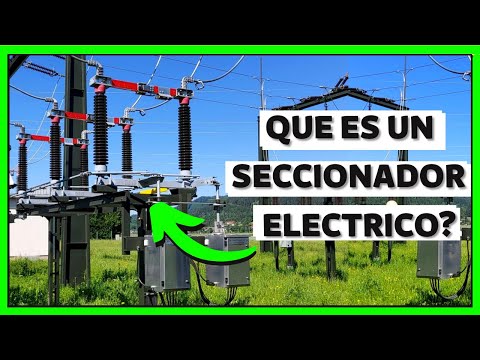
👉 Qué son los SECCIONADORES ELECTRICOS en SUBESTACIONES ELECTRICAS de BAJA, MEDIA Y ALTA TENSION ⚡
What are Sectionalizers?
Introduction to Sectionalizers
- The video introduces the concept of sectionalizers, focusing on their definitions and real-life applications in electrical circuits.
- Sectionalizers serve four main functions: they must withstand nominal overload and short-circuit currents, provide visible or safe disconnection, maintain a grounded state when open, and operate without load.
Functions of Sectionalizers
- The first function is to handle nominal current levels during overload and short-circuit conditions; overload refers to currents above nominal levels while short-circuits can involve multiple times the nominal current.
- A visible cut-off is essential for safety; this ensures that operators can see when the circuit is open.
- Maintaining a grounded state when open prevents accidental reconnection under load conditions.
Types of Sectionalizers
- Different types exist based on operational power requirements (low, medium, high voltage), with specific designs like knife switches for low voltage applications.
- The construction includes two main parts: a base and movable blades that connect or disconnect the circuit.
Safety Features
- Some sectionalizers are designed to be operated remotely using poles to ensure safety from electric shock during maintenance.
- They must ensure that there’s no load present before opening; otherwise, damage may occur.
Additional Insights on Fuses
- Fuses integrated into sectionalizer systems act as protective devices against overcurrent by melting under excessive heat caused by high currents.
- Once a fuse operates due to an overload or short circuit, it cannot be reset until replaced; this ensures ongoing protection against faults.
Maintenance Procedures
- Proper procedures dictate that maintenance should only commence after ensuring all loads are disconnected from the transformer or equipment being serviced.
- Operators must verify that no voltage remains in the lines before proceeding with any work on electrical systems.
Understanding Unipolar and Bipolar Switches
Overview of Switching Mechanisms
- The discussion begins with the concept of unipolar switches, which allow current and voltage to flow through specific contacts when rotated.
- Bipolar switches are introduced, highlighting that they consist of two poles. Each pole is referred to as a "senador," with images showing both open and closed configurations.
Insulator Distances and Voltage Ratings
- The distance between insulators is crucial for voltage ratings; for example, at 145 kV, the distance is approximately 2.17 meters, while at 245 kV it increases to about 3.20 meters.
Operation of Sectionalizers
- Sectionalizers operate by contracting parts that elevate to make contact directly with the line. This mechanism ensures safe operation during maintenance or fault conditions.
Types of Switches and Their Functions
- Various types of switches are discussed, including rotary sectionalizers that function similarly but have different designs for operational efficiency.
- Tripolar sectionalizers are highlighted for their ability to connect multiple contacts simultaneously, allowing current passage effectively.
Remote Operation Capabilities
- Some switches can be operated remotely or manually from a control box located at the bottom, enhancing flexibility in managing electrical systems.
Symbols Used in Electrical Diagrams
- The presentation covers symbols used in electrical schematics for various devices like selectors and circuit interrupters, emphasizing their roles in circuit management.
Turn any video into a summary like this
YouTube links, meetings, lectures. With transcripts, search, and chat.