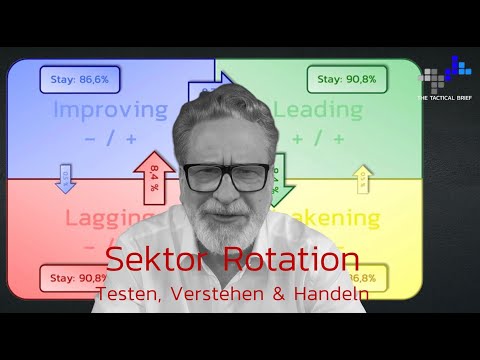
Sektor Rotation - Outperformance mit Momentum & Relativer Stärke
Is Sector Rotation Real? Analyzing 24 Years of Data
Introduction to Sector Rotation
- The discussion focuses on the concept of sector rotation, analyzing its validity through a backtest of 24 years of data. The hosts aim to derive trading decisions from statistically tested data.
- The session features three presenters: Murat, David, and the host, who emphasize their commitment to statistical analysis in trading strategies.
Importance of Backtesting
- Backtesting is highlighted as a crucial method for validating trading strategies based on historical performance; it allows traders to avoid untested transactions.
- The presenters discuss how sectors fluctuate with economic cycles, affecting demand and investment opportunities in various sectors over time.
Analyzing Historical Data
- They express interest in understanding the duration and impact of sector transitions on individual stocks, particularly from an options trading perspective. This insight helps determine optimal entry points for trades based on historical significance.
- David has developed advanced tools for analyzing this data effectively, which will be shared during the presentation alongside practical examples like Nvidia trades.
Methodology Overview
- The analysis begins with a focus on relative strength and momentum using a Relative Rotation Graph (RRG), which visualizes stock performance against a benchmark (S&P 500). This tool aims to identify early movements in stocks based on changes in relative strength or momentum.
- They clarify that while their primary focus is on stocks within the S&P 500 index, similar methodologies can apply across other asset classes such as commodities or cryptocurrencies.
Statistical Findings
- Initial findings indicate that when positioned in certain quadrants (e.g., Improving Quadrant), there’s an approximately 87% chance of remaining there the next day, suggesting stability within these positions. Conversely, lower probabilities exist for transitioning into less favorable quadrants like Lagging Quadrant.
- They explore transition probabilities between quadrants as critical indicators for setting up trades; higher probabilities signal potential trade setups when moving from one quadrant to another. This statistical approach aids timing decisions significantly when entering trades.
Trade Setup Strategy
- A proposed strategy involves entering long positions when transitioning from Lagging to Improving Quadrant and exiting upon moving from Leading to Weakening Quadrant; this basic framework yielded a notable success rate across numerous trades analyzed against benchmarks like SPX and sector ETFs.
- Results show an impressive win rate of around 62% with significant returns per trade calculated against both SPX and sector performances; they also consider digital options as part of their strategy evaluation process but note limitations due to market conditions at expiration dates.
Enhancements and Filters
- To refine their approach further, they discuss implementing filters such as Simple Moving Averages (SMA) that could help confirm trends before entering trades—this adjustment aims at improving timing without drastically altering trade volume or success rates observed previously.
This structured overview encapsulates key discussions surrounding sector rotation analysis while providing timestamps for easy reference throughout the video content.
Exploring Market Inefficiencies and Trading Strategies
Introduction to Moving Averages
- Murad suggests analyzing the market by applying a simple moving average (SMA) not just on individual stocks but also on benchmarks like SPX, to understand market behavior better.
Statistical Insights from Data
- The results show comparable probabilities of success in trading strategies, although no significant reduction in risk was observed. Murad plans to demonstrate these findings live for clarity.
Market Efficiency Discussion
- David emphasizes that in an ideal world where predictions are impossible, traders would have no statistical advantage; however, real markets exhibit inefficiencies that can be exploited.
- The concept of market efficiency is explained: if prices reflect true value perfectly, deviations would not occur. Their tests indicate that markets are indeed inefficient.
Momentum Trading Strategy
- A stock may experience sudden interest leading to price jumps; thus, utilizing a 5-day moving average can help capitalize on this momentum.
- By focusing on the positive side of market movements, traders can leverage discovered inefficiencies for profit within their investment processes.
Practical Application with Examples
- Murad shares his excitement about using hard data for trading decisions and demonstrates how they apply their findings using Trading View for educational purposes.
Case Study: Nvidia
- Using Nvidia as a case study due to its recent popularity, Murad illustrates potential entry points based on their trading strategy.
Emotional Challenges in Trading
- Reflecting on personal experiences with Nvidia, he acknowledges losses attributed to emotional decision-making rather than sticking strictly to established rules.
Importance of Process and Routine
- Emphasizing adherence to systematic approaches over fundamental analysis helps mitigate emotional biases in trading decisions.
Chart Analysis Techniques
- Murad describes his charting approach involving daily, weekly, and monthly charts for comprehensive trend analysis. He believes "the trend is your friend" and advocates trading with prevailing trends.
Trade Entry Signals
- He introduces a unique trade entry method based on quadrant theory—identifying transitions between different quadrants as signals for entering trades.
Performance Metrics
- Analyzing performance metrics shows that following this system could yield substantial returns over time without additional filters complicating the process.
Risk Management Strategies
- Effective risk management is crucial; even with a model indicating high probability trades (60%+), maintaining favorable risk-reward ratios ensures long-term profitability despite inevitable losses.
Conclusion: Simplifying Trading Approaches
- The discussion concludes by reinforcing the importance of simplicity in trading strategies while acknowledging the complexities introduced by various filters. They emphasize maintaining a positive expected value through disciplined practices.
Insights on Backtesting and Sector Rotation
Impact of Backtesting on Trading Returns
- The results from backtesting indicate a slight decrease in profits or returns over the fully tested period.
Discussion on Sector Rotation
- Murat expresses satisfaction with the backtest, emphasizing the importance of demonstrating sector rotation in trading strategies.
Entry Points and Money Management
- The analysis confirms that there are optimal entry points that outperform random chance, allowing for effective portfolio management without daily stress.
Monthly Investment Strategies
- A monthly strategy is highlighted as an excellent approach for investors looking to grow capital while minimizing losses, promoting a drama-free investment process.
Tools for Trade Ideas Generation
- Internal tools provide insights into trade ideas by analyzing 500 stocks and sector ETFs, enhancing decision-making in trading.
Statistical Foundations of Trading Strategies
Validity of Sector Rotation
- Emphasis is placed on the statistical backing behind sector rotation, confirming its existence and effectiveness when applied with appropriate tools.
Confirmation of Existing Systems
- The discussion reaffirms confidence in existing systems used by participants, suggesting potential for increased profitability through refined strategies.
Advanced Analysis Techniques
Drawdown Insights and Sweet Spots
- Participants share theories regarding drawdowns and ideal points to capture gains, indicating ongoing interest in refining their approaches based on future results.
Detailed Trade Evaluation Tools
- Introduction of detailed tables for trade evaluations allows users to refine their trades further using various asset classes beyond just stocks.
Portfolio Management Strategies
Relative Strength Measurement
- Tools enable measurement of relative strength among currencies and other assets, aiding personal portfolio management decisions effectively.
Customization Options for Users
- Users can input various values into the system to compare different markets or assets against benchmarks like DAX or S&P 500.
Visualizing Market Dynamics
Importance of Visualization
- Effective visualization helps traders identify strong versus weak assets at a glance, facilitating informed portfolio adjustments based on performance metrics.
Future Directions in Trading Education
Upcoming Content Focused on Currencies
- Plans are discussed for creating separate content focused specifically on currency trading dynamics using visual tools to enhance understanding.
Correlation Between Market Movements
Understanding Autocorrelation
- The relationship between past market movements and current trends is emphasized; recognizing this correlation can improve trading strategies significantly.
Combining Strategies for Enhanced Probability
Options Strategy Integration
- Discussion includes leveraging options strategies to increase probability rates above 60%, highlighting risk management techniques available through options trading.
Engagement with Audience
Call to Action for Viewers
- Encouragement for viewers to subscribe and engage with additional resources provided by Murat related to foundational theories discussed earlier in the presentation.