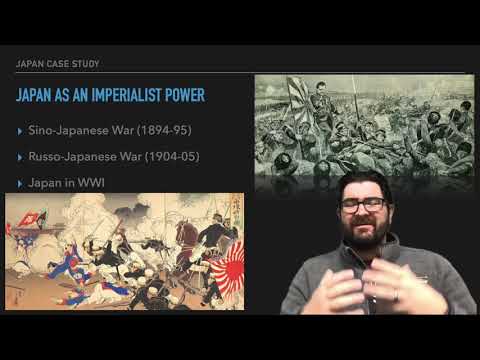
IB History: Move to Global War-Origins of Japanese Nationalism and Militarism
Introduction to the Unit
The transcript begins with an introduction to a new unit on the lead up to World War II. The focus of the unit is on two case studies: Japan and East Asia, and Italy and Germany in Europe.
Japan's Policies of Nationalism and Militarism
- In the late 19th century, Japan aimed to become a western-styled military power and believed it was destined to lead the Asian sphere as an imperial power.
- Japan faced a need for raw materials due to its relatively small size compared to its large population.
- Discrimination by Western powers, including at the Paris Peace Conference, pushed Japan towards nationalist ideas and militarization.
Historic Developments in Japan
- In 1853, Commodore Perry led the first American fleet to Tokyo Harbor. This event, following the British imposition on China during the Opium Wars, sparked sentiments against Japanese government isolationism.
- The Meiji Restoration in 1868 led to rapid modernization in Japan. Reforms included adopting a western-style constitution, economic reforms for industrialization, education modeled after German schools with a focus on developing Japanese nationalism, and military reforms based on modern western-style officers.
Sino-Japanese War (1894)
- Japan went to war with China in 1894. The modern Japanese military achieved a resounding victory over an outdated Chinese army.
- As a result of this war, Japan gained land concessions such as Taiwan and influenced Korea as a puppet state.
Russo-Japanese War (1904)
- Ten years later, Japan fought against Russia in the Russo-Japanese War. Despite facing challenges from Russia's delayed naval presence in the Pacific and internal political instability, Japan emerged victorious.
- This victory established Japan as a major player in the western world and led to further land concessions from Russia.
Conclusion
- The transcript concludes by mentioning that Japan would enter a new phase after the Russo-Japanese War.
The summary has been organized chronologically, following the structure of the transcript.
Japan's Quest for Racial Equality in the League of Nations
This section discusses Japan's request for a racial equality clause in the League of Nations and its subsequent rejection. It also highlights Japan's move towards internationalism in the 1920s.
Japan's Request for Racial Equality Clause
- Japan, as an Asian nation, sought equal representation and a racial equality clause within the League of Nations.
- However, the Western powers with colonial holdings outside of the Western world opposed including such a clause in the Treaty of Versailles.
- The absence of a racial equality clause created frustration for Japan.
Move towards Internationalism
- In the 1920s, Japan shifted towards internationalism and working with the international community.
- Diplomat Shitahara Kajuro played a significant role in leading this shift.
- In 1921 and 1922, Japan participated in the Washington Conference, resulting in multilateral agreements with other nations:
- Four Power Treaty: United States, Britain, France, and Japan agreed to consult each other if their Asian holdings were threatened.
- Nine Power Agreement: Multiple nations agreed to keep China open for all nine powers.
- Five Power Naval Agreement: Japan agreed to limit its navy size compared to the United States and Great Britain.
Challenges Faced by Japan
- The limitation on navy size under the Five Power Naval Treaty led to feelings of discrimination against Japan.
- The democratic Japanese government faced fragility due to financial scandals and public questioning of its legitimacy.
- There were concerns about left-wing radicalism and communism following Russia's revolution during World War I.
- Conservative groups and military factions opposed internationalism as it conflicted with their expansionist goals.
- The Japanese economy experienced slumps in the 1920s due to Europe recovering from war and later worsened by the Great Depression.
Political Instability in China and the Rise of Rivalry
This section focuses on the political instability in China after the fall of the Qing dynasty and the growing rivalry between the Guomindang (Chinese Nationalists) and the Communist Party of China.
Political Instability in China
- After the fall of the Qing dynasty in 1911-1912, China experienced significant political instability.
- Various entities competed for control, leading to a divided nation vulnerable to attack.
- The 1920s witnessed a rivalry between two main political entities:
- Guomindang (Chinese Nationalists) led by Jiang Jieshi (Chiang Kai-shek)
- Communist Party of China led by Mao Zedong
Civil War and Chinese Instability
- The late 1920s marked the beginning of a civil war between the Guomindang and Communist Party.
- This conflict would intensify throughout the 1930s.
- The Chinese instability emboldened Japanese militarists.
The transcript does not provide further information beyond this point.