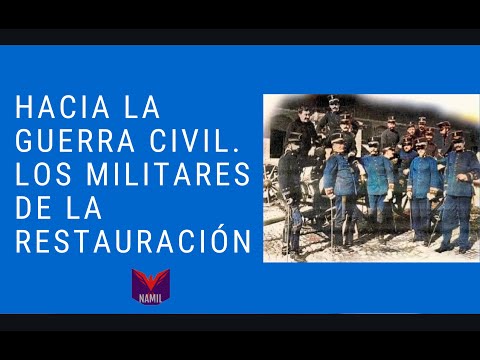
HACIA LA GUERRA CIVIL 1. LOS MILITARES DE LA RESTAURACIÓN.
The Spanish Civil War and the Role of the Military
In this section, we explore the historical context leading up to the Spanish Civil War in 1936. We examine the role of the military in Spain during the 19th century and how it gained prominence. We also discuss the rivalries among military leaders and their political ideologies.
The Role of the Military in 19th Century Spain
- The military played a significant role in 19th century Spain during its transition to liberalism.
- Pronunciamientos (military uprisings) were common, with young generals vying for power.
- Most military leaders during this period were liberals.
Prominent Generals and their Influence
- Generals like Espartero, Prim, Serrano, Martínez Campos, etc., gained prominence and shaped liberal Spain.
- With the restoration of monarchy in 1876, Antonio Cánovas del Castillo and Mateo Sagasta led a turn between political parties known as "turnismo."
Limitations on Military Power
- After the restoration, a new constitution limited military power.
- Antonio Cánovas del Castillo played a key role in reducing military influence.
- Political power shifted to dynastic parties like Partido Liberal Conservador and Partido Liberal.
Military Responsibilities and Regional Divisions
- The army had responsibilities for maintaining public order according to a constitution established in 1878.
- While administrative regions did not exist at that time, there were military regions with captains general having authority over units within their jurisdiction.
The Restoration Period and Regional Divisions
This section focuses on the Restoration period after 1876 when a new constitution was introduced. We discuss regional divisions within Spain and how languages other than Castilian Spanish were preserved.
The Restoration Period and Constitution
- The Restoration period began in 1876 with a new constitution that limited military power.
- Antonio Cánovas del Castillo and Mateo Sagasta led the political regime during this time.
Regional Divisions and Military Regions
- Spain was divided into military regions, each headed by a captain general.
- Captains general had authority over units within their jurisdiction.
- They could declare a state of war and suspend constitutional guarantees in their territory.
Linguistic Diversity and Preservation
- Spain's regional divisions had linguistic diversity.
- Languages like Catalan, Valencian, Galician, etc., survived despite policies favoring Castilian Spanish as the official language.
- These languages continued to be spoken due to historical reasons and local identity.
Regional Identity and Language Survival
In this section, we delve deeper into regional identities within Spain and how languages other than Castilian Spanish survived despite policies promoting the dominance of Castilian Spanish.
Regional Identities and Historical Background
- Regions like Aragon, Valencia, Catalonia, Galicia had distinct historical backgrounds as former kingdoms or principalities within the Kingdom of Aragon.
- These regions maintained their own languages due to historical continuity and local identity.
Language Survival Despite Policies
- Decrees promoting Castilian Spanish did not eradicate regional languages.
- Catalan, Valencian, Galician, etc., continued to be spoken alongside Castilian Spanish.
- These regional languages were preserved due to their significance in local culture and heritage.
Military Power During the Restoration Period
This section focuses on the power wielded by the military during the Restoration period. We explore the authority of captains general in maintaining public order and suspending constitutional guarantees.
Authority of Captains General
- Captains general had significant power within their military regions.
- They had command over all units in their jurisdiction.
- They could declare a state of war and suspend constitutional guarantees without consulting the national government.
Suspension of Constitutional Guarantees
- When captains general declared a state of war, they could impose censorship and assume control over public order.
- This gave them immense authority and influence, even though political power shifted to dynastic parties.
These notes provide an overview of the transcript, highlighting key points about the Spanish Civil War, the role of the military, regional divisions, and language preservation. The timestamps provided allow for easy reference to specific parts of the transcript for further study or review.
The Enrichment of Catalan Bourgeoisie
This section discusses the history of Catalanism and how the Catalan bourgeoisie became enriched. It explores the opening of Catalan ports to trade with America, the region's early involvement in the Industrial Revolution, and Barcelona's rise as a prominent city.
The Growth of Catalan Bourgeoisie
- Carlos III opens Catalan ports to trade with America, leading to the enrichment of the Catalan bourgeoisie.
- Catalonia becomes an important region during the Industrial Revolution, experiencing rapid growth.
- Migration from other parts of Spain contributes to Barcelona becoming more significant than Madrid.
Influence of Captains General in Catalonia
- Captains General in Catalonia hold high prestige and influence.
- Prominent military figures such as Wheeler Camilo de Por la Vieja and Es Pujols Linares serve as captains general before becoming ministers of war.
- Barcelona gains attention from military leaders due to its advanced political and economic status.
Military Power during Restoration
- During the Restoration period, military officials hold significant power over civil authorities.
- The Minister of War is always a military officer until 1917 when a civilian assumes this role after protests by defense boards.
Expansion into Morocco
- In 1909, Spain is assigned a zone in northern Morocco through the Algeciras Treaty.
- Spanish generals command Ceuta and Melilla, protecting mining operations near Nador.
- Economic constraints prevent further expansion into Morocco initially.
Factors Leading to Conflict
This section highlights additional factors that contribute to tensions leading up to the Spanish Civil War. It discusses Spain's involvement in Morocco, conflicts in Melilla, and the emergence of Africanist military officers.
Expansion into Rif Region
- Spain faces challenges in northern Morocco due to tribal resistance against the Moroccan king.
- Melilla and Ceuta are the main Spanish strongholds in the region.
- Economic limitations prevent significant expansion beyond these cities.
First Melilla War
- The first war in Melilla occurs in 1909, leading to the gestation of a group of military officers who serve in Africa.
- These officers experience a different reality from their counterparts on the mainland, facing a ruthless enemy and adopting a distinct character known as "africanistas."
- Rapid promotions based on wartime merits create divisions within the military.
Junta de Defensa
- In 1917, defense boards (Juntas de Defensa) emerge due to disagreements over promotions based on wartime merits.
- Some infantry and cavalry officers oppose promotions solely based on war merits, leading to a crisis for the Restoration regime.
Africanistas and Spanish Civil War
- Africanistas are predominantly associated with those who participate in the 1936 coup d'état against the Republic.
- However, not all Africanistas support the coup; some like Fermín Galán were involved in pro-republican movements before being executed.
- The distinction between Africanistas and peninsular military officers becomes significant during the Spanish Civil War.
Impact of Military Officers
This section explores how military officers play a crucial role in shaping events leading up to and during the Spanish Civil War. It discusses their influence, involvement in politics, and division among different factions.
Influence of Military Officers
- Military officers exert significant influence over political affairs during this period.
- Their actions often involve coercion towards governments or exerting pressure through defense boards.
Division Among Military Officers
- There is a divide between Africanistas (military officers with experience in Africa) and peninsular military officers who lack combat experience.
- The protest by defense boards in 1917 highlights the disagreement over promotions based on war merits.
Africanistas in Politics
- Some Africanistas, like Emilio Mola, rise to prominence and become key figures in the Spanish Civil War.
- The military officers who despise peninsular officers form a distinct group with their own experiences and perspectives.
Conclusion
This section concludes by summarizing the role of military officers in shaping events leading up to the Spanish Civil War. It emphasizes that both sides of the conflict had individuals with Africanista backgrounds.
Role of Military Officers
- Military officers play a significant role in political affairs and decision-making.
- The distinction between Africanistas and peninsular officers becomes relevant during the Spanish Civil War.
- Not all Africanistas support the coup, as some are involved in pro-republican movements before the war.
The Role of Africanist Military Officers
This section discusses the significance of Africanist military officers during the Spanish Civil War. These officers had extensive experience fighting in Africa and played a prominent role in the conflict.
Africanist Military Officers
- Many Africanist military officers had been involved in combat since 1909, with some dedicating their entire military careers to Africa.
- General Sanjurjo, who led the failed Sanjurjada uprising in 1932, was one such officer. He later became a key figure in the coup attempt of 1936 but died in a plane crash before it could take place.
- Within the group of Africanist officers, there were those who aligned with republican ideals, such as the Cabanellas brothers who collaborated with Manuel Azaña, Minister of War.
Introduction to Modernity and Political Movements
This section provides an introduction to modernity and political movements leading up to the Spanish Civil War. It highlights the growth of general strikes and anarchist movements, particularly in Catalonia.
Modernity and Political Movements
- The increasing number of general strikes and influence of anarchist movements, especially in Catalonia, marked Spain's entry into modernity.
- These developments paved the way for various political ideologies to emerge and gain prominence.
Growing Influence of Military Power
This section explores how continuous declarations of states of emergency granted increasing power and fame to military generals during this period.
Influence of Military Power
- Continuous declarations of states of emergency extended for months at a time contributed to an expanding role for military personnel.
- Generals gained not only more power but also increased recognition among the public.
- The identity and position held by the Captain General of each military region became more widely known.
Setting the Stage for Conflict
This section concludes the discussion for now and hints at future videos that will focus on specific events and individuals leading up to the Spanish Civil War.
Setting the Stage for Conflict
- The video ends by mentioning upcoming videos that will delve into specific topics, such as the war in Mérida in 1909 and its impact on military politics.
- It also alludes to the creation of forces composed mainly of volunteers from the Rif region, known as "tropas regulares," and the subsequent establishment of conscription.
- Viewers are encouraged to subscribe to the channel for more interesting content related to Catalan nationalism and its connection with militarism during this period.
The remaining part of the transcript is not included in this summary.
Turn any video into a summary like this
YouTube links, meetings, lectures. With transcripts, search, and chat.