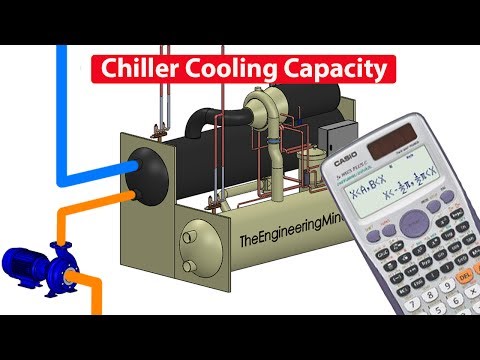
CALCULATE Chiller cooling capacity - Cooling Load kW BTU Refrigeration Ton
Introduction and Chiller Cooling Capacity
In this section, Paul introduces the topic of calculating chiller cooling capacity and explains that it refers to the amount of cooling a chiller can produce during operation. The units used for this calculation are kilowatts, BTUs, and refrigeration tons.
Calculating Chiller Cooling Capacity
- To perform the calculation, several pieces of information are needed:
- Volume flow rate: The rate at which water flows through the pump.
- Temperature of water going into the evaporator.
- Temperature of water leaving the evaporator.
- Density of water at average temperature.
- Specific heat capacity of water at average temperature.
- The volume flow rate can be measured from the pump, but in this video, assumed values will be used.
- The density and specific heat capacity values can be found in engineering tables or online resources like peacesoftware.de or unitconversion.org.
- Average temperature is calculated by taking the sum of inlet and outlet temperatures divided by two.
Metric Calculation
- Assuming a pump flow rate of 0.995 m³/s, inlet temperature of 12°C, outlet temperature of 6°C, density at average temperature is approximately 999.78 kg/m³, and specific heat capacity is about 4.19 kJ/kg·K.
- The formula for calculating chiller cooling capacity is Q = V̇ × ρ × Cp × ΔT (Q = cooling capacity in kW).
- Plugging in the values:
- Flow rate (V̇) = 0.995 m³/s
- Density (ρ) = 999.78 kg/m³
- Specific heat capacity (Cp) = 4.19 kJ/kg·K
- Temperature difference (ΔT) = (12°C - 6°C) = 6K
- Calculate the cooling capacity using the formula.
Imperial Calculation
- For imperial units, conversion factors need to be applied.
- The same formula is used, but with different units:
- Flow rate (V̇) in cubic feet per second (ft³/s)
- Density (ρ) in pounds per cubic foot (lb/ft³)
- Specific heat capacity (Cp) in BTU per pound per °F
- Temperature difference (ΔT) in °F
- Conversion factors can be found on unitconversion.org for density and specific heat capacity.
Conclusion and Recommendations
In this section, Paul concludes the video by recommending watching both the metric and imperial calculations to understand different units. He also suggests using online resources for conversions and emphasizes the importance of learning these calculations to become a better engineer.
Conclusion and Recommendations
- It is recommended to watch both the metric and imperial calculations to gain a comprehensive understanding of different units.
- Online resources like peacesoftware.de and unitconversion.org can be helpful for finding values and performing conversions.
- Learning these calculations is important for becoming a better engineer.
The transcript does not provide any further content beyond this point.
New Section
In this section, the speaker explains how to calculate the water flow rate and refrigeration capacity of a chiller.
Water Flow Rate Calculation
- The brackets in the equation are multiplied together to give a water flow rate of 99.48 kilograms per second.
- The Kelvin values are calculated by adding 12 to 273.15, resulting in an inlet temperature of 285.15 Kelvins and an outlet temperature of 279.15 Kelvins.
- The temperature difference is determined by subtracting the outlet temperature from the inlet temperature, resulting in a difference of six Kelvin.
Refrigeration Capacity Calculation
- To calculate the refrigeration capacity, all three figures (water flow rate, specific heat capacity, and temperature difference) are multiplied together, resulting in a value of 2500 kilowatts.
- To convert kilowatts to refrigeration tons, divide the kilowatts by 3.517, giving a value of 711 refrigeration tons.
- To convert kilowatts to British thermal units per hour (BTU/h), multiply the kilowatts by 3412.142. This gives the BTU/h value for cooling capacity.
New Section
In this section, the speaker explains how to calculate the refrigeration capacity using imperial units.
Assumed Values
- The pump provides water at a volume flow rate of 12,600 cubic feet per hour.
- The inlet water temperature is 53.6 degrees Fahrenheit.
- The outlet water temperature is 42.8 degrees Fahrenheit.
- The average density of water at that temperature is found to be 62.4 pounds per cubic feet.
- The specific heat capacity of water at that average temperature is 1.0007 BTU's per pound per Fahrenheit.
Refrigeration Capacity Calculation
- The mass flow rate is calculated by multiplying the volume flow rate and density of water.
- The temperature difference is determined by subtracting the outlet temperature from the inlet temperature.
- All figures are multiplied together to give the refrigeration effect in BTU/h.
- To convert BTU/h to refrigeration tons, divide by 12,000.
- To convert refrigeration tons to kilowatts, multiply by 3.517.
Conclusion
The transcript provides a detailed explanation of how to calculate the water flow rate and refrigeration capacity of a chiller using both metric and imperial units. The calculations involve multiplying various figures together and converting between different units of measurement.